
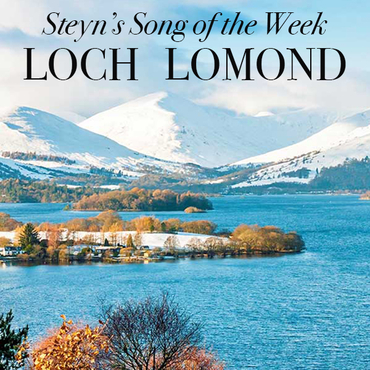
 To all our Scottish readers, a Happy St Andrew's Day. A decade or so back - during the independence referendum - this song figured in a lot of glib headlines: "Will Scotland take the high road?" Etc. That testifies to its enduring familiarity, even in a wholly transformed Caledonia. This essay is adapted from Mark's book A Song For The Season, personally autographed copies of which are exclusively available from the Steyn store:
O you'll tak' the high road and I'll tak' the low road
And I'll be in Scotland afore ye...
The best known Scottish song of all time is the one about forgetting old acquaintances that's boffo for two minutes every year. But in the competition for a very distant runner-up "Loch Lomond" is a strong favorite. It has just enough politico-historical associations to make it appropriate for Scotland's national holiday (St Andrew's Day) without being (like more explicitly political dirges) incredibly tedious for everyone else. But, even if you've not the slightest interest in Scots nationalism, chances are you know this song in one form or another – maybe from Maxine Sullivan's lightly swingin' version with the Claude Thornhill band:
Or maybe from Benny Goodman later in the Thirties, or Bill Haley's "Rock Lomond" run at it from the Fifties:
Or subsequent versions by Natalie Merchant, Marillion, AC/DC...
Good grief, you may even know a traditional version of it – or at least be vaguely familiar with strange lines about taking high roads and low roads to bonnie banks and bonnie braes.
What's a brae? It's a hillside. And on yon bonnie banks and on yon bonnie braes the sun shines bright on Loch Lomond. Not on the only occasion I visited. It was a grey, rainy, chilly morn, although the loch was not without its charms. Yes, there is a real Loch Lomond. It starts about 15 miles north of Glasgow, and it's the second biggest body of water in the British Isles, after Lough Neagh just west of Belfast. But nothing competes with Loch Lomond musically. It's a rare example of a British place made universally famous by a song about it, a trick the Americans pull off with effortless ease ("I Got A Gal In Kalamazoo", etc) but which seems harder work in the old country. Still, Loch Lomond is a pretty nice place, and sounds so in the song.
Ah, but for the protagonist of our tale it exists mainly in memory:
By yon bonnie banks and by yon bonnie braes
Where the sun shines bright on Loch Lomond
Where me and my true love will ne'er meet again
On the bonnie, bonnie banks o' Loch Lomond...
Why will they ne'er meet again? That depends which legend of the song's origins you believe. Or which version of the lyrics you think came first. Another variant of the chorus runs:
Where we twa ha'e pass'd sae mony blithesome days
On the bonnie, bonnie banks o' Loch Lomond...
The song is said by some to be the work of Lady John Scott. Born Alicia Ann Spottiswoode, she married in 1836 a younger son of the fourth Duke of Buccleuch, and a couple of years later wrote the famous Scottish song "Annie Laurie":
So she would certainly have been capable of assembling words and/or music for "Loch Lomond". The earliest extant copy of the song was published by Paterson & Roy under the title "Bonnie Loch Loman" and bearing the tantalising credit: "Written by a Lady." Strands of the melody are similar to phrases from many other tunes, including "The Bonniest Lass In A' The World", published in 1733:
Then again, unlike so many Scottish airs, it's not a pentatonic melody but constructs itself on a six-note scale. There are those who believe the tune was simply lifted from that of an Irish folk song:
Red Is The Rose that in yonder garden grows
And fair is the lily of the valley
Clear are the waters that flow from the Boyne
But my love is fairer than any
- which is easily interchangeable with the chorus of "Lomond":
O you'll tak' the high road and I'll tak' the low road
And I'll be in Scotland afore ye
For me and my true love will ne'er meet again
On the bonnie, bonnie banks o' Loch Lomond...
However, if I had to make a guess without spending the weekend in lab analysis and carbon-dating the texts, I'd say "Red Is The Rose" feels more recent – more polished, more constructed. It sings as if someone were writing alternative lyrics to an already famous tune. So, whether or not Lady John Scott herself formally composed the song, I'd be inclined to hand the honors to some Caledonian or other rather than to the Hibernians. Perhaps it's the work of the wee laddie that (in another well-retailed legend) Lord and Lady John are said to have heard singing the air on the streets of Edinburgh one day.
As for the words, the situation seems simple enough: In happier days, the singer and his true love "were ever lak to gae" to Loch Lomond – ie, he and his chick dig hanging out by the aforementioned body of water. But now they will ne'er meet again. What's the deal with that? She wanted to marry? He was seeing another? The song is coy on the specifics:
'Twas there that we parted in yon shady glen
On the steep, steep sides o' Ben Lomond
Where deep in purple hue the hieland hills we view
And the moon comin' out in the gloamin'...
Yeah, yeah, enough with the local color. Why exactly are ye partin' in yon shady glen?
At this point, it helps to know a wee bit of Scottish history. In the decades after the Glorious Revolution of 1688, when King James was deposed and replaced by his daughter Mary and her husband William of Orange, Scotland's Jacobites waged a long campaign to restore the House of Stuart to the British throne. ("Jacobite" comes from "Jacobus", the Latin form of "James".) Any realistic possibility of a return to Stuart rule ended with the defeat of the Young Pretender, Bonnie Prince Charlie, at the Battle of Culloden in 1746. However, political failure notwithstanding, the Jacobite rebellions cast long cultural shadows, their events and aftermath inspiring a brace of novels apiece by Sir Walter Scott (Rob Roy and Waverley) and Robert Louis Stevenson (The Master Of Ballantrae and Kidnapped), not to mention Henry Fielding's Tom Jones. That's no relation to the Tom Jones of our St David's Day song, but the Jacobite rebellions are credited with at least two musical contributions to British popular culture. The first is a song by Genesis:
So they're riding along on the crest of a wave
They're headed for London and that will be their grave
Eleventh Earl of Mar
Well, he couldn't get them down that far
Daddy! I'm waiting, I'm waiting...
"The Eleventh Earl Of Mar" was John Erskine, who is, more accurately, the 22nd Earl of Mar since the peerage's original creation circa the beginning of the 12th century, or the sixth Earl of Mar, if you count from Queen Mary's recreation of the title in 1565, which was the one recognized by the House of Lords in their ruling of 1875. Anyway, that's enough peerage annotation. (My daughter and I visited Mar Lodge a couple of years ago, and I'm good for another twenty minutes on the subject.) However you want to number him, Lord Mar was a notably inept military leader but undeniably a real figure in the Jacobite rising. What's more dubious is whether the second song in the supposed Jacobite songbook, "Loch Lomond", really belongs in there.
Let's go back to the text's most famous lines:
O you'll tak' the high road and I'll tak' the low road
And I'll be in Scotland afore ye...
What's that about? If you're one of the millions of Americans who danced to the swingin' Maxine Sullivan version, you probably never gave it a second thought. There's a low road leading through the valley and a higher one cut up across Ben Lomond? Hey, what's the big deal? But, according to legend, there's more to it than that. The "low road" is the road of death – the road that begins six feet under - and the words were supposedly composed by a Scottish soldier captured in "the Forty-Five" – the Second Jacobite Rebellion of 1745 – and held south of the border at Carlisle Castle. Post-Culloden justice was a bit arbitrary: Some soldiers were sentenced to hang; others just as randomly were kicked out and told to walk home to Scotland. So presumably one unfortunate rebel is telling a luckier cellmate that, while his brother in arms will take the "high road" – ie, along the surface of the ground – back to their native land, he, after his hanging, will perforce take the low road. But he'll get there first.
It's a fine allusion, and, with it, the rest of the song falls into place:
For me and my true love will ne'er meet again
On the bonnie, bonnie banks o' Loch Lomond...
Of course, they'll never meet again: She'll be back in Scotland pining, and he'll be swinging from an English gibbet. Powerful stuff. Even more so when you consider the friends and family members who walked all the way from Scotland to England to attend the trials of their loved ones. So, according to some interpretations, our brave laddie is telling not merely a fellow soldier but his own true love that, when it's all over, she'll take the high road back to Scotland, but his shade will be walking the low road. Or perhaps it refers to the fact that many executed rebels – or patriots (depending or one's point of view) – were literally "in Scotland afore ye": Their corpses were shipped back to Glasgow along the principal highways and supposedly displayed en route pour encourager les autres. The only problem with this vivid interpretation of the song is that there's no real evidence supporting it, and alleged verses to the song that make it explicit seem all too obviously to have been written in at a later date:
I trusted my ain love last night in the broom
My Donald wha loves me sae dearly
For the morrow he will march for Edinburgh toon
Tae fecht for his king and Prince Charlie...
That seems to be part of a sustained effort to make literal narrative out of what, in the well-known verses, are vague and allusive. Certainly, if you compare it side by side with the earliest published version, it seems to be part of a retrospective politicization of material whose principal appeal to Lady John Scott's generation was chiefly sentimental. Indeed, any significance in the low road/high road distinction might derive less from the heroic nationalist struggle than to more prosaic Caledonian rascallyness: The song is being sung by a fugitive. So, while ye'll tak' the high road, swanning along the principal thoroughfares and staying at the best inns, he'll be skulking along the low road – the quieter byways and winding lanes where the authorities are less likely to be on the lookout for him.
But that's the genius of the song, intended or not. It has a memorable hook that can mean everything – or nothing. If you're a Celtic folk singer playing to a nationalist audience, the song runs along the most powerful currents of history. But, if you're jitterbugging in a dance pavilion in the America of the late Thirties or Forties, the contrast between the low road and the high road might be no more than that between sticking your left foot in and shaking it all about and then doing likewise with your right foot.
When Maxine Sullivan moved from Homestead, Pennsylvania to New York City and landed a gig at the Onyx Club, she certainly (as she once told me) had no interest in Scottish history. Why would she? She was a black kid who loved jazz and blues. But the pianist Claude Thornhill thought it would be cute to record a couple of swingin' arrangements of "Annie Laurie" and "Loch Lomond", and the latter became Maxine's first hit, and a record that defined the song for a generation of Americans. For a while, Miss Sullivan was the go-to gal for hepped-up trad tunes – she subsequently recorded "I Dream Of Jeannie" and "Drink To Me Only With Thine Eyes" – but "Loch Lomond" was the one she kept in the act all the way to the end:
Ultimately, all we can say for sure is that whoever wrote the best-known lines in "Loch Lomond" – the ones written before all the supplementary verses attached themselves – freighted the song with such a sense of place, of memory, of love and loss that, if you're in the market for an oblique meditation on the Jacobite Rebellion, it can certainly hit the spot. For the millions of others who like it, it's just a great muscular tune with an obscurely catchy lyric. But that's the level the best popular music works on, leaving it to the listener to decide for himself whether to tak' the interpretative high road of deep geopolitical socio-cultural significance or the low road of catchy words and a tune you can dance to. And so it will go, for as long as it's sung:
By yon bonnie banks and by yon bonnie braes
Where the sun shines bright on Loch Lomond
Where me and my true love will ne'er meet again
On the bonnie, bonnie banks o' Loch Lomond.
~the above essay is adapted from Mark's book A Song For The Season, which includes many favorite Song of the Week essays from "My Funny Valentine" to "White Christmas" - not to mention "Rock-A-Hula Baby". Personally autographed copies are exclusively available from the Steyn store - and, if you're a Mark Steyn Club member, don't forget to enter the promo code at checkout to enjoy special Steyn Club member pricing.
The Mark Steyn Club is now in its ninth year. As we always say, club membership isn't for everybody, but it helps keep all our content out there for everybody, in print, audio, video, on everything from civilizational collapse to our Sunday song selections. If you've got some kith or kin who might like the sound of all that and more, we also have a special Gift Membership. More details here.