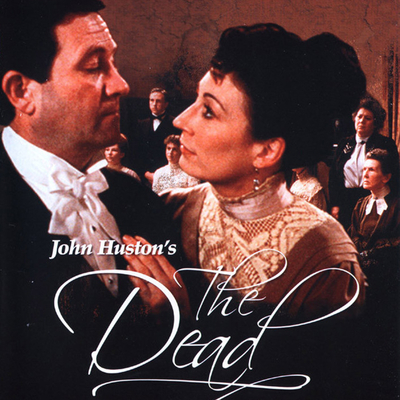
John Huston was dying when he made The Dead, his last movie, in early 1987. It's the kind of thing that the mordant Huston would have found amusing, but the details of filming, as recalled in Jeffrey Meyer's biography John Huston: Courage and Art, are a grim read.
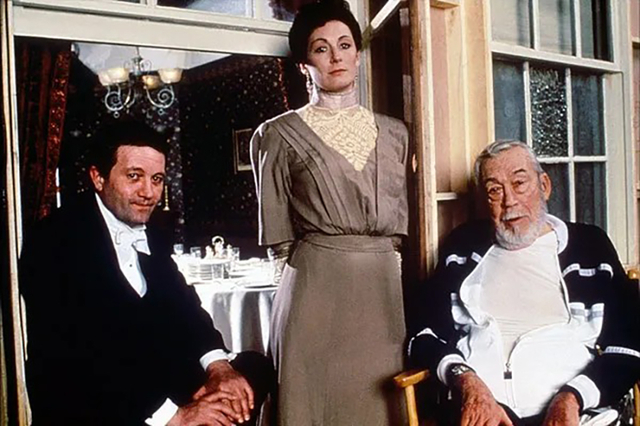
"Huston," he writes, "was a dead man walking, or wheeling, attached to a tall green rocket of oxygen that shot air into his failing lungs and enable him to breathe." He would have preferred to shoot on location, as he always did from the moment he freed himself from the Hollywood backlot, but director Karel Reisz was on standby to take over should the emphysema take an early victory, and Huston's doctor had forbade him to get on a plane and fly to Ireland.
"His lungs are like lace," the doctor said, "and he'll be dead when he steps out of the plane."
And so, except for some second unit exteriors filmed in Dublin, The Dead was shot in a warehouse in Valencia, in Santa Clarita, thirty-five miles north of Los Angeles. "He had bags under his watery eyes," Meyer writes," hollow cheeks and drawn features. He abandoned his once-stylish clothes and, bundled up in a warm vest and jacket, wore an old man's zipped-up track suit. The ailing Huston said he could now concentrate fully on the picture since 'there were no longer any distractions.'"
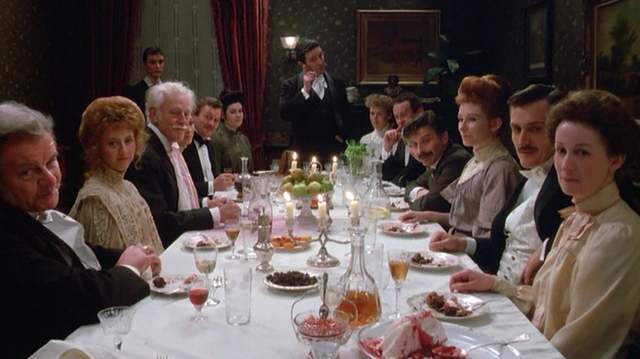
The film is based on the final and what's generally considered the best story in Dubliners, James Joyce's collection of short stories, published in 1914. Most of it takes place at a Twelfth Night or Epiphany party held by two spinster sisters, Julia (Cathleen Delany) and Kate Morkan (Helena Carroll), and their niece Mary Jane (Ingrid Craigie).
The great drama at the start of the evening is whether Freddy Malins (Donal Donnelly) will show up drunk despite taking the pledge on New Years Eve at the insistence of his mother (Marie Kean). The attendees include Gabriel (Donal McCann), the beloved nephew of the Misses Morkan and his wife Gretta (Anjelica Huston), as well as D'Arcy, a promising young singer (played by famed Irish Tenor Frank Patterson), Molly Ivors (Maria McDermottroe), a committed young Irish nationalist, and Browne (Dan O'Herlihy), a charming older gentleman and the only Protestant at the gathering.
Additionally there are a group of young women, most of them students of Mary Jane, a music teacher, and their escorts, one of whom is played by a young Colm Meaney, early in his career and just before rocketing to fame in Star Trek: The Next Generation. Huston and his son Tony, who wrote the original adaptation of Joyce's story, added one new character: Mr. Grace (Sean McClory) is Gabriel's superior at the university, whose principal role is to represent an older, established generation of Irish Catholics, to recite Lady Gregory's translation of an old Irish ballad about a woman abandoned by her lover, and to disapprove of the self-infatuated D'Arcy.
Dubliners is the most conventional work Joyce published, written before the landmark Portrait of the Artist as a Young Man, his career-defining Ulysses and the inscrutable (and, to me, basically unreadable) Finnegan's Wake. The short story "The Dead" provides the solid structure for a detailed depiction of a middle-class dinner party in Edwardian Dublin in 1904, eleven years after the 2nd Home Rule Bill, twelve years before the Easter Uprising, and the year when Joyce met Nora Barnacle and left the country to go into self-imposed exile on the continent.
I'm not sure if a young audience would find its measured, meditative pace unbearably slow; they clearly have an appetite for period pieces, though compared to The Dead, Downton Abbey is as busy as an episode of The Sopranos and Bridgerton is a cartoon. Huston, born in 1906, would have had vivid childhood memories of the era, gathered while living between his two bohemian parents. At the end of his life the director appears fascinated with the world he was born into, his camera seeming to drink in the rich evocation he's summoned up on that improvised California soundstage.
He deftly paints in what we need to know about the ensemble of characters, contrasting the sloppy inebriation of Freddy Malins with a lifelong alcoholic like Browne – at least until they've both topped themselves off – and the competing self-satisfaction of Grace and D'Arcy, the former only a little less strident thanks to age and the comfort of his position.
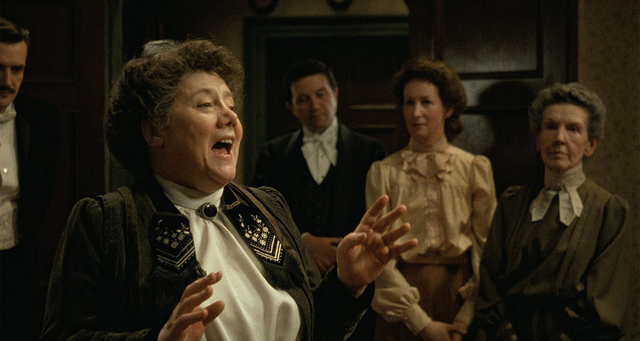
Gabriel's aunts are more vividly drawn than the average spinster; Julia, the senior, is a little enfeebled and distracted, and clearly on the steep part of the slope to the end of her life. Her sister Kate is a force of nature, occasionally outspoken and a bit vulgar – she does what would have been nearly unthinkable at the time and openly criticizes the Holy Father for replacing women in church choirs with boy choristers, discarding years of service by women like her sister for reasons she clearly can't fathom.
(It's tempting to speculate that it was decades of these arbitrary decisions, large and small, that would erode the Church in Ireland from its primacy to near irrelevance in less than a century.)
You can't help but wonder why Julia and Kate ended up as discards from the marriage market near the end of their lives. They have the consolation – as Joyce explains in his story – of a comfortable living inherited from their older brother. Perhaps they were simply too good at entertaining themselves with passions that were only supposed to be distractions while waiting for a suitable suitor. In any case it's obvious that their niece is on a similar trajectory, though her spinsterhood will play out in a transforming country in the aftermath of British rule.
Irish politics casts its longest shadow when Kate pairs Gabriel with Molly Ivors in the dancing; she has been trying to catch his eye since he arrived but it isn't a flirtation. She's figured out that he's been writing book reviews in the Daily Express, a pro-British newspaper, signed with only his initials. He doesn't deny it, but she presses him further about his apparent lack of interest in the Irish language, or of Ireland as a vacation destination (he prefers cycling trips to Europe). He isn't an Irish speaker, he tells her and has more interest personally and professionally in Europe than his home country.
"To tell you the truth I'm sick of my own country," he blurts out, and when he refuses to explain why, Miss Ivors takes it as her victory. She accuses him of being a "West Briton" – a term that would evolve into something very like a sympathizer or even a collaborator when nationalism embraced violence and could even mean a death sentence.
Since Gabriel is, if not strictly a protagonist, at least our point-of-view character, sympathy is weighted toward him, and Miss Ivors the Irish nationalist is more than a little tiresome in both Huston's film and Joyce's story. Ultimately it's worth remembering that as sympathetic as Joyce was to the aesthetic ambitions of Irish nationalism he worried that, politically, it would only encourage provincialism and a wholly sentimental vision of Ireland. It proved to be a solid intuition. In any case, he never returned after he left the country in 1904.
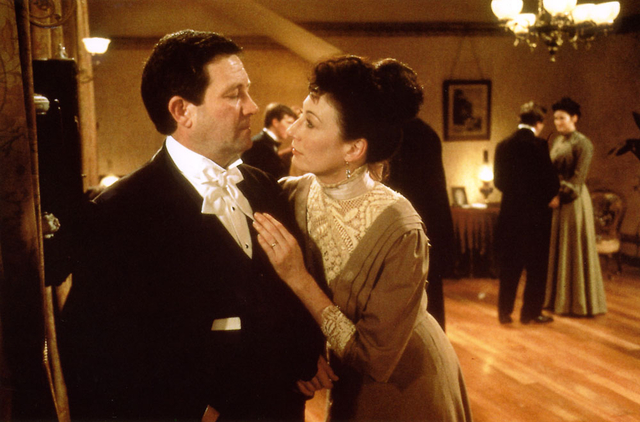
Huston, at the end of his career, might have been diminished physically but not creatively. He moves his camera eloquently, never more so than in a scene where Aunt Julia is persuaded to perform a number from her long-ago "concert days" – "Arrayed for the Bridal" by Bellini, a composer whose whole reputation today rests on a single opera, Norma, and on "Casta Diva", a single aria.
In another small but key change from the original story, Huston chooses to pitilessly show the old woman struggling with a quivering, thin voice (Joyce is far kinder, describing it as "strong and clear in tone") and lets his camera linger on her, orbiting around the old woman for a whole verse.
But just when you think he's being cruel it cuts to the stairs and a shot of coats piled on beds with a doll's house in the background at the start of an elegiac montage of objects in the house, a collection that are likely Julia's, tokens and trinkets collected in a long but circumscribed life: needlepoint, stiff family photos, war medals laid out in front of a little photos of a man in uniform, a rosary on a hymnal, assorted bric a brac.
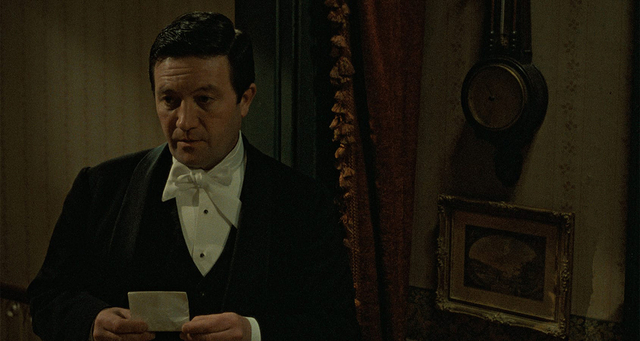
Huston builds an atmosphere of unease around Gabriel as he fusses with his notes for the after-dinner speech he's expected to deliver. He dreads the obligation and in Joyce's story fantasizes about simply walking out of the party and into the wintry street where "the snow would be lying on the branches of the trees and forming a bright cap on the top of the Wellington Monument. How much more pleasant it would be there than at the supper table!"
He worries that the lines of poetry he's chosen for his speech "would be above the heads of his hearers," people whose "grade of culture differed from his." Like his attempt at humour that fell flat earlier with Lily, his aunts' part-time maid, he's sure that he going to "make himself ridiculous by quoting poetry to them which they could not understand. They would think that he was airing his superior education ... He had taken up a wrong tone. His whole speech was a mistake from first to last, an utter failure."
But Huston shows Gabriel succeeding with precisely the show of erudition he thought a weakness, praising the evening as a paragon of the "Irish hospitality" that was famous around the world and describing his aunts and their niece as the "Three Graces", baffling Julia but moving her to tears. But he gives the audience plenty of room to decide if Gabriel was sincere or ostentatiously flattering his hosts and their guests with fatuous metaphors and compliments. A reasonable concern for the Irish, a people uniquely susceptible to falling in love with the sound of their own voice.
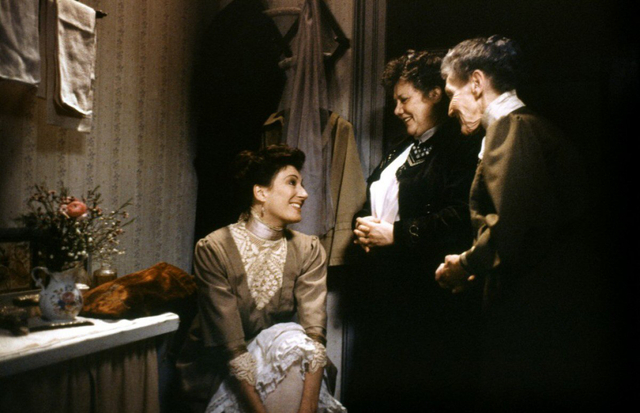
As the story reveals Gabriel's anxieties and reservoir of self-doubt, his sole fixed point of light is Gretta, his wife, whose calmness and abundant, unforced charm make her irresistible. That Huston chose his daughter Anjelica for this role wasn't mere nepotism; he had been making movies too long to make this sort of mistake, especially on the film that would cap his entire career.
He had made that mistake at the start of her career, casting her as a French aristocrat in A Walk With Love and Death in 1969, an experience that was so unpleasant for both of them that Anjelica switched to modeling for several years before making a tentative return to acting with small but notable parts in films like The Last Tycoon, The Postman Always Rings Twice, Frances and This Is Spinal Tap.
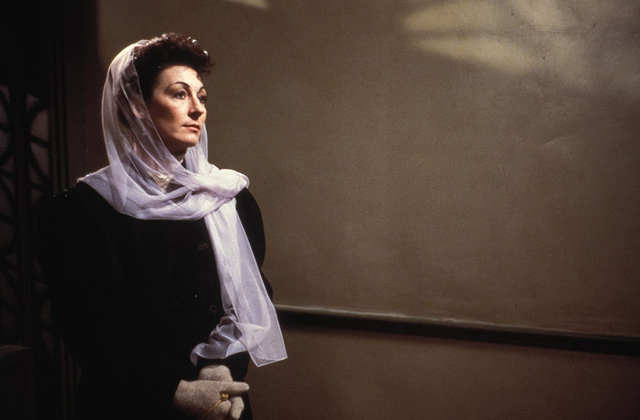
Huston cast her again in Prizzi's Honor, which was Huston's last hit film while he was alive and won Anjelica an Oscar for best supporting actress. In The Dead, he's kinder to Gretta than Joyce was in his story, and cinematographer Fred Murphy makes her luminous, lingering on her classical profile and how well she suits the period costumes.
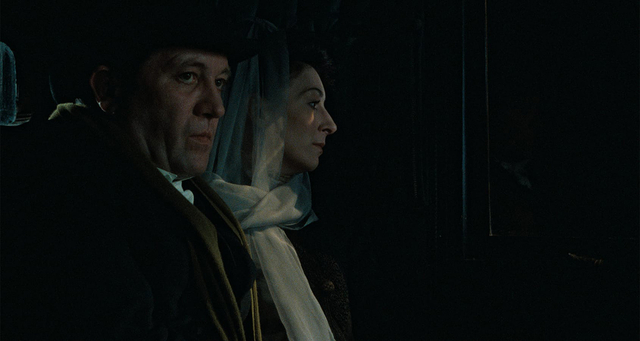
This is crucial to how she unwillingly delivers a crushing blow to her husband's sense of himself by the time the credits roll. At the party's end, as Gabriel is helping his aunts get Browne and the Malins into cabs and home, D'Arcy begins singing in the upstairs parlour for one of the female guests – an achingly sad Irish ballad called "The Lass of Aughrim". (It's another quietly audacious touch by Huston that he hired Frank Patterson to play a tenor but has him deliver his sole song off camera.)
While he sings, Gretta stops on the stairs, transfixed by the music, her expression rapt while her husband watches her. "There was grace and mystery in her attitude as if she were a symbol of something," Joyce wrote, and all the way home his wife is distant, lost in her thoughts while Gabriel is suddenly overcome with desire for her.
But back at their hotel she begins crying when he asks her what has made her so melancholy. The song, she says, was a favorite of a boy she knew back in Galway when she was young. His name was Michael Furey and she describes him as "a delicate boy ... Such eyes as he had: big dark eyes! And such an expression in them – an expression!" He had been ill when she learned she would be leaving for convent school in Dublin, and though she sent him a letter telling him that they might see each other again next summer, he manages to present himself at night, shivering, in her garden during a storm.
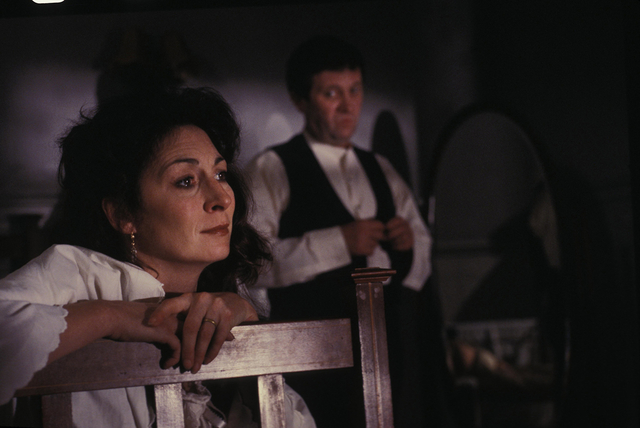
She pleads with him to go home and a week later learns that he died. "I think he died for me," she tells her husband. The revelation, that she had been carrying around this great, tragic passion for years – a passion that he knows he'd never experienced in his life, not with her, not with anyone – is a final devastation to Gabriel's fragile self-esteem.
"A shameful consciousness of his own person assailed him," Joyce wrote. "He saw himself as a ludicrous figure, acting as a pennyboy for his aunts, a nervous well-meaning sentimentalist, the pitiable fatuous fellow he had caught a glimpse of in the mirror."
The surge of sadness tinged with dread, lingering around every moment of the picture until then, suddenly fills the dark hotel room where Gretta lies asleep, exhausted by her emotions, while her husband realizes even this painful revelation will subside with the life that he can already see ending.
As the camera shows us Irish landscapes of fields and stone fences and tombstones blanketed by the relentless snow, McCann's voiceover reads one of the most famous passages in Joyce, where Gabriel feels that "his own identity was fading out into a grey impalpable world: the solid world itself which these dead had one time reared and lived in was dissolving and dwindling."
The snow, he imagines, staring out his hotel window, "was general all over Ireland. It was falling on every part of the dark central plain, on the treeless hills, falling softly on the Bog of Allen and, farther westward, softly falling onto the dark mutinous Shannon waves. It was falling, too, upon every part of the lonely churchyard on the hill where Michael Furey lay buried ... His soul swooned slowly as he heard the snow falling faintly through the universe and faintly falling, like the descent of their last end, upon all the living and the dead."
John Huston did not live to see The Dead released into theatres in December of 1987; he had died nearly four months earlier, after traveling to Newport, Rhode Island to act in a TV movie directed by his younger son, Danny. Assuming that the town still had a glittering social season straight out of The Great Gatsby, he packed a tuxedo. He died there, in a rented house overlooking the harbor.
I saw The Dead when it came out and remember leaving the theatre haunted by the mournful ending and how that sense of dread had crept in relentlessly from the start until it filled the screen. But I already knew that it was made by a man nearly dead himself. Tony Huston won an Oscar for his screenplay but never made another film again. Akira Kurosawa said it was one of his 100 favorite films.
Club members can let Rick know what they think by logging in and sharing in the comments below, as access to the comments section is one of many benefits that comes along with membership in the Mark Steyn Club.