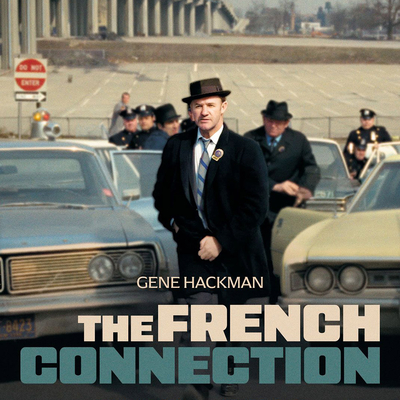
Gene Hackman was still alive the last time I wrote about him here, in a column about Arthur Penn's 1975 neo-noir Night Moves. But early last year, news broke – a confused story that was revealed piecemeal in a series of sordid details – that Hackman, his wife Betsy and their dog had been found dead in their home outside Santa Fe, New Mexico.
Hackman, who suffered from Alzheimer's and was quietly estranged from the children of his first marriage, had been dead for eight days and had been alone in the house with their three dogs for at least six after Betsy had died of pulmonary hantavirus. Police reports stated that their bodies showed signs of mummification in the dry desert air. It was all so unspeakably sad.
The vivid, often aggressive figure Hackman cut onscreen is hard to square with the (rather overcooked) portrait Joy Williams paints in "One Four Two Five Old Sunset Trail", a feature about the Hackmans' last days in the November issue of Harpers, and of a man for whom, as Williams writes, "discretion had devolved into reclusion, privacy into withdrawal":
"For fourteen days after Betsy's death, no one came to the property. The cadre of help most wealthy people surround themselves with was nonexistent. There was no majordomo or maid or gardener or cook, no conditioning coach or groomer or therapist or secretary. There were just two dogs roaming the necropolis all that while, unseen and unheard."
Fans of Hackman's work would have been dismayed by the story while they had, over the years, been quietly prepared for such a bleak ending by Hackman's best films and the unhappy place they usually left him at the end. There was Harry Caul sitting in the wreckage of his apartment as the final credits rolled on The Conversation, and Harry Moseby bleeding on the floor of a boat as it turns in an endless circle in the Gulf of Mexico at the end of Night Moves.
And there was Hackman's Jimmy "Popeye" Doyle in the final moments of The French Connection, running with his gun drawn after a spectre into the shadows of a ruined building, just before we learn how badly everything we've watched over the previous hundred minutes has turned out. You can't help but wonder if Hackman – famous for never rewatching his films – recalled these characters and their dire circumstances during those lonely, confused six days, and hope that a merciful God spared him.
The unlikeliest of men to top a marquee, Hackman was the movie star we needed, not wanted; a star in spite of himself who slipped through the cracks during a brief moment when easy glamour had apparently been one of the things the studios got rid of in their fire sale at the end of the '60s. He arrived, at least according to one well-loved myth, in the Trojan horse that was Bonnie and Clyde, then burst into stardom playing one of the two rule-breaking cops who dominated the box office in 1971 (the other being Clint Eastwood's squinting, seething Harry Callahan.)
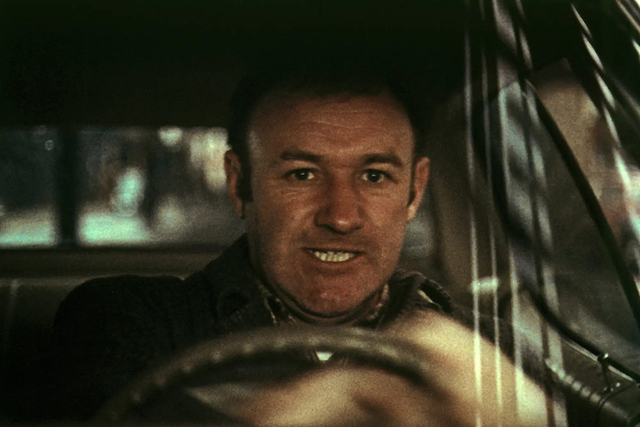
The film begins in Marseilles, that most unlovely of French port towns, where we're introduced to Charnier (Fernando Rey), a mob boss, and his henchman Nicoli (Marcel Bozzufi) as they're being tailed by a French undercover cop (Jean Luisi) who Nicoli guns down in cold blood. (Nicoli's ruthlessness is demonstrated when he steps over the dead man but stops to rip off and eat the heel of the baguette he was carrying. It's a very French moment.)
Charnier is running heroin into the United States – sixty kilos every six weeks – and his latest mule is going to be a TV presenter, Devereaux (Frédéric de Pasquale), who will smuggle the drugs into the country hidden in a Lincoln Continental Mark III. On the other end of the deal is Sal Boca (Tony Lo Bianco), an ambitious mobster working behind the front of a Brooklyn luncheonette.
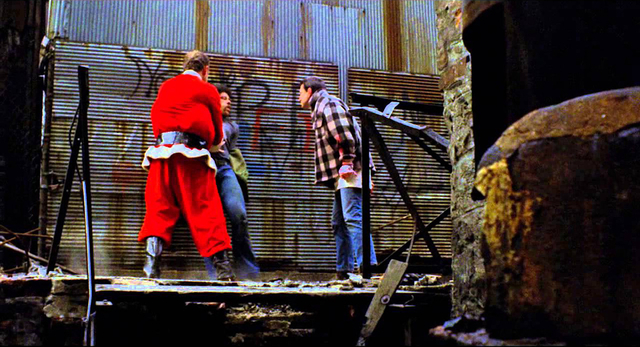
But before we meet Sal we're introduced to "Popeye" Doyle and his partner Buddy "Cloudy" Russo (Roy Scheider) undercover on a stakeout in Brooklyn with Russo running a street vendor's cart and Doyle in a Santa suit. Russo spots a suspect and they chase him through the crumbling streets of Mayor John Lindsay's New York, running him to ground in a vast vacant lot where much police brutality and very little Miranda reading happens.
After busting this apparently low-level dealer Doyle convinces Russo to celebrate with a drink at the Copacabana (the famous mob-run club, still at its original location on East 60th Street, though the film's producers couldn't get permission to shoot there and used a place on E. 56th). Doyle and Russo enter while The Three Degrees (of subsequent "When Will I See You Again" fame) are performing a frantic version of Jimmy Webb's "Everybody Gets to Go to the Moon".
Even while off-duty Doyle is unable to relax and he spots Boca and his wife Angie (Arlene Farber) at a table celebrating with two high-level mobsters. They're inspired to tail the couple, following them all night, all over the city until they return to their luncheonette where the detectives settle in for a stakeout.
As improbable as all of this seems, up till this point The French Connection closely tells the story of a famous heroin bust made a decade earlier by Eddie "Popeye" Egan, a legend of the NYPD, and his partner Sonny "Cloudy" Grosso. A dreaded "larger than life" figure, Egan welcomed any and all fame that came his way and took an active part in the book Robin Moore published about the bust in 1969 and in the film producer Philip D'Antoni eventually put together, with backing from Richard Zanuck and David Brown at 20th Century Fox.
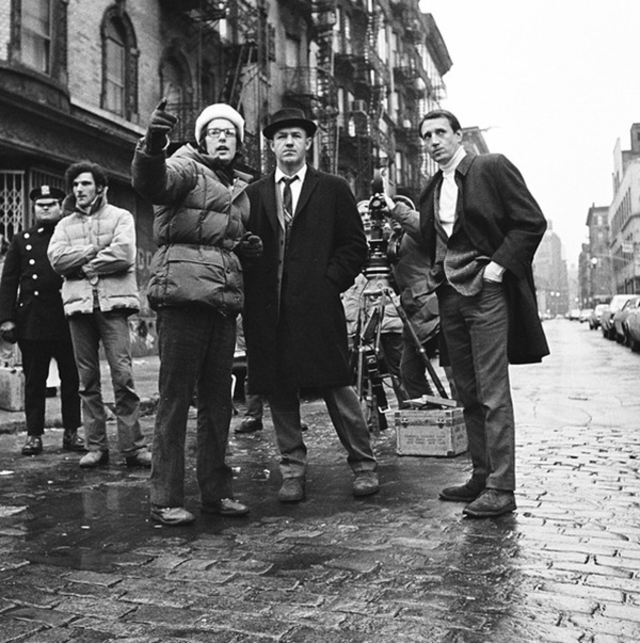
D'Antoni chose a director who, like many of the "New Hollywood" generation, learned his craft in live television and documentaries. William Friedkin's start in feature films was no stranger than any of his peers – his debut was the Sonny and Cher vehicle Good Times, followed by an adaptation of Harold Pinter's The Birthday Party, filmed in the UK and starring Robert Shaw. He followed that up with The Night They Raided Minsky's, a musical written and produced by Norman Lear, and the controversial film version of Matt Crowley's gay drama The Boys in the Band.
D'Antoni picked Friedkin for his background in documentary filmmaking – there's certainly nothing about The French Connection that resembles the director's previous four features – and set about making a film that captured the gritty reality of New York City as its precipitous decline was picking up speed. Chicago-born but New York-based, Friedkin took up D'Antoni's challenge eagerly, and rubs the audience's nose in the city's worn-out streetscapes but still-abundant energy.
This isn't the ruined New York of Abe Beame and Ed Koch, struggling to reinvent itself – there are plenty of tenement blocks punctuated by fields of brick and rubble, but the subway cars are still clean; it would take a few years before graffiti exploded across the inside and outside of every train. It's a city running on the fumes of the gargantuan vigor that had powered it for a tumultuous century. Both Egan and Rosso's pursuit of the dealer and their evening at the Copa have a frantic, sweaty energy that Friedkin keeps simmering beneath the whole picture, exploding into mayhem every time Popeye and Cloudy get a chance to lunge at the suspects they're pursuing.
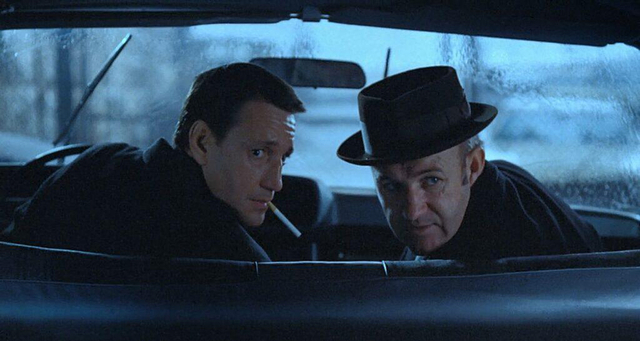
Gene Hackman is utterly identified with the role of "Popeye" Doyle but his casting was more like a last resort. Friedkin never actually wanted him for the role, right through filming; Paul Newman was one of the top picks but cost too much, and Jackie Gleason was seriously considered but vetoed thanks to notorious flops like Gigot and Skidoo. Peter Boyle, Lee Marvin, Robert Mitchum, James Caan, Charles Bronson and Steve McQueen were all in contention but either turned the role down or asked for too much money. An alternate version of the film with Boyle, Marvin or Caan might even be worth imagining.
Friedkin strongly supported casting columnist Jimmy Breslin, even though he had never acted and not only couldn't drive but – a typical New Yorker – refused to learn. Eddie Egan thought that he looked like Rod Taylor, and even though the actor lobbied for the part he ultimately lost to Hackman. Egan would end up with an extended cameo as Doyle and Russo's supervisor. Roy Scheider, then mostly a New York theatre actor, was cast as Russo and no one else was seriously considered; Sonny Grosso also landed a cameo, as an FBI agent.
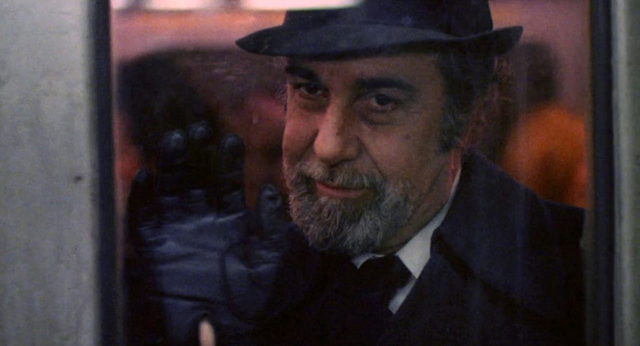
The most amusing casting story has Friedkin insist on Fernando Rey for Charnier after seeing Luis Bunuel's Belle de Jour. Unfortunately he got Rey confused with Francisco Rabal, another Spanish actor, and was shocked to discover his mistake when Rey showed up in New York. The producers tried to correct their error but when it turned out that Rabal spoke neither French nor English Rey ended up with a role he played so well that he returned to play Charnier in the sequel.
You'd guess that after all these missed opportunities and miscommunications there would have been some tension on set. The biggest flashpoint was between Hackman and Egan who was, along with Grosso, on set for much of the shooting whether he was on camera or not. Hackman found him overbearing and battled with Friedkin over how much of Egan's crudeness and racism would find its way into Doyle.
One particular line, early in the film, has Doyle casually use a racial epithet so taboo today that Disney – the current owner of the Fox catalog – cut several seconds from the print of the film they made available for streaming. When the picture was programmed by the Criterion Channel viewers familiar with the film noticed and kicked off a controversy about whether this was done with Friedkin's approval or just typical, ham-fisted Disney censorship. (In all likelihood the latter.)
You could even make the argument that Popeye's racism makes it hard for modern audiences to sympathize with him, that if the film were made today it would be eliminated to make him more conventionally heroic. Of course, this presumes that Doyle was supposed to be heroic in the first place, and I can't see anyone making it to the end of the picture with this presumption intact.
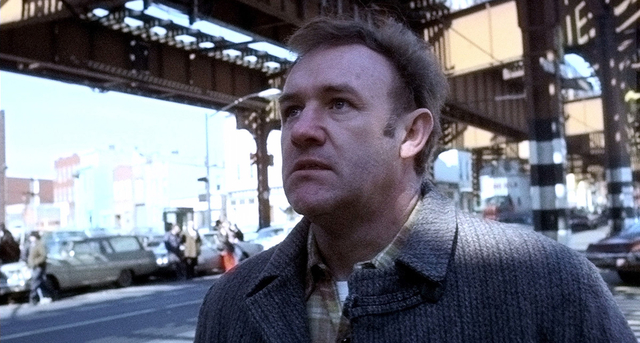
The past is a different place, and this is nowhere clearer than in the story of the most famous sequence in the picture. At a low point in the picture, when Doyle and Russo have been taken off the case, Popeye finds himself targeted by Nicoli like that unlucky cop in Marseilles. Sniping at him from the roof of his apartment building in Brooklyn, Nicoli kills a mother pushing a pram instead and sets Popeye after him relentlessly.
This is the set-up for a car chase that's considered one of the greatest in movies, and at least as influential as the one in Bullitt three years earlier – a picture also produced by D'Antoni. Doyle pursues Nicoli to a stop on the local elevated subway line but loses him when the Frenchman boards a train on the opposite platform.
Desperate to beat the train Doyle commandeers a car – a 1970 Pontiac LeMans – and races between the pillars of the El tracks, weaving in and out of traffic at high speed. In the meantime, Nicoli shoots a police officer and hijacks the train, holding the driver at gunpoint until a group of passengers led by a transit worker confront him; he shoots the transit worker while the driver has a heart attack and sends the train racing out of control.
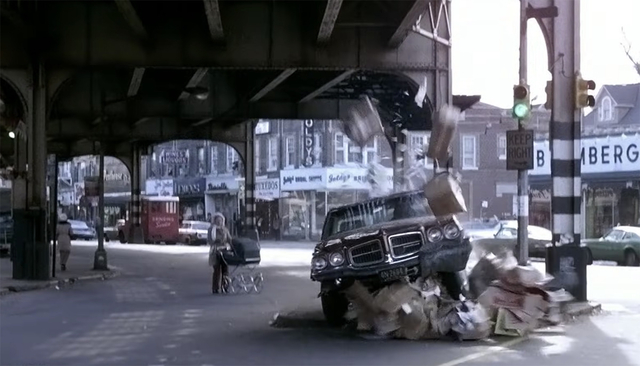
D'Antoni said years later that permission to film on the subway was obtained with what was basically a bribe to an MTA official. Popeye's race along the streets beneath the elevated tracks, however, was captured with little in the way of permits and nothing but a "gumball" police siren to clear the way as they barreled through Brooklyn.
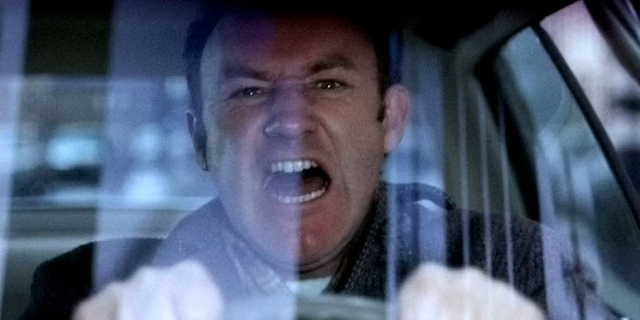
With cameras mounted on the front bumper of the Pontiac and Friedkin in the back operating another camera, stunt driver Bill Hickman did most of the driving for the sequence, which includes so many hair-raising close calls weaving in and out of opposing traffic that you can't believe either driver or car escaped unscathed. And they didn't – the car took some impressive damage and Hackman lost control and hit a wall while being filmed behind the wheel.
The chase holds up today because it was actually as dangerous as it looks – a triumph of practical effects and a violation of public safety that no studio or production insurer would allow today. "It was irresponsible," Friedkin admitted later. "Thank God no one was hurt."
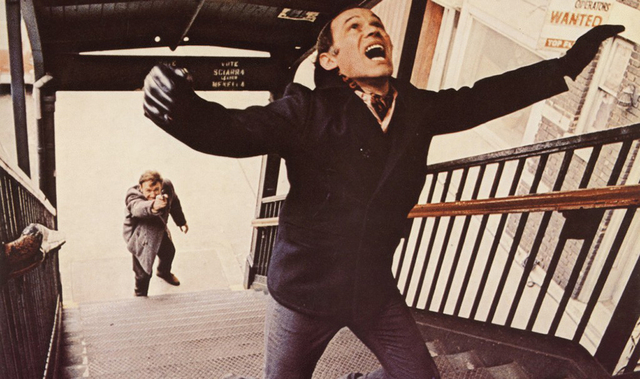
The sequence ends after Nicoli's train has been brought to an abrupt stop and the hit man staggers down the stairs of the El only to find Doyle waiting. Randy Jurgensen, a NYPD detective who worked as a consultant on the picture, objected to Friedkin showing Doyle shoot the Frenchman in the back as he tried to flee back up the stairs. But the shot of Nicoli's death not only became the film's poster image, but Friedkin trumped Jurgensen's objections when they saw the audience at a preview burst into applause.
Friedkin knew in a way that Jurgensen didn't how Popeye's obsessively narrowing focus on revenge was the backbone of the picture – not so much a hero's quest as a man's tragic unraveling. Once Doyle and Russo have been able to piece together enough of Charnier and Boca's scheme, they only need to find the heroin in the Lincoln and set the trap.
As a thriller The French Connection isn't about criminal masterminds or brilliant police work; Nicoli is a terrible sniper, Boca is a small time mobster so intent on scoring that he ignores the avalanche of law enforcement poised to descend on him and Charnier is nowhere near as successful as the real French mob that ran heroin into the US for decades.
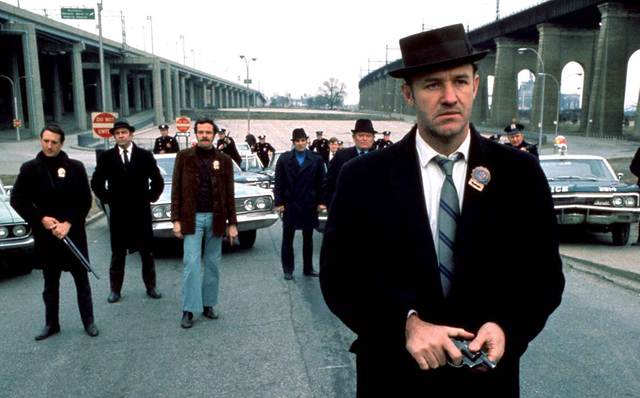
On the other side the police are keenly thuggish and only hold the high ground on the right side of the law because order in the city is breaking down, conceding new territory for drugs and violence to flourish. The best they can muster are Popeye's hunches and brute force, which come at a reckless cost. By the end cops and criminals are doing open battle in abandoned ruins on the fringe of the city.
Before the credits roll we learn that poor work by the police and prosecutors have left most of the criminals free to return to their criminal business, either through poor case work, sloppy prosecution or what's implied as judicial indifference to conviction and punishment. It's certainly been an exciting ride for the audience but little to no actual justice has been served; it's no wonder the audience get their only moment of catharsis with the murder of an obvious killer.
Apparently alone among everyone who made The French Connection, Friedkin hoped that the best he could hope for was to "get away with it" when his picture went in front of audiences. It did more than that, making $75 million on a budget of just over $2 million and winning five of eight Oscar nominations, including best picture, director and actor. Hackman and Rey would return for a sequel four years later, directed by John Frankenheimer.
Despite his director's misgivings and his own mixed feelings about the man behind his character, Hackman made an indelible impression on moviegoers when the film became a hit and "Popeye" and his pork pie hat joined a pantheon of movie characters recognizable in silhouette. At the end of his life, which came two decades after he rolled up his career, Joy Williams summed up Hackman's screen persona:
"His characters were often brutally unpredictable. He did controlled rage brilliantly, uncontrolled rage even better. Every character he inhabited he exposed right down to the bone, so professional he was authentic. He was a workman, sturdy as a church pew."
Ultimately Hackman recoiled from being exposed and retreated to a place where death finds you before family, friends or even strangers. It's the sort of ending that wouldn't make it past a first draft because, for a movie star, it's simply too sad to be believable.
Club members can let Rick know what they think by logging in and sharing in the comments below, as access to the comments section is one of many benefits that comes along with membership in the Mark Steyn Club.