
Programming note: Tomorrow, Saturday, I'll be here with the latest episode of my Serenade Radio weekend music show, On the Town. It starts at 5pm British Summer Time - which is 6pm in Western Europe and 12 noon North American Eastern. You can listen from almost anywhere on the planet by clicking the button at top right here.
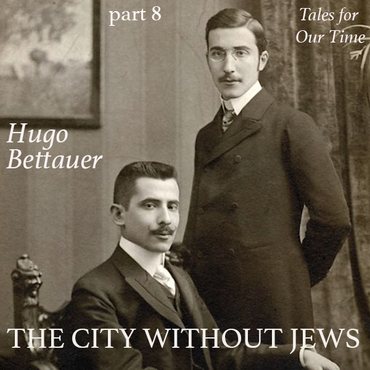
~Welcome to Part Eight of The City without Jews by Hugo Bettauer. In tonight's episode, among the discontents of the general population, the gay young things of Vienna are feeling especially put upon:
During the last half century it had become a tradition that the pretty young girl of the Viennese middle class should have a Jewish sweetheart. Let the father be an enthusiastic Christian-Socialist, let the brother be just as enthusiastic a German nationalist—Poldi or Fini, Mitzi or Grete "went" with a Jew, who might be a salesman or a bank clerk, a business man or a student. Those of their friends who had no Jews would often taunt and jeer at them—but always were they envied. For to have a Jew as one's lover meant to be taken to the theatre and to nice cafés, to be well treated and to receive generous gifts...
But when the sweet young things were gathered together privately, in an intimate group, and began to tell one another their erotic experiences and exploits, then they spoke of the sensuousness of the Jews and of the manifoldness of their erotic inclinations as contrasted with their Aryan friends—good Christians and splendid fellows, but far less entertaining...
To enjoy Part Eight of The City without Jews, members of The Mark Steyn Club should simply click here and log-in. Earlier episodes can be found here. A linguistic note: the Hakenkreuz, of which liberal mention is made in this installment, is what is known in English as a swastika.
I've had queries from several listeners about how on earth I ever came across this novel. Well, it was about a third-of-a-century ago: I was spending a lot of time in Vienna making a documentary about operetta for BBC television. And somewhere along the way somebody mentioned it to me. I'm reasonably confident it was Marcel Prawy, a member of the Habsburgs' old Jewish nobility, but it might have been the composer Robert Stolz's very merry widow. Her name, Einzi, was short for "die Einzige" - the Only One - which she was called because of her uniquely energetic efforts on behalf of Austrians in exile during the war. Before the Anschluss, she and her husband had also driven a couple of dozen Jews from Berlin to comparative safety in Vienna, getting them across the frontier in the trunk of their car.
Einzi was not to everyone's taste but I found her delightful to dine with - and she was kind enough to say she preferred my company at supper to that of Franz Lehár, whom she found a bit of a cheapskate: You can hear her talking about that on this episode of our Song of the Week. Einzi also confirmed the general thesis Hugo Bettauer outlines above.
If you've yet to hear any of our Tales for Our Time, you can do so by joining The Mark Steyn Club. For more details, see here. And please join me on Saturday for Part Nine of The City without Jews.