
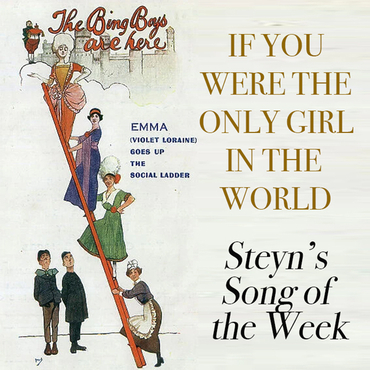
 Well, the Winter Olympics are underway in Milan, so I thought we should have a song by an Olympic gold medallist.
Er... okay... hang on, give me a minute...
And then I remembered: the English lyricist Clifford Grey. He wrote a big hit for Sting in the Eighties ("Spread a Little Happiness") and another that became the Tommies' favourite of the Great War (today's show). He also won two gold medals at the 1928 and 1932 Winter Olympics as part of the four-man bobsled team.
And then I also remembered: oh, wait, no, that's total bollocks. But the wanker peddling it managed to implant it in every reference work on the planet for a couple of decades.
Clifford Grey's daughter was a good friend of mine in her last years. Forty years ago, I was making a show for the BBC on her father's centenary, and so went up to her modest flat in Glasgow to interview her. We hit it off, and Dorothy trusted me enough that, when she found out I travelled back and forth between London and New York all the time, she gave me her dad's American royalty cheques to cash at his Manhattan bank and return to Scotland in twenty-dollar bills. I assume that, like everything else other than Somali remittances, that's been illegal since the "Patriot Act", but my young self enjoyed the frisson of padding about midtown with thousands of greenbacks in my briefcase - except for the one time I left it with north of thirty grand under my stool at the counter of Burger Heaven on 57th Street (long gone) and hurriedly had to sprint back up Fifth Avenue to retrieve it lest my cheeseburger work out even more overpriced than it usually was.
Anyway, back in 1987, I had been astonished to find in the Ascap directory of songwriters that Clifford Grey was not only an in-demand lyricist for Jerome Kern, George Gershwin and Vincent Youmans but also an Olympic bobsledder. No one who'd actually known Mr Grey - such as his composing partner Vivian Ellis - had ever heard of his two gold medals, and it appeared to have been the inspiration of Yankee magazine, now located a few hours due south of me in Dublin, New Hampshire. A writer working on a story about the 1932 Lake Placid Olympics had decided that the champion bobsledder Clifford Gray (sic) was the same Clifford Grey as the one who wrote songs for Fred Astaire and Fats Waller. According to Yankee, his daughter confirmed the gold medals.
"Did you?" I asked.
"Well," she said, sheepishly, "Daddy never mentioned it. But then he was a very modest man."
So, when the Yankee journalist called her from New Hampshire seeking a comment, that was the first she'd heard of it.
"Why," I wondered, "would an Englishman be on the US bobsled team?"
"That's what I asked the American gentleman," said Dorothy, "but he said they weren't so particular about things like that back in the Twenties."
"But you never saw a four-man bobsled lying around the house?"
Dorothy said she'd told the reporter she'd been at finishing school in Lausanne in the late Twenties. He asked: "Did your dad ever come out to Switzerland to visit you?"
"Yes," she said. He wanted to know when, and she said, well, she was at the school from 1926 to 1928...
"So," he concluded, "he could have visited you when he was in Switzerland for the 1928 Olympics in St Moritz" - from which it's a convenient 500km drive to Lausanne, so easy to get back in time for sled practice.
And on that basis Yankee magazine decided Clifford Grey, lyricist, was also Clifford Gray, bobsledder. When they'd lived in New York in the Twenties, Dorothy had very vivid memories of Astaire and Gershwin coming round to their home to hear Daddy's latest lyrics. Yet she had not even the vaguest recollection of a pudgy middle-aged man ever expressing the slightest interest in bobsledding - although, for a Broadway musical called Ups-a-Daisy that opened the season after "his" 1928 Olympic triumph, Clifford Grey did concoct a plot about a chap who purports to be an Alpine mountain climber while actually passing his days whooping it up in Pigalle, which is about as close as Dorothy's dad got to winter sports.
"This story's rubbish, isn't it?"
Dorothy nodded. Nevertheless, despite my best efforts, it remained in the British and American Dictionaries of National Biography until the early years of this century.
So much for songwriting Olympians. Hence we have cancelled our Sled of the Week and hastily substituted an audio edition of our Song of the Week, in which we celebrate a sentimental Clifford Grey song that was, without question, the favourite of the Great War - for the boys in the trenches on the western front, and for the girls waiting at home for their return. It is, as I say on the show, an old-fashioned song, yet it has endured across a century, its power acknowledged in Noël Coward's Private Lives and telly's Downton Abbey. In this episode, I talk to the composer's son, the late Nat Ayer Jr, who shares his childhood memories of the song's creation, including its original title - and we'll hear it sung by everyone from Louis Prima and Barbra Streisand to romantic novelist Dame Barbara Cartland and British Commonwealth boxing champ Henry Cooper.
Click above to listen.
~This airing of Steyn's Serenade Song of the Week is a special presentation of The Mark Steyn Club. We do enjoy your comments on the show. Steyn Clubbers are welcome to leave them below - or anybody can leave them over at Serenade Radio, where they love hearing from listeners.
Steyn's Song of the Week airs thrice weekly on Serenade Radio in the UK, one or other of which broadcasts is certain to be convenient for whichever part of the world you're in:
5.30pm Sunday London (12.30pm New York)
5.30am Monday London (4.30pm Sydney)
9pm Thursday London (1pm Vancouver)
Whichever you prefer, you can listen from anywhere on the planet right here.