
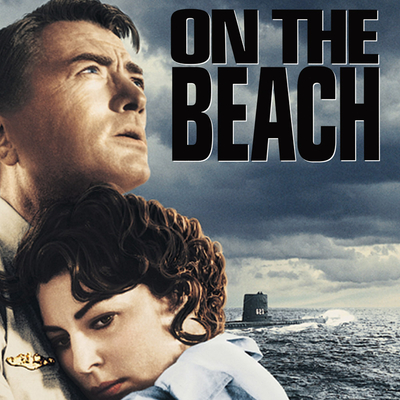
In Nevil Shute's 1957 novel On the Beach there's a scene set in the "Pastoral Club" in Melbourne – a fictional combination of the real-life Australian Club and Melbourne Club, relics of the country's "more British than Britain" men's social clubs. John Osborne, a scientist, is visiting with Peter Holmes, a lieutenant in the Australian navy, and they encounter John's great-uncle, Sir Douglas Froude, a commander of the country's army during the last war.
The old man tells the two younger men that "three years ago my doctor told me that if I didn't stop drinking the club port he couldn't guarantee my life for longer than a year. But everything's changed now, of course."
What's changed, as we already know a third of the way into the book, is that the southern half of Australia is one of the last habitable places in the world as a cloud of nuclear fallout is descending from the northern hemisphere and ending life as we know it. The old man can drink as much of the club port as he wants to since nobody's likely to be alive by the end of that year.
Some of that port is eminently drinkable but a lot could stand to age in the cellar for a few more years. "I blame the Wine Committee very much, very much indeed," says Sir Douglas. "They should have seen this coming." It's what passes for humour in Shute's story.
When director Stanley Kramer made On the Beach into a movie two years later he turned Sir Douglas into a nameless pair of old fogeys in the Pastoral Club – a matched set of Col. Blimps complaining about the port situation. And they were just about the closest thing the film got to comic relief.
Shute was a British aeronautical engineer who spent World War Two working on secret weapons like the Panjandrum and the Rocket Spear, an anti-submarine missile. He published his first novel in 1926 and his celebrity as a writer was notable enough to get him sent to Normandy on D-Day and to Burma as a correspondent. Dissatisfaction with British tax rates and the Clement Attlee government inspired him to move with his family to Australia in 1950.
On the Beach began as The Last Days on Earth, a four-part serial published in the London Sunday Graphic, and was his best-known and best-selling novel. The writer was initially excited at working with Kramer on the movie adaptation – as both producer and director, Kramer was behind conspicuously serious, issue-oriented films like High Noon, The Caine Mutiny, The Wild One, The Pride and the Passion and The Defiant Ones. But by the time filming began around Melbourne he was severely disillusioned and put distance between himself and the film. (Some people even say his experience with Kramer shortened Shute's life.)
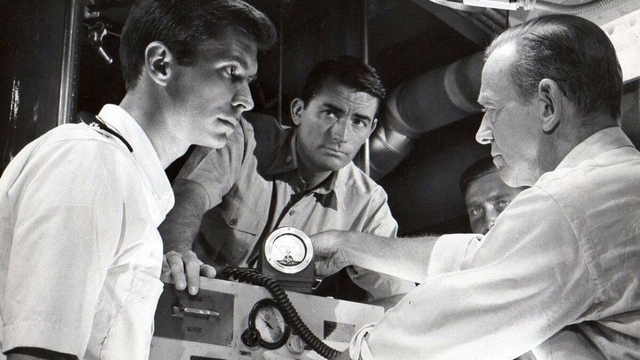
The picture begins on the bridge of an American nuclear submarine, the USS Sawfish, as it sails into harbour at Melbourne's Williamstown docks. Gregory Peck is the captain, Commander Dwight Towers, so you know both the crew and the movie are in sturdy hands. There's a cut to a domestic scene – Lt. Peter Holmes (Anthony Perkins), his wife Mary (Donna Anderson) and their infant daughter going about their morning business of baby bottles and tea. On the radio we catch a few words from the announcer about how "the atomic war has ended..."
Holmes is assigned as liaison between the Royal Australian Navy and the Sawfish, which was somewhere in the northern Pacific when the war broke out and laid waste to the Northern Hemisphere. As the young officer makes his way to the naval department building in downtown Melbourne (actually the old General Post Office building), we see streets full of bicycles, horses and horse drawn buggies surging around the occasional tram. Fuel shortages were the first thing to change everyday life in the country, but the submarine's nuclear reactor means that it's one of the last oceangoing vessels available.
Everyone we meet either remains in denial about what's happening, like Mary, or have already accepted the new, grim reality, like Peter. A few, like Towers, live in their memories as if nothing has changed while confronting the present with clear minded acquiescence to the truth. For a moment we see Mary slump, dispirited as she looks at a calendar telling us that it's January of 1964, near the height of Australian summer. The scientific consensus is that it will be five months until clouds full of invisible killer radioactive dust reach Melbourne, the southernmost large city before Antarctica.
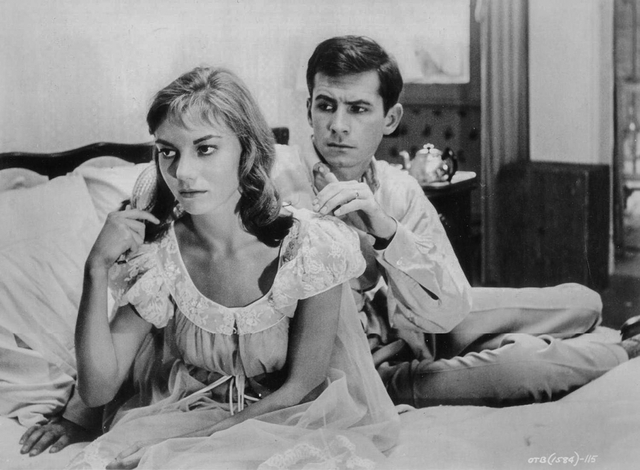
Peter's invitation for Towers to spend a weekend with him and his family at their home in Frankston, a beach suburb, distresses Mary; she's worried that spending time with them will remind Towers of his own family, almost certainly dead, back in the United States. There had been an awkward, tearful scene with an RAF colleague of Peter's earlier, apparently. Mary is desperate not to be confronted with the truth of their situation.
They throw a party and arrange for a friend of theirs to be Towers' "date". Moira (Ava Gardner) is considered vivacious and fun but describes herself as the "town drunk" – she's decided to double down on her drinking to cope with the situation. But it isn't the American who ends up upsetting Mary (Peck's Towers is as stoic as you'd expect) but another old friend, Julian (Fred Astaire), a scientist who has taken to the same alcoholic cope as Moira.
Julian is introduced in the middle of an argument with another partygoer who is intent on blaming the war on scientists like Osborn. He's outraged that Julian has described the global exchange of atomic weapons as an "accident", but Julian insists that it was more like a mistake. "In the end," he says, "we shall find that our so-called glorious civilization was destroyed by a handful of vacuum tubes and transistors. Probably faulty."
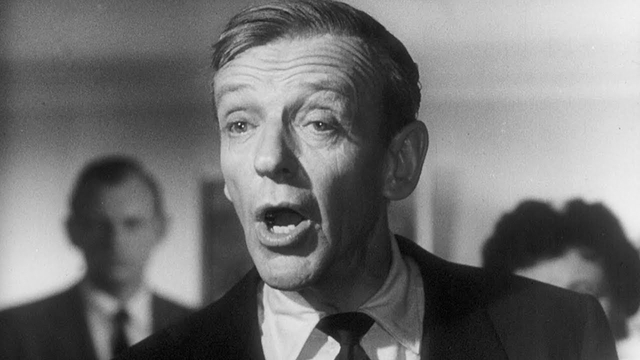
Julian agrees that scientists were probably the "blind mechanics of disaster" but insists that they can't be made to take the whole burden of blame.
"Every man who worked on this thing told you what would happen," Julian argues. "The scientists signed petition after petition. But nobody listened. There was a choice. It was build the bombs and use them. Or risk the United States and the Soviet Union and the rest of us would find some way to go on living." In any case the radiation level in the room they're in is nine times higher than it was a year ago.
"We're doomed, you know," Julian tells them. "The whole silly, drunken pathetic lot of us. Doomed by the air we're about to breathe. We haven't got a chance."
The whole terrible scene reduces Mary to tears and inspires Moira to get drunker and, later that night when the party is over, try to get Towers to explain to her what happened and why. He can't explain it any better than anyone else – the film is far vaguer than Shute's book with a geopolitical scenario for global nuclear war – but it's the beginning of a simmering flirtation that was inevitable once Kramer put Peck and Gardner in the same frame.
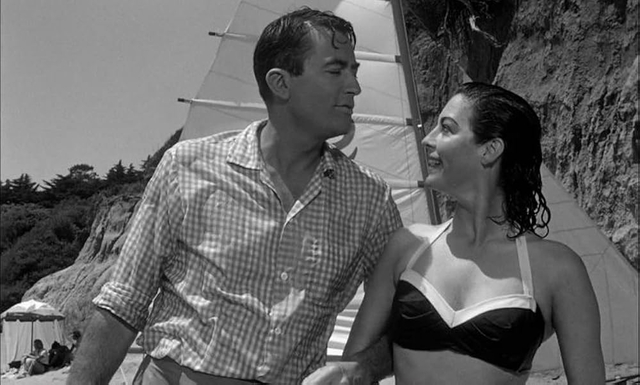
Perkins, Gardner and Astaire all play Australians but while Perkins and Astaire attempt a spotty accent in early scenes it's gone long before the end of the picture and Gardner doesn't even bother. It probably didn't matter much to American audiences at the time, but what did bother Shute was the changes Kramer made to the budding romance between Moira and Towers.
In adapting the story with screenwriter John Paxton, John Osborne became Julian Osborn and was aged up from a man in his late twenties to the spry but senior Astaire. Moira was also aged up from a petite blonde in her twenties to the curvaceous brunette Gardner, attractive but showing every bit of her hard-lived thirty-six years, and still able to draw the stares of a shipful of sailors on the aircraft carrier HMAS Melbourne as she walks down the dock to the Sawfish. This all makes On the Beach a movie artifact of a world of adults, glimpsed just before youthful demographics would banish that world to ancient history.
Shute was particularly upset that the unconsummated romance between Towers and Moira in his book – she respects that he's still mourning his wife – is very obviously consummated in the film. Peck agreed with Shute but he was overruled by the director; Shute's story, full of stoic characters and meticulously repressed emotions, became a high-minded melodrama in Kramer's hands.
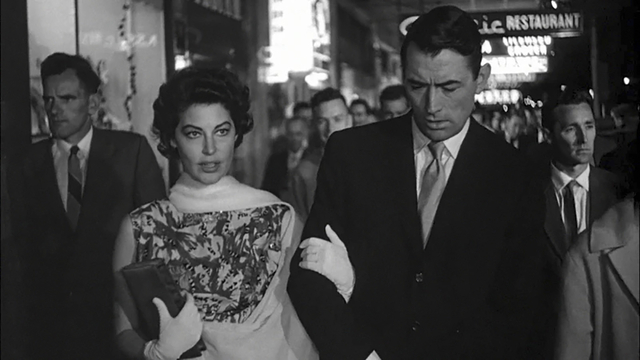
When a scientist hypothesizes that heavy rain might have reduced radioactivity in parts of the Northern Hemisphere, Towers and the Sawfish are sent out on a voyage across the Pacific to Point Barrow at the northern edge of Alaska, with Peter and Julian on board, the latter running radiation tests. They're also tasked to find the source of a mysterious morse code transmission from somewhere near San Diego, in the desperate hope that someone might have survived the war.
They discover that the hypothesis is wrong from the top of the Bering Strait all the way to San Francisco, which they find eerily deserted but intact. (In Shute's novel nuclear warheads "salted" with cobalt – radiological weapons – were used by China against Russia, poisoning the land and air but leaving buildings intact.) A crewman who called San Francisco home escapes from the sub and swims ashore, choosing to die, painfully and alone, in the city rather than halfway across the world.
The mysterious morse signal turns out to be a Coke bottle caught in the pull of a venetian blind by a broken window, draped across a telegraph key and powered by a set of turbines that have remained spinning without maintenance. Kramer conspicuously avoids showing us ruins or bodies, opting for something austere and desolate – a world covered with the evidence of civilization, absent of its creators.
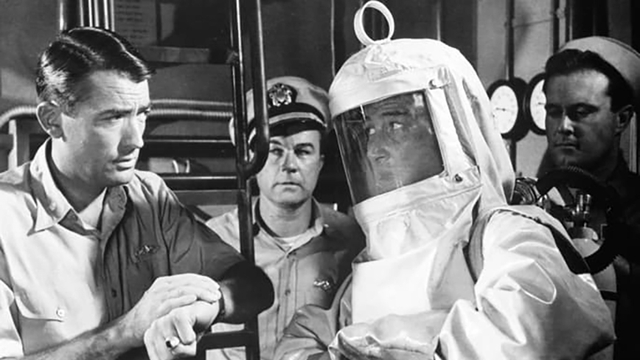
During pre-production Kramer contacted the United States Navy for assistance but came up against opposition right from the top – President Eisenhower, who considered the film's pessimism dangerous not just to the country's nuclear defense strategies but to civil defense and public morale. The United States Information Agency called the picture "defeatist" and Leo Hoegh, the former governor of Iowa and director of the Office of Civil and Defense Mobilization, said his agency considered On the Beach "something very harmful; because it produced a feeling of utter hopelessness, thus undermining OCDM's efforts to encourage preparedness on the part of all citizens."
In his essay "Fallout On the Beach", Mick Broderick details how the government prepared a campaign to delegitimize the message of Kramer's film, with an "Infoguide" prepared by the USIA and the State Department that disparaged the movie as "science fiction" and full of scientific inaccuracies.
Despite the efforts of US Navy Chief of Operations Admiral Arleigh Burke to convince the USIA and his own staff that the film could be helpful to the national interest, after discussions with Kramer about removing the "pessimistic slant" of his story, the Pentagon denied support and the director ultimately worked with the Royal Australian Navy, who lent the diesel-powered HMAS Andrew to stand in for the nuclear Sawfish.
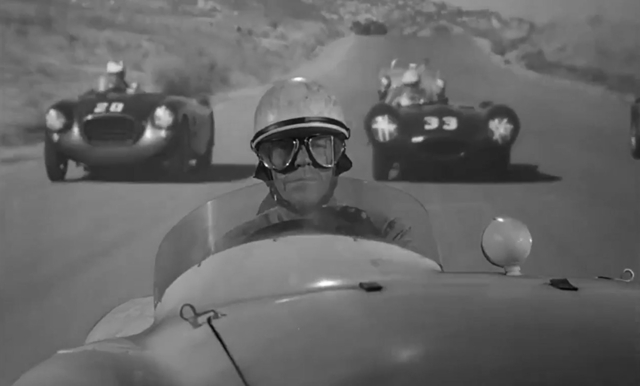
With time running out, we see characters attempt to cope with the imminent end; Julian buys a Ferrari (a 1955 750 Monza) and enters the last Australian Grand Prix, fulfilling a lifelong dream to race cars. Kramer stages the race as a suicidal demolition derby; racers hurl themselves down the track and into spectacular, fiery crashes.
Astaire sits behind the wheel looking utterly unconcerned by the carnage around him, and Julian wins despite never having raced before. Later, he stuffs blankets under the doors of his garage, sits in the car and hits the gas pedal, filling the room with carbon monoxide while the soundtrack swells.
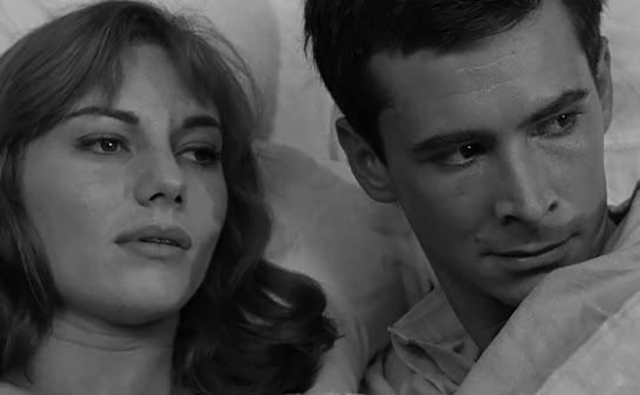
As the contaminated cloud gets near Melbourne, the government provides the population with suicide tablets, and Kramer shows citizens queueing in orderly lines for the pills. Peter had tried to prepare Mary for this exit but she had been unable to bear the responsibility of killing not just herself but their child. Cinematographer Giuseppe Rotunno painstakingly filmed their home with bright, clinical, shadowless light, preparing us for this scene from the start of the picture. The young couple prepare for the end in bed, talking about how they met ("on the beach", apparently) and about the life they didn't get to live together.
In Shute's novel they're already suffering from radiation sickness at the end. Mary wonders why it happened: "Was it because Russia and China started fighting each other?"
He says that's "about the size of it" but adds that "there was more to it than that... The whole thing started with Albania." Mary wonders if it could have been stopped but Peter says that "some kinds of silliness you just can't stop." He says they might have been able to educate people out of this madness if they'd used the newspapers but "we all liked our newspaper with pictures of beach girls and headlines of cases of indecent assault, and no government was wise enough to stop us having them that way."
Mary isn't sure if she understands but says that she doesn't miss newspapers. "It's much nicer without them."
Finally she tells him that "I've had a lovely time since we got married. Thank you for everything, Peter."
He drew her to him and kissed her. "I've had a grand time, too," he said. "Let's end on that."
They put the tablets in their mouths, and drank.
The scene is a pretty decent example of the stiff upper lip shared by nearly every character in Shute's book, and it's no surprise that Kramer felt no obligation to duplicate it in his film, but the ending he gives Peter and Mary is no less bleak, as they lie together on their bed and regretfully glance offscreen at their infant daughter who, it's inferred, has already been given her life-ending medicine.
"God forgive us," Mary says – her last words in the picture.
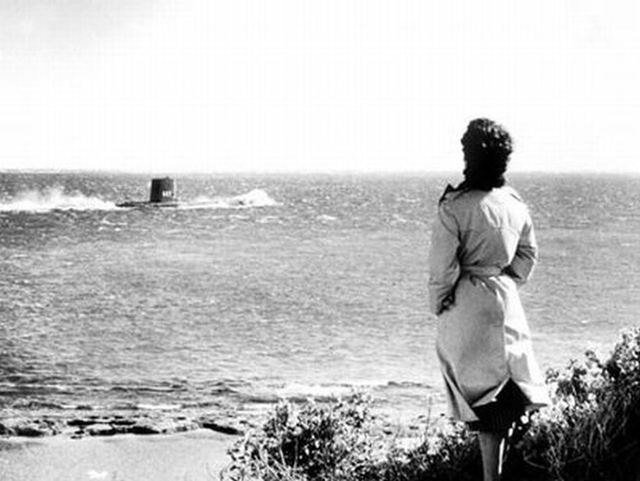
Towers chooses duty at the end despite his feelings for Moira and decides, after a vote, to sail with his men in the Sawfish back to America and certain death at home. Moira accepts his decision and races her Austin Healy to the bluff at Barwon Heads to watch the submarine sail out of the film the way it entered.
In Shute's book, Towers and what remains of his crew sail the Sawfish out to the open ocean to scuttle the submarine. In the 2000 Australian TV remake of the picture (directed by Russell Mulcahy of Highlander fame), Armand Assante's Towers emerges from the bushes – in full navy whites! – to surprise Rachel Ward's Moira and make their exit together while his sub wails away.
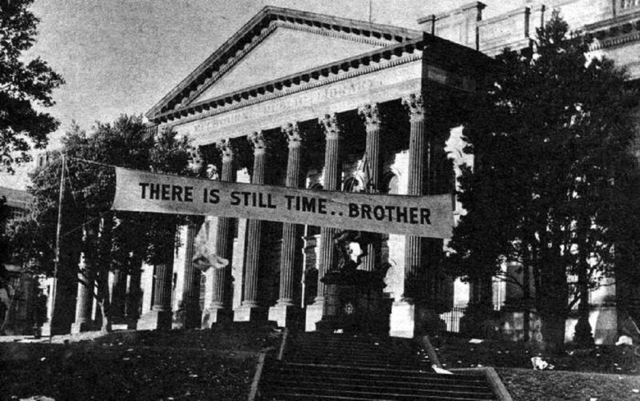
Kramer ends the film in Melbourne's deserted downtown with litter blowing through the streets, and the square in front of the Public Library where we'd seen a Salvation Army band play for steadily dwindling crowds. With each cut the soundtrack blares a brassy shock chord before settling on a banner reading "THERE IS STILL TIME... BROTHER". It's like being boxed across the ear, unsubtle even for a director as committed to his message as Kramer.
On the Beach is such a famous, relentless downer that it's no surprise, with or without the efforts of the USIA, the State Department, the OCDM and the Pentagon, the film flopped at the box office. Eisenhower needn't have worried. And as if confirming the old adage about "first time as tragedy, second as comedy", five years later Stanley Kubrick would tell a nuclear war story as essentially bleak and hopeless with Dr. Strangelove or: How I Learned to Stop Worrying and Love the Bomb.
My first column for SteynOnline, nearly five years ago, was about nuclear war movies and my own youthful certainty that, somewhere in my future, there was a mushroom cloud with my name on it. By the end of the '80s and the release of Miracle Mile – the subject of that column – the nuclear war story had been told many, many times, so often that it had lost much of its dread. On the Beach was apparently the inspiration for "Dancing with Tears in My Eyes", a 1984 hit by Midge Ure and Ultravox. I remember thinking at the time, just twenty years old, that it was terribly romantic.
I know now that, like Russell Mulcahy's remake of Kramer's film, it was kitsch. Two years ago writer Annie Jacobsen was promoting her bestselling book Nuclear War: A Scenario, which told the story of global devastation after a nuclear exchange that starts with North Korea. (The Albania of the 2010s.) In it she writes that:
"The madness of MAD (Mutually Assured Destruction) is that the two sides are like a mirror. Like the myth of Narcissus but with a biblical twist: a madman stares in a pond, sees his image on the surface of the water, and mistakes himself for his enemy. Falling for the illusion, he attacks, slips into the water, and drowns, but not before he unleashes Armageddon."
It sounds like wise analysis but, on deeper reflection, it's a kitsch sentiment – a parable that gilds our idiocy with the eternal resonance of myth, like a nuclear war story that lets us mourn ourselves, to imagine a kind of pyrrhic victimhood that has the singular benefit of consuming everyone, including the people who brought destruction down on us. It's a tragedy so huge that it implicates everyone but assures us that we can't possibly share in the blame. What, after all, could we have done to deserve this, besides live at the wrong end of human history?
Club members can let Rick know what they think by logging in and sharing in the comments below, as access to the comments section is one of many benefits that comes along with membership in the Mark Steyn Club.