

Programming note: Tomorrow, Wednesday, I hope to be here for another edition of our Clubland Q&A taking questions from Steyn Clubbers live around the planet at 3pm North American Eastern - which is now restored to its regular hour across the Atlantic: 8pm in London, and 9pm somewhere between Zurich and Liechtenstein, which will be the general vicinity of yours truly.
~We are in a strange interlude before the promised doomsday hour of 8pm US Eastern, when the destruction of the entirety of Iran's civilian infrastructure is scheduled to commence:
US President Donald Trump has threatened Iran again, saying "a whole civilization will die tonight" as his deadline to open the Strait of Hormuz looms.
🔴LIVE updates: https://t.co/wVPXcvHgpY pic.twitter.com/dowYMj2vl4
— Al Jazeera English (@AJEnglish) April 7, 2026
Ahead of that, the IDF is promising a little light warm-up pre-Armageddon:
"For the sake of your security, we kindly request that from this moment until 21:00 Iran time [17:30 GMT], you refrain from using and travelling by train throughout Iran," the military posted on X.
Possibly that was just a bit of deflection. Those wily Israelis have now hit a synagogue in Tehran. If Iranian Jews rise up, we could easily wind up with a second Zionist Entity in the region. Didn't see that plot twist.
Well, we shall see what the next twenty-four hours bring. In the meantime, let us turn our attention north - as JD Vance, the US Vice President if you recall, is doing. His silence in recent weeks has been noted by many, but it turns out he's just been working on his Hungarian keynote. "Air Force Two" (Steyn rolls eyes) has just touched down in Budapest, where Mr Vance will be speaking at a campaign rally for the beleaguered Viktor Orbán. I shall be in the Hungarian capital for this Sunday's Election Day to give you my take on what, as the presence of JD confirms, is a most consequential election. It may be that Mr Orbán is a dominant figure who simply outstayed his welcome, as happens in a democratic system: see John Howard Down Under in 2007. Or it may be that the time and money the Euroklatura have invested in taking out their longest-lasting enemy has finally paid off.
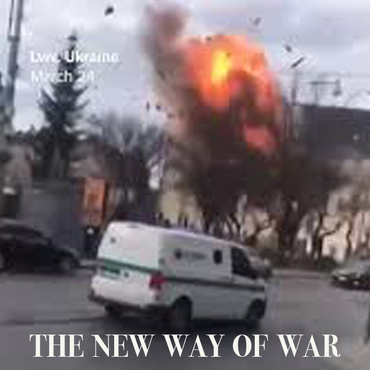
The day after the Hungarian election I shall be in Ukraine. I am often accused by commenters of "fighting the last war". But, in fact, the last war is still being fought. In just a few weeks, the Ukraine war will have gone on longer than the First World War. That is somewhat remarkable. Many pundits have scoffed at the inability of the nation with more nukes than any other in the world to annex more of Ukraine at a faster speed. I shall give you my view from up close in a week or so.
My doctors have minimal enthusiasm for this trip, since the Ukrainian health system has no great reputation for anything other than drone injuries. However, very sportingly playing along, they have advised me that, in the event of another heart attack, this time in western Transcarpathia, I should try to make it back to an Hungarian hospital. Extending the principle, in the event of a heart attack in southern Ukraine, I shall try to make it to a Moldovan hospital and, in northern Ukraine, to a Belarus hospital. If it happens in eastern Ukraine, I shall head to a Russian hospital, and try to steer clear of the sixth-floor windows.
However, I note that, on the latest global health-care rankings, Ukraine comes higher up the hit parade than Hungary, Moldova and even Belarus. So who knows? The point to remember is that the Ukrainian war is one of those conflicts that has changed the nature of warfare, like the aforementioned Great War. In the first month of that conflict - early September 1914 - the Imperial Japanese Navy deployed what is generally recognised as the first "aircraft carrier", when the crane of the Wakamiya (a Russian freighter captured a decade earlier) lowered its seaplanes into the water to take off and attack Austro-Hungarian and German ships. Since then, possession of an aircraft carrier has been taken as the easiest shorthand for whether a country is militarily serious or not. Only yesterday the President of the United States was sneering at the Prime Minister of the United Kingdom because the latter's "old" aircraft carriers "barely work".
On the other hand, these days whose do? Trump is said to have been surprised that the deployment to the region of his own carrier, the Abraham Lincoln, did not force the Iranians to back down. Since the commencement of hostilities, the Lincoln has retreated over a thousand kilometres away - because it has realised that in the age of drone warfare an aircraft carrier is just a big floating target. The Lincoln is in the Iran war in the same sense that me deploying my own personal aircraft carrier, HMCS Steyn, to the English Channel would be in the Ukraine war. The most expensive carrier on earth, the USS Gerald Ford, was forced after a somewhat mysterious "fire" in the laundry room to withdraw for critical maintenance to Split on the Dalmatian coast, which is well-known to Mark Steyn Cruisers if not to the average ayatollah. The fire having been extinguished, the carrier has now left Croatia to return vaguely to the vicinity of the Centcom "area of responsibility". So far neither carrier has been remotely relevant to the Iran war. We are in a new era of warfare in which the multi-bazillion-dollar white elephants of the military-industrial complex are less important than cheap'n'cheerful drones almost anyone can make for four figures or (if top of the line) the low fives. So a week or two hence I shall take a look at the phenomenon close-up.
However, my own view, as longtime readers will know, is that it is the home front that matters, and that therefore the EU's defeat of its bête-noire in Budapest this Sunday would be a significant setback for Euro-sanity. I said recently that populist successes in the west always ended up as one-step-forward-two-steps-back: reformist candidates, to one degree or another, win elections after a fashion - Geert Wilders, Giorgia Meloni, the Rassemblement-National, etc - and their victories are always castrated by the permanent state. The one great exception to this rule has been Viktor Orbán, who, unlike Mme LePen or the AfD, is not eternally on the verge of achieving power, but has actually taken it and held it. For aficionados of the Austro-Hungarian Empire, the difference between Brussels-compliant Europe and resistance to it is obvious on a casual stroll through downtown Vienna and then Budapest. He is also the only western leader who articulates the stakes:
We are in a change, a change is coming, that has not been seen for five hundred years. This has not been apparent to us because in the last 150 years there have been great changes in and around us, but in these changes the dominant world power has always been in the West. And our starting point is that the changes we are seeing now are likely to follow this Western logic. By contrast, this is a new situation.
In the past, change was Western: the Habsburgs rose and then fell; Spain was up, and it became the centre of power; it fell, and the English rose; the First World War finished off the monarchies; the British were replaced by the Americans as world leaders; then the Russo–American Cold War was won by the Americans.
But all these developments remained within our Western logic. This is not the case now, however, and this is what we must face up to; because the Western world is not challenged from within the Western world, and so the logic of change has been disrupted. What I am talking about, and what we are facing, is actually a global system change. And this is a process that is coming from Asia. To put it succinctly and primitively, for the next many decades – or perhaps centuries, because the previous world system was in place for five hundred years – the dominant centre of the world will be in Asia: China, India, Pakistan, Indonesia, and I could go on. They have already created their forms, their platforms, there is this BRICS formation in which they are already present. And there is the Shanghai Cooperation Organisation, in which these countries are building the new world economy.
Is what is happening in Iran accelerating or arresting this trajectory? If I seem to be somewhat nonchalant about the nuking of Marseille or Minneapolis, it is because no bomb has yet been devised that could do the damage to what we used to call Christendom that the last three generations of the western political class have inflicted. We do not need to be nuked; as I wrote all those years ago in America Alone, we are our own suicide bomb.
So I shall hope Mr Orbán's poll numbers are off, as I hope Mr Trump's are off. But, on the brink of a half-millennium "global system change", neither is where we should be.
Final thought, from the inaugural address of the forty-seventh President of the United States:
We will measure our success not only by the battles we win but also by the wars that we end — and perhaps most importantly, the wars we never get into. (Applause.)
My proudest legacy will be that of a peacemaker and unifier. That's what I want to be: a peacemaker and a unifier.
More on this tomorrow, assuming we're all still here.
~Thank you to all those new members of The Mark Steyn Club in this our ninth year, and thank you to those old members who've signed up a chum for a Gift Certificate or a Gift Membership. Steyn Clubbers span the globe, from London, Ontario to London, England to London, Kiribati. We hope to welcome many more new members in the years ahead.