

Greetings from Ukraine, where I continue to progress eastward, through towns that seem far more desolate than they did four years ago. The bombing truce for the (orthodox) Easter weekend has come to an end, so I am told to expect the air-raid alerts tonight. Tomorrow, Wednesday, I'll be here - electricity and Internet permitting - for another edition of our Clubland Q&A taking questions from Steyn Clubbers live around the planet at 3pm North American Eastern - which is now restored to its regular hour across the Atlantic: 8pm in London, 9pm in western Europe, and 10pm in Ukraine - where, if the air-raid sirens go off mid-show, I'm informed sternly that I have to make my way down to the bunker. I tried to do it last night only to find that the somewhat surly proprietress of my somewhat unprepossessing hotel had taken the precaution of locking the door at the top of the stairs, thus preventing egress and giving Putin a clean shot. To modify the late Poet Laureate, "Come, friendly bombs, and fall on Steyn."
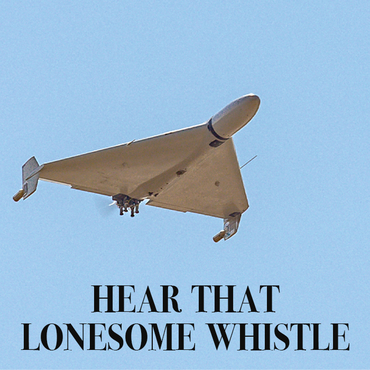
But, as I have said, it's all connected - at least when it comes to the two Cold War superpowers adjusting to the new way of war. Readers will be familiar with my long-held contempt for what Eisenhower euphemised as "the military-industrial complex". Even so, it beggars belief that the Pentagon, which (as anyone in Kiev will tell you) was running the first three years of this war, did so without apparently noticing that drones had changed the most basic assumptions of warfare. So it was completely blindsided at the launch of its own Iran war, when Tehran's drones penetrated defences at Prince Sultan Air Base in Saudi, Camp Victoria in Baghdad and a dozen other US bases and rendered them all but unusable - even though the self-same Iranian Shahed drones had been dropping on Ukraine for the previous four years.
As I observed last time I was on the ground, prior to the war I mostly associated Ukraine with those striking blonde hotties with the distinctive dark luxuriant Slavic monobrow. An acquired taste, one would have thought, although judging by the Ukrainian stranglehold on the London and Paris "escort" market an awful lot of people seem to have acquired it. I'm talking about the girls, that is. Can't speak for the boys: you'd have to ask Keir Starmer about that. In the first small border towns there are far fewer young men - by which I mean under retirement age - than there were last time I was here, and the age distribution on the hastily improvised war memorials is very different from those of Commonwealth cemeteries in Normandy: men in their twenties, thirties, forties, fifties and sixties. All now dead, or fled to the clammy embrace of Sir Keir. On the distaff side, the only Ukrainian blonde in the bar last night was an infantrywoman in uniform having one for the road before returning to the front after an Easter break.
So Oksana and I discussed the drones. "Do you know what 'Shahed' means?" she asked.
"Of course," I said, forebearing to roll my eyes. "It means 'witness' in both Farsi and Arabic." What could be more natural than showing off one's Persian in a Ukrainian bar? Oksana laughed and ordered another round.
"But the Russians," she said, "have made them even better witnesses." She explained that, when the war started, the Iranians had great difficulty keeping up with Russian demand, so eventually they sub-licensed the manufacturing rights to the Kremlin, which now makes its own Shahed drones in Tatarstan. However, unlike the Iranian originals, the Russian Shaheds have far more sophisticated video-targeting technology, which the mullahs decided to do without in theirs because it required foreign-made components that could easily be hacked. "Once an Iranian Shahed is launched it's on its own up there," she said. "But with the Russian ones it's Shahed safari: they're on the hunt in real time. Even if one is hit the radio has shared its target with nearby drones so another can change course and take out the passenger train ahead." She smiled, and added: "How are you getting around?"
"By train." And we clinked glasses. The Russians have been amping up their train attacks in an effort to hamper Zelenskyyy's ability to re-supply the front. There were one hundred drone strikes on trains in January; in April, a railwayman tells me, it's estimated to be three hundred. I do the math: the odds of one's journey being totalled by Putin are still less than of it being ruined by the soddingly incompetent Ukrainian rail reservation system, which makes it impossible to buy a ticket for an express train at a railway station in order to prevent you re-selling the ticket to a higher bidder, which apparently is now a thing in Ukraine. Seat 47G on a train to Lviv is like two on the aisle at Hamilton. The ticket window is called "KACA", which I think is a little too obvious. On the other hand, the station offers "The Hall of Enhanced Comfort", which is not something I've ever found at Penn in NY; it is, alas, closed. After four years of war, there is not a lot of "enhanced comfort" to be found.
"So how do you deal with drone attacks?" I ask the railwayman.
"We can't really hear drones above the engine," he says. "But if I see one coming toward us down the track my orders are to stop, and tell everyone to get out quick."
Unlike the blonde soldier gal, he doesn't enjoy talking to me. Ukrainians are a lot less friendly to foreigners - or at any rate to me - than they were four years ago, when they made the mistake of thinking that all those blue-and-yellow flag avatars that overnight replaced the Covid masks and vax needles on the world's social media actually meant something. And, as I noted yesterday, the most immediate consequence of the Fall of Orbán is that the war will go on, because Europe is determined to fight Putin to the last Ukrainian.
Which shouldn't be long now. Ukraine's population peaked with the collapse of the Soviet Union at a tad over fifty-four million in 1993. By the start of the war in 2022 it was a whisper over forty-one million. The estimated population right now is twenty-eight million - or just over half what it was thirty years ago.
On the other hand, who needs Ukrainians? President Zelenskyyyy just yesterday:
The future is here, on the battlefield, and Ukraine is creating it. These are our ground robotic systems. For the first time in this war's history, an enemy position was taken exclusively by unmanned GRS platforms and drones. The occupiers surrendered, and this operation was completed without infantry involvement and without losses on our side... A robot went into the most dangerous zones instead of a soldier.
I don't suppose the robot looks as hot in uniform as my blonde from the bar, but perhaps this was the point all along. Ukraine has not yet, formally, lost the war, but, demographically speaking, it has already lost the peace. Why the American Deep State and the European Union chose to do this to a harmless, peripheral nation has always remained mysterious. But perhaps the plan was always to create the first post-human society. Maybe my train will be droned by Putin or maybe the robot will sprint down the track to disable it and then return to my carriage to invalidate my ticket with almost as much surliness as the old human conductor.
~Thank you to all those new members of The Mark Steyn Club in this our ninth year, and thank you to those old members who've signed up a chum for a Gift Certificate or a Gift Membership. Steyn Clubbers span the globe, from London, Ontario to London, England to London, Kiribati. We hope to welcome many more new members in the years ahead.