
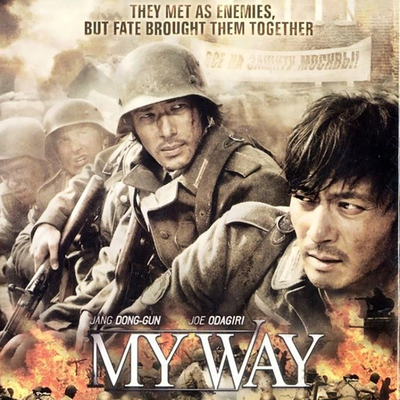
The incredible story of Yang Kyoungjong is all the more phenomenal because, while there's very little proof that he ever existed, our need to believe that he did has been so urgent that facts seem to matter very little. But that hasn't stopped at least three reputable historians from telling Yang Kyoungjong's story with confidence, and the premise of his life even became the basis for My Way, a multimillion-dollar South Korean action movie, albeit one embroidered with its own fictions.
Yang Kyoungjong's story begins just after D-Day when, in an interview made for historian Stephen Ambrose years later, an American officer recalls the capture of four soldiers of Asian origin in Wehrmacht uniforms. They were, he said, Koreans who had been conscripted into the Japanese Imperial Army, captured by the Soviets, forced to fight against the Germans who captured them in turn and pressed them into one of the forced labour battalions sent to build and man the fortifications along the English Channel. (Or at least that's how Ambrose tells the story.)
A photograph of an Asian-looking young man in a German uniform taken prisoner by the Allies after D-Day, while never attested in any official record to be Yang Kyoungjong, became attached to his story as proof that these hapless men existed. And because every story needs an ending, we were told – with remarkable confidence given the vagueness of the scraps of fact about Yang Kyoungjong's origin – that he had been sent to a prison camp in the UK and emigrated to the U.S. after the war, dying in Illinois in 1992. An incredible story, repeated in books and online and on museum walls, albeit one that hasn't been substantiated by a single piece of paperwork in eight decades.
After telling us that the story we're about to see is based on facts and a brief prologue at the 1948 London Olympics, Kang Je-gyu's 2011 film My Way begins in 1928 in Gyeong-seong (now Seoul) where Kim Jun-shik's father works as a servant on the farm owned by Hasegawa, a retired Japanese military officer. When his grandson Tatsuo comes to visit, they begin a rivalry based on marathon running that reaches its peak when they're teenagers and Sohn Kee-chung (Yoon Hee-won) wins a gold medal in the marathon at the 1936 Berlin Olympics.
By this point Tatsuo (Joe Odagiri) is a true believer in Japanese militarism after Korean nationalists kill his grandfather with a bomb. Jun-shik (Jang Dong-gun), now working as a rickshaw driver, is also a talented runner and a rallying point for nationalists protesting the Japanese occupation of Korea, which began after the Japanese victory in the Russo-Japanese War turned colonial occupation into full annexation when Korean nationalists assassinated Prince Ito, Resident-General of Korea, in 1909. A montage shows the two young men beating each other in alternating races until Jun-shik is unfairly disqualified in a race and Japanese officials hand the win to Tatsuo.
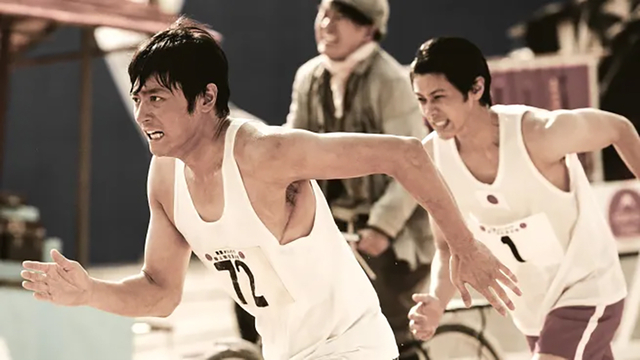
This sets off a riot after which Jun-shik and his best friend Lee Jong-dae (Kim In-kwon) are arrested and punished with conscription into the Imperial Japanese Army. They get deployed to Mongolia where Japan is fighting not just Chinese rebels but an undeclared war against the Soviet Union, where the Japanese Kwantung Army was provoking the Soviets in conflicts like the Battles of Khalkhin Gol. When the Japanese troops retreat (against forces led by General Gyorgy Zhukov) their commander is replaced by Tatsuo, who forces the old commander to commit ritual suicide.
Jun-shik captures Shirai (Fan Bingbing), a Chinese sniper whose parents were killed by the Japanese, but when he refuses to join a suicide squad led by Tatsuo in the next battle against the Soviets, he's beaten viciously and thrown into the same prison pit as Shirai. Jong-dae and his friends help them both escape the night before their execution and are running away when they meet a massive Soviet armoured division heading toward their camp.
When I wrote here about Kang Je-gyu's 2004 Korean War film Tae Guk Gi (released here as The Brotherhood of War) I noted that the director was at the vanguard of a new generation in the South Korean film industry, and that he and his production team had to re-invent how to make a war movie from the ground up. Working from the precedents set by Saving Private Ryan and Band of Brothers, they doubled down on realistic violence in the battle scenes, which had an almost hallucinatory quality.
"Shells kick up geysers of dirt, not smoke, when they miss, and fountains of gore and viscera when they hit," I wrote. "Bodies disintegrate in the air and squibs from bullet impacts produce rich sprays of blood while the camera staggers and reels amidst the battlefield action." Pursuing Shirai after she picks off several of his comrades, Jun-shik dodges slow-motion bullets that puncture sheets hanging on a laundry line.
By 2011, directors like Kang Je-gyu and the Korean film industry in general had joined in setting the wild standards in action cinema showcased constantly by directors in Russia, India, China, Thailand and elsewhere all over southeast Asia, all of them inspired by the groundbreaking work done years earlier by Hong Kong directors like John Woo, Tsui Hark, Ringo Lam and Sammo Hung.
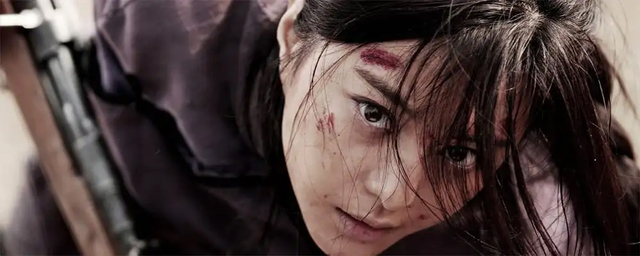
Jun-shik decides to leave his friends and head back to warn Tatsuo and the rest of his Korean comrades about the approaching Soviets. Caught in the open, he's strafed by a Russian pilot in an I-16 "Ishak" fighter. Shirai, following him, fights a duel against the plane with her rifle that leaves them both dead. It's exactly the kind of improbable and violent action that would get an American or British war film dismissed as a cartoon while it's the bread and butter of modern war films elsewhere in the world – such as the Sisu films from Finland.
Tatsuo is leading his troops out to attack the Soviets when Jun-shik comes running to warn him – followed closely by waves of Soviet BT-5 and BT-7 tanks. (Built, apparently, on the chassis of British armoured personnel carriers.) Despite their overwhelming numbers, Tatsuo leads his suicide squad against the Russians and seems to be winning a costly victory until yet another wave of Soviet tanks and infantry come over the crest of a hill to overwhelm his diminishing troops.
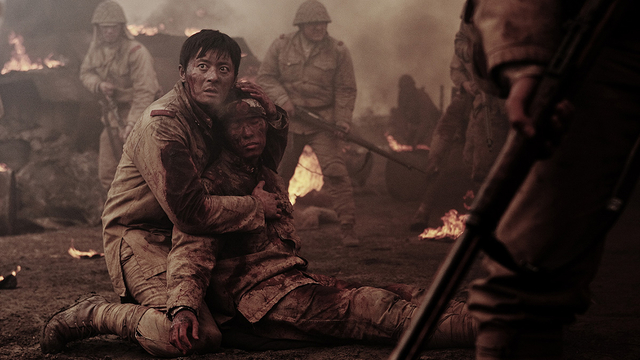
The gore is pitiless and impressively graphic; one of Jun-shik's wounded Korean comrades has his pelvis crushed by a Soviet tank while he holds him. Mud mixes with blood all over the screen and, while Jun-shik pleads with the fanatic Tatsuo to order a retreat, they're both blown up by a shell burst, their bodies flung in slow motion up toward the camera while it hangs in the air above the battlefield.
The Battles of Khalkhin Gol shown in the film – provoked by the Kwantung Army independent of the Japanese high command, like so much of the Japanese war in Manchuria, Mongolia and China – are a reminder that while the west thinks World War Two began with the German invasion of Poland in September of 1939, it had been going on in Asia for years, and that from the Asian perspective that war lasted nearly a decade and a half and began when the Japanese staged the Mukden incident in 1931, a false flag event that started the invasion of Manchuria.
The German annexation of Austria and Czechoslovakia and the Munich Crisis all happen offscreen and unnoticed, and by the time we see Jun-shik and Tatsuo again they are prisoners of the Soviet Union, who signed a non-aggression treaty with Japan in April of 1941, while Rommel is winning in North Africa and Germany invades Greece and Yugoslavia.
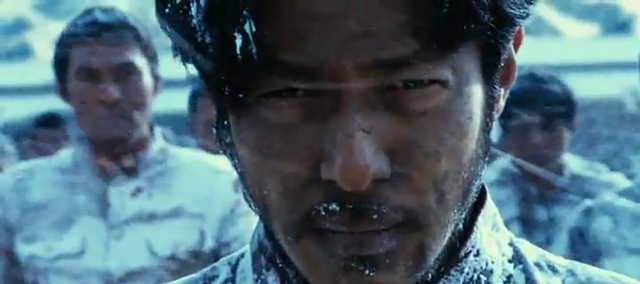
As a train carrying the prisoners from Khalkhin Gol takes Jun-shik and Tatsuo into captivity, a map shows them traveling through Omsk and Perm to a POW camp outside Kungursk, closer to Moscow than Mongolia, though the film depicts it as an always-winter Siberian hellscape.
In the camp the Japanese soldiers no longer have authority over the Koreans. The Soviet commandant taunts Tatsuo by telling him that despite the non-aggression pact his government has forgotten him and has made no effort to repatriate captured Japanese soldiers. He encourages the Koreans to bully the Japanese prisoners, using Korean capos like Lee Jong-dae, who has become a pro-communist camp commissar under the name "Anton".
Director Kang depicts the camp as a Soviet version of Treblinka or Sobibor, where dead and dying inmates are fed into crematoria ovens that provide the only apparent source of heat; Jong-dae happily takes his old friend Jun-shik there to share a bottle, assuring him that this is the best place to be and that as long as he's in charge his friends are safe.
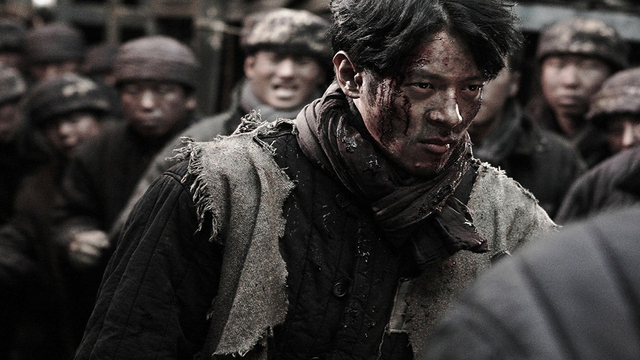
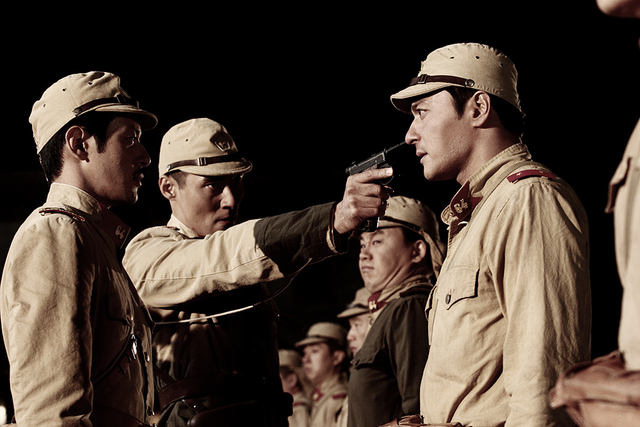
While rumours about Germany attacking Russia circulate through the camp, brutal work details thin out the prisoners' ranks with illness, starvation, accidents and beatings. The commandant cheerfully encourages Tatsuo and Jun-shik to fight each other to the death with a dagger he tosses on the barracks floor but Jun-shik spares Tatsuo. When a riot breaks out against the brutal conditions the two enemies are sentenced to die in front of a firing squad but get a last-minute reprieve when a press gang arrives at the camp looking to conscript prisoners to fight the invading Germans, and Jong-dae volunteers Jun-shik and Tatsuo.
The Kwantung Army, the POW camp and the Soviet army all subject their inmates to relentless indoctrination, with slogans and dogma barked out constantly while loudspeakers reinforce the ideological brainwashing. But by the time Jun-shik and Tatsuo arrive to fight the Wehrmacht at Dedovsk, where the Nazi invasion of Russia is about to stall in sight of Moscow, the onetime fanatic is starting to slip his militarist conditioning.
As in Mongolia, Jun-shik and Tatsuo find themselves up against a superior enemy. The movie echoes earlier films like Enemy at the Gates (2001), which shows unarmed Russian troops advancing into German machine guns at Stalingrad hoping to pick up rifles dropped by unlucky comrades as they're mowed down. The German front line is helpfully decorated with fresh swastika banners hanging from ruined buildings, Jong-dae dies pitifully trying to lead the advance and Tatsuo sheds his last shred of patriotic fervor when he recognizes himself in the Soviet commander ordering his men on a suicidal charge while NKVD machine guns in their rear fire at retreating soldiers.
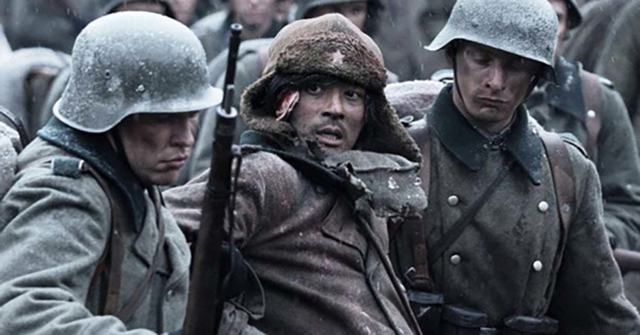
Left wounded but alive after the battle is over, Jun-shik encourages Tatsuo to change into Nazi uniforms stripped from corpses so they can sneak through the German lines and try to escape home. The film relies on curious geography as, instead of making their way through the steppes and open landscape of the Fulda Gap they end up hiking through snowy mountain passes you're more likely to find in Bavaria.
Tatsuo collapses just as they stumble into an abandoned town, where Jun-shik goes to find some medicine and they both get captured by German soldiers who can't understand what they say. There's another jump forward in time and Tatsuo is in a truck with soldiers from a Wehrmacht Eastern Battalion on their way to the bunkers and beaches of Normandy.
Curiously, Kang's film depicts the German army as benevolent compared to the Japanese and Russians; Tatsuo and his new comrades from the Slavic countries conquered by or allied with the Nazis only work until the golden hour, after which they play soccer on the beach amidst the Belgian gates, steel hedgehogs, log ramps and wooden stakes. It's a facet of a strange and abiding east Asian take on Nazi Germany, which has a fascination with swastikas and Hitler completely divorced from its context in the west, which places Nazism and everything about it at the pinnacle of a toxic historical evil.
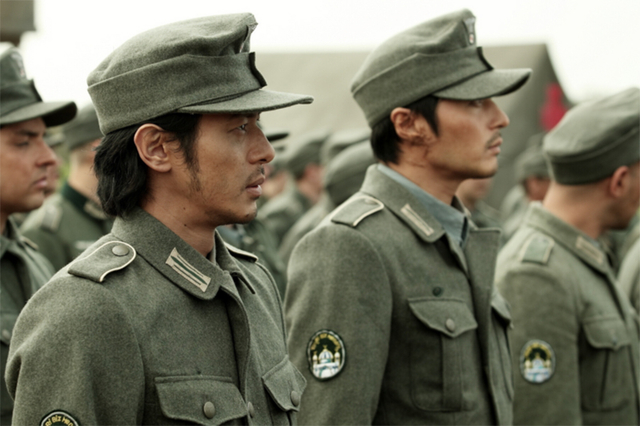
Kang's film does share the consensus that the Axis powers, specifically Germany and Japan, thought fit to conscript and enslave the populations they conquered when they were winning the war to fill growing gaps in their manpower when they began to lose, especially after America joined the conflict and set its massive industrial base to work. Japan and especially Germany relied on economic kleptocracy, and labour compelled at gunpoint, justified by racial ideologies.
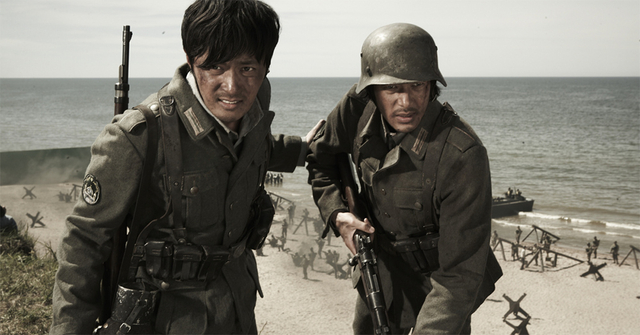
Looking out the firing slit of a bunker at the end of a day's (forced) labour, Tatsuo sees another soldier running on the beach and recognizes Jun-shik. No longer enemies but comrades united by the need to escape their situation and find a way home, Tatsuo asks Jun-shik to join him in his escape plan, to the port at Cherbourg and a freighter that will take them away from Europe. Unfortunately the dawn that breaks as they begin their escape is the morning of June 6, 1944.
There are three big action sequences in the film but there's no doubt that this is the one Kang built his picture around. From the moment Tatsuo's friend looks up from his post and asks "Are those our planes?" all hell starts to break loose. Tatsuo and Jun-shik are separated when the first bombs from the B-24s start falling on their trenches and bunkers and have to find a way to each other while the fortifications are taken apart by shells from the battleships just offshore.
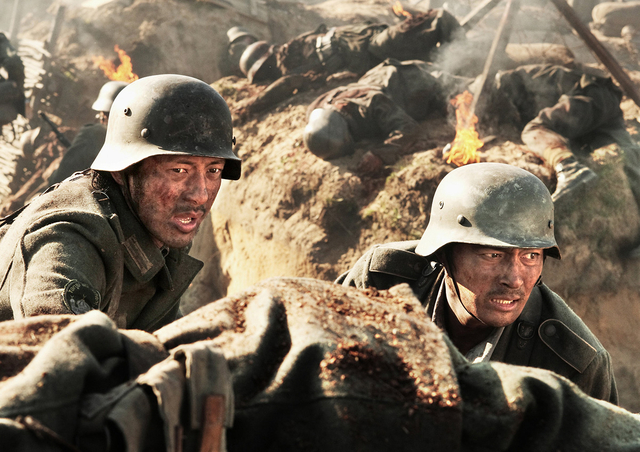
There is just enough historical accuracy to keep one toe of this war fantasy on the ground; there were two Eastern Battalions in Normandy on D-Day: the 795th, made up of Georgians, and the 649th, which was surrounded on the Cotentin peninsula and surrendered just after D-Day. Historian Antony Beevor, author of one of the definitive books about Stalingrad, is one of the most notable proponents (along with Stephen Ambrose and Steven Zaloga) of the story of Yang Kyoungjong, and he has the hapless Korean captured by the same U.S. airborne troops who surround Tatsuo and Jun-shik at the end of My Way (though not, as the film shows, mere yards behind the beach.)
For Beevor, Yang Kyoungjong's story is useful to explain the global nature of the war and how it consumed young men from all over the world, either making them the victims of terror and brutality or its perpetrators (or both). "This reluctant veteran of the Japanese, Soviet and German armies had been comparatively fortunate in a war that stretched around the globe and killed between 60 and 70 million people," he wrote. "In the monstrous clashes of the Second World War, individuals had no control over their own fate. It felt as if they were at the mercy of giant historical forces – as revealed in previously unpublished letters and diaries of the time.
Historical writer Martin Morgan, who worked with Stephen Ambrose and his estate, has found virtually no paper trail for Yang Kyoungjong beyond myth and hearsay. He insists that the persistence of his story comes down to exoticism and the popular fondness for esoteric tales instead of solid research; in a podcast interview he somewhat bitterly admits that this has made it harder for him to get his work published while AI-generated pseudohistory explodes online. For both historians and their audience, there are too many stories that are simply "too good to be false."
In her book The World War II Combat Film: Anatomy of a Genre, Jeanine Basinger writes how "the complaint of 'unreality' in Hollywood war films can be connected best to its narrative content: the sentimentalization of relationships (both on the home front and in combat), the propagandizing of motives (which was part of the war on all fronts), and the presentation of battle violence that could not actually re-create the true battle experience. The falsification that made war more exciting or glamorous was more a postwar phenomenon."
At the end of My Way, the film returns to that marathon race at the 1948 London Olympics, where the Korean runner taking the lead is revealed to be Tatsuo competing under Jun-shik's name. (South Korea did compete in the 1948 Olympics but did not win any medals.) We have already seen how a mortally wounded Jun-shik switched his name tags with Tatsuo before their capture to prevent a Japanese in German uniform from being executed on the spot. The onetime Japanese militarist has become a Korean; this is the tale Kang's film grafts onto the myth to make a political point. (It's also proof of my long-held rule that there are no period films: every movie is about the time in which it's made.)
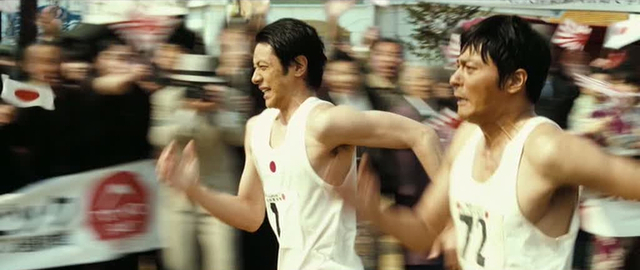
Kang used the same identity swap on the battlefield as a plot device in Tae Guk Gi, but it's employed here to address ongoing tension between Korea and Japan with a particularly Korean slant. The two counties didn't seriously begin repairing their relationship until the 1965 Treaty on Basic Relations was signed, when postwar Korea began pulling themselves out of poverty by copying Japanese economic and business models, ultimately with great success. Since then the two countries have engaged in avid cultural trade that has seen Korean food on Japanese menus and Korean pop music, movies, television and anime become wildly popular in Japan.
Tensions remain, though; Koreans think the Japanese are insufficiently apologetic for atrocities committed during the colonial period, while the Japanese are alarmed by South Korea's eagerness to maintain diplomatic and economic ties with China. (An uneasy relationship with China is one thing that Japan and North Korea have in common.) Tae Guk Gi was a massive hit in South Korea but My Way, an equally melodramatic war story, was a palpable flop, losing at its opening weekend box office to Mission: Impossible – Ghost Protocol and earning back a fraction of its $24 million budget. But the irresistible story of Yang Kyoungjong marches on.
Club members can let Rick know what they think by logging in and sharing in the comments below, as access to the comments section is one of many benefits that comes along with membership in the Mark Steyn Club.