In 2010 the Western Writers of America surveyed its members and compiled a list of the top 100 western songs of all time. They presented it at their annual convention in Knoxville, Tennessee, and holding down the top three spots were, in descending order, "Ghost Riders in the Sky", Marty Robbins' "El Paso" and the chestnut "Cool Water", recorded most famously by The Sons of the Pioneers.
"El Paso", the most cinematic of all three songs, was never featured in a movie, while Stan Jones' "Ghost Riders" has showed up in many, starting with Gene Autrey's 1949 film Riders in the Sky. None of them, however, really lived up to the promise of the song's wistful supernatural theme, which is still waiting for a great ghost story western to fulfill it's promise.
"Cool Water", written by Canadian Bob Nolan, would appear first in a Roy Rogers film, Along the Navajo Trail, performed by Nolan and his group, The Sons of the Pioneers, and showed up in the Coen Brothers' 2018 western comic anthology The Ballad of Buster Scruggs. It isn't until number six that the list includes a song written explicitly as the theme for a western movie – Dmitri Tiomkin's "The Ballad of High Noon", also known as "High Noon" or "Do Not Forsake Me".
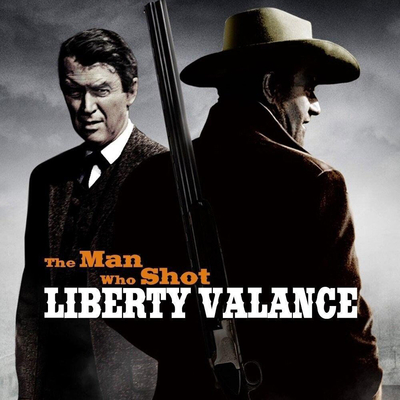
You have to scroll all the way down to number thirty-six – past "Tumbling Tumbleweeds", "Home on the Range", "Don't Fence Me In", "Happy Trails", "Rawhide" and "Knockin' on Heaven's Door" to get to "The Man Who Shot Liberty Valance", the song that (depending on who tells the story) was meant to be the theme tune of John Ford's 1962 western (Pitney insists that Paramount Pictures paid for the recording session) even though the song wasn't finished until after the film was already in theatres.
Written by no less than Burt Bacharach and Hal David just before they shifted gears into their defining period with songs created for Dionne Warwick, it's a classic piece of pop western songwriting, complete with "clip clop" rhythm and an irresistible earworm of a fiddle hook. It also gives away nearly the whole plot of Ford's film, which is one reason why no one seriously imagines the director would have allowed Paramount to slap it over the credits to his picture.
If you're at all curious, the Bacharach and David tune beat out "The Ballad of Ira Hayes", "North to Alaska", "Oklahoma!", "Tom Dooley", "Battle of New Orleans", "O Susanna" and "Rocky Mountain High" on the list. You can argue with the choices and ranking all you want, but I don't think I'm the only one who thinks it might be a gas to attend the Western Writers of America's annual convention (which happens next weekend in St. Louis).
The Man Who Shot Liberty Valance was made when the director was edging into physical and mental decline. It came after one somewhat decent picture (Sergeant Rutledge) and a very mediocre one (Two Rode Together) that Ford himself called "the worst piece of crap I've done in twenty years."
But he was still considered a big deal in Hollywood, especially when he was making a film starring John Wayne. Paramount and its head of production, Howard W. Koch, gave him a budget of $3.2 million – a lot of money for a black and white picture shot mostly on a soundstage, but a good deal of that ($750,000) went to Wayne, with another $150,000 to Jimmy Stewart (and a comparatively small $50,000 for the third star, Lee Marvin).
Now, near the end of Ford's career behind the camera, the actor who he had made into an icon held the power Ford had at the start of their relationship. "Ford still had life," said Koch, "but the Big Cowboy was really the whole thing." Ford held firm against Paramount's desire that the film – like almost every other studio picture – should be shot in colour, but the director was certain that there was no other way for him to make the story work except in black and white.
Ford begins the film with what would have been a pointedly retro touch even in 1962, with the title credits painted in blocky "old west" type on weathered barnboard signs. Cut to a train pulling into the station at Shinbone, a western town whose rough origins are hinted at in its name but undercut by the new brick town hall and gazebo bandstand – signs of permanence and civic amenities that could only have arrived after the frontier had truly passed over the town on its way to the ocean.
It's a special train, laid on for Senator Ransom "Ranse" Stoddard (Stewart) and his wife Hallie (Vera Miles), but the only person waiting for them on the platform is Link Appleyard (Andy Devine), the town's former marshal. Their visit was supposed to be incognito but they're spotted by a cub reporter from the Shinbone Star who imposes on Ranse to give him an interview. In the meantime Link takes Hallie to the desert outskirts of the town where they contemplate the ruins of a burned-out house being reclaimed by cactus, blooming with desert roses.
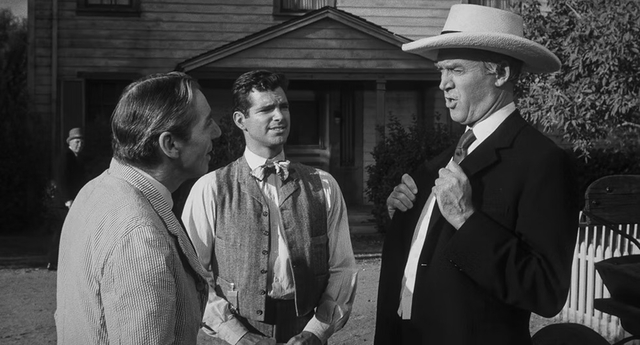
Stewart makes a big show of playing Stoddard as a blowhard, a man who's used to being listened to with the deference due to an esteemed career politician. He nonetheless tries to keep his reason for returning to Shinbone obscure, admitting to the reporter and his editor (Carleton Young) only that he's there for the funeral of Tom Doniphon, a man whose name none of them recognize.
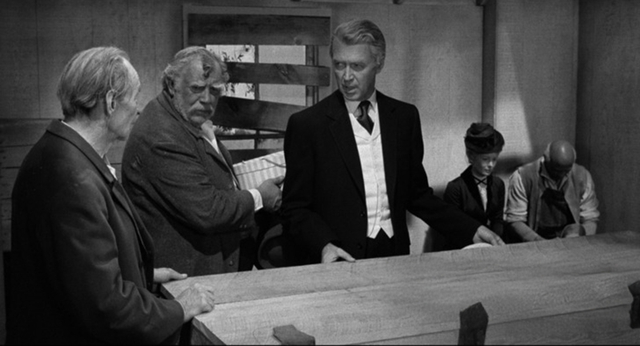
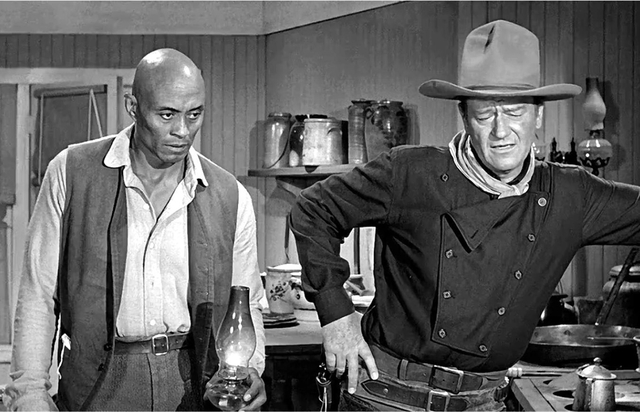
The only other person sitting in mourning for Doniphon besides Link and the Stoddards is his best friend Pompey (Woody Strode), who sits in the corner of the dim back room at the undertakers where the body lies in a rough pine coffin with leather hinges. When the undertaker admits that he scavenged the boots off the body, Stoddard angrily insists that he put them back on, along with his gun belt, though he's informed that Doniphon hadn't carried a gun in years.
The whole of this first sequence of scenes is relentlessly downbeat and mournful, with all of Doniphon's mourners looking like they're carrying the burden of some unstated guilt and regret bound to the body of the man in the coffin. We know that the film is going to explain all of this and it's almost a relief when the newspaper editor returns and demands an explanation with all the entitlement of a member of the fifth estate in a time when the institution still commanded respect.
Stoddard agrees to provide one, and Stewart sits down to begin the long flashback that makes up the bulk of the film's story. It's starts in venerable western movie fashion with the robbery of a stagecoach bringing the young Ranse, a recent law graduate from the east, to the frontier where he had responded to the urging of journalist Horace Greeley to "Go West, Young Man" – a quote that typically gets cited without its subsequent appeal to "grow up with the country."
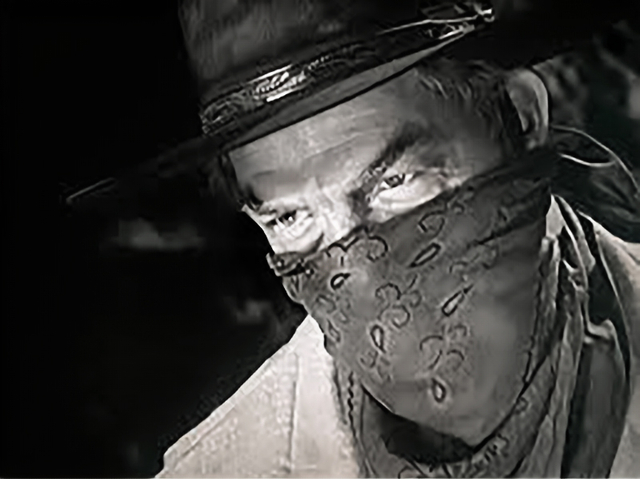
The leader of the gang of bandits is the titular Valance (Marvin), a more than usually psychopathic thug who takes Ranse's chivalric defense of a widow being stripped of her last jewelry as a provocation. He makes a point of tearing pages out of Stoddard's law books before viciously beating him with his trademark silver-handled horsewhip.
He's left for dead but saved by Tom and Pompey, who take him into Shinbone and put him in the care of Tom's girl, Hallie, and John and Nora Ericson (John Qualen and Jeanette Nolan), the Swedish couple she works for at the local chop house. Battered but furious, Ranse states his intention to bring Valance to justice, in front of a court of law – an idea that Tom finds hilarious. Valance is crazy, a dead shot, and "the toughest man south of the Picketwire – next to me."
He'd be better off arming himself and looking for a chance to gun Valance down if he wants revenge, but Ranse is horrified by the idea. It would make him little better than Valance – just another killer in a landscape where they've crowded justice to the margins. "Out here a man settles his own problems," Tom tells him with undisguised pride.
"What kind of community have I come into?" Ranse asks himself in response, apparently shocked that the wild west comes as advertised.
Shinbone, it's clear, has arrived at an early stage of civilization and stopped there, a town full of drunks where taverns, saloons, cantinas and chop houses services basic appetites, though it does have a newspaper, the Shinbone Star – a one-man operation run by Dutton Peabody (Edmond O'Brien), a onetime colleague of Greeley who took his advice and produces a one-sheet tabloid whose main purpose is to vilify Valance and argue for statehood.
Ranse has taken a job busing tables for the Ericsons while trying to establish a law practice – a job that put him in regular contact with Hallie, whose own future is in limbo as long as she waits for Tom to finish the new room on his cabin and finally propose to her. In the meantime, Ranse discovers that she's illiterate and Hallie lashes out at him with a comment calculated to wound his masculinity: "What good is readin' and writin' for? What good has it done you – in an apron?"
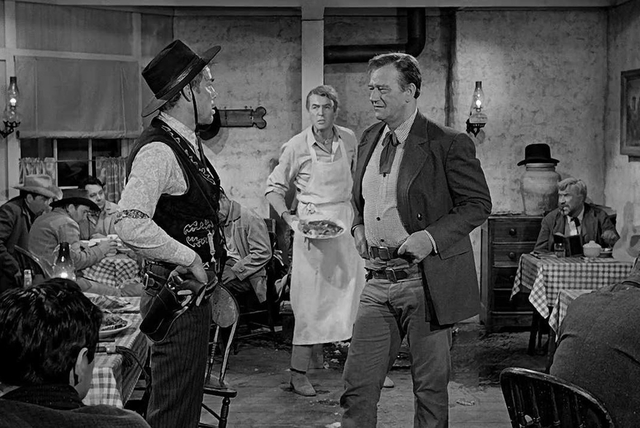
The next confrontation with Valance comes on a night when everyone's been paid and fill the streets looking for a meal, a drink and a fight. Valance arrives at the Ericsons and bullies Ranse, tripping him while he carries a tray of food, which brings Tom to his feet – the only man who seems to frighten Valance. Ranse discards his dignity and picks up the plates and food while Tom and Valance stare each other down.
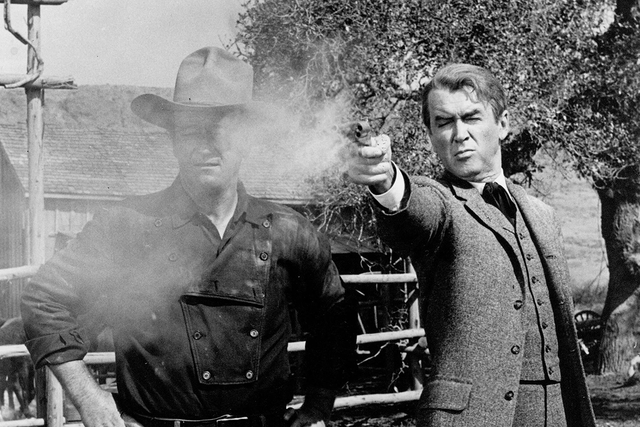
Rance doubles down on his efforts to civilize the town, hanging the shingle for his law office outside Peabody's newspaper and opening a school in a back room, where he teaches Hallie, Pompey and Link's huge brood of children how to read while giving them civics lessons. He's also hedging his bets with target practice.
His efforts to civilize the town and its citizens have a looming deadline in the coming convention on statehood, which pits the big cattle ranchers on one side of the Picketwire against the small farmers and merchants on the other and in the towns. Valance is in the pay of the ranchers and putting together an armed gang of criminals and mercenaries to intimidate their opponents; when one of the townsfolk mentions the "sheep wars" at least some of the audience in 1962 would remember the range wars and cattlemen's wars and the Johnson County War in particular, which erupted into small-scale civil wars on the frontier in which the government didn't necessarily defend the interests of homesteaders.
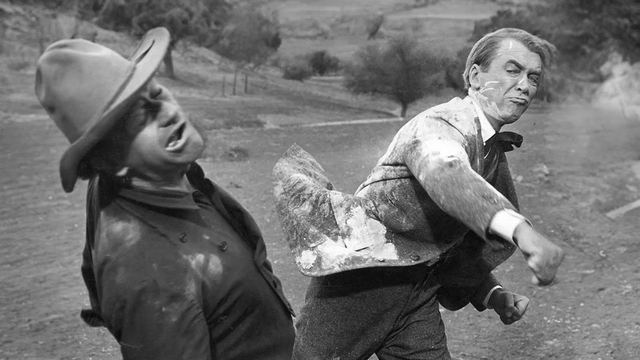
Curious to see how well Ranse can shoot, Tom brings him to his ranch and has him set up paint cans as targets. When it becomes obvious that Ranse is more of a danger to himself, he tricks him by shooting the cans on fence posts over his head and covering Stoddard and his suit in paint. Enraged, the lawyer takes a swing at Tom that connects solidly – the first time the tenderfoot earns Tom's respect.
At the town meeting to elect delegates to the convention Ranse tries to nominate Tom but gets turned down; Tom, in turn, nominates Ranse to general acclaim and Peabody gets added to the delegation but when Valance tries to muscle his way in he discovers that Stoddard has become a rallying figure for the town's opposition to the big cattlemen in general and him in particular. He vows to return for revenge.
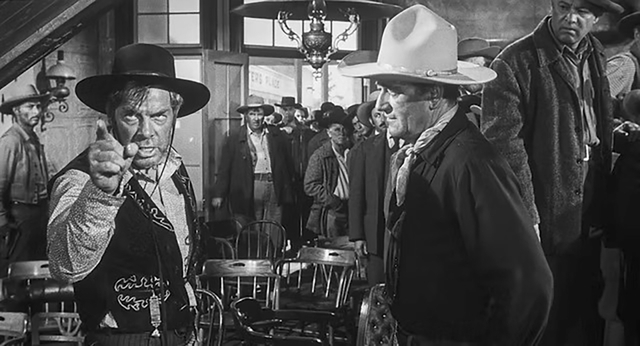
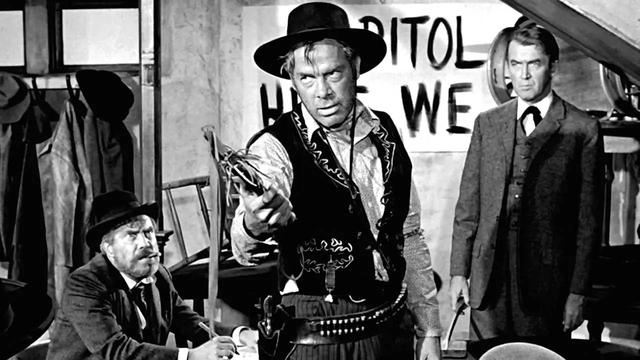
When the night of the showdown comes Valance and his henchmen Reese (Lee Van Cleef) and Floyd (Strother Martin) corner Peabody in his newspaper office, smashing up the place and beating the newspaperman nearly to death. Ranse comes out to meet Valance in the street and the outlaw, even drunk, toys with him and wounds him in his shooting arm, but just before Valance can deliver his coup de grace Stoddard gets a lucky shot and Valance drops down dead.
The town rises up behind their new hero, but when Tom walks in on Hallie ministering to the wounded man with obvious tenderness, he gets drunk before riding back to his ranch and burning down his cabin. He tries to commit suicide in the flames but Pompey pulls him out and saves their horses.
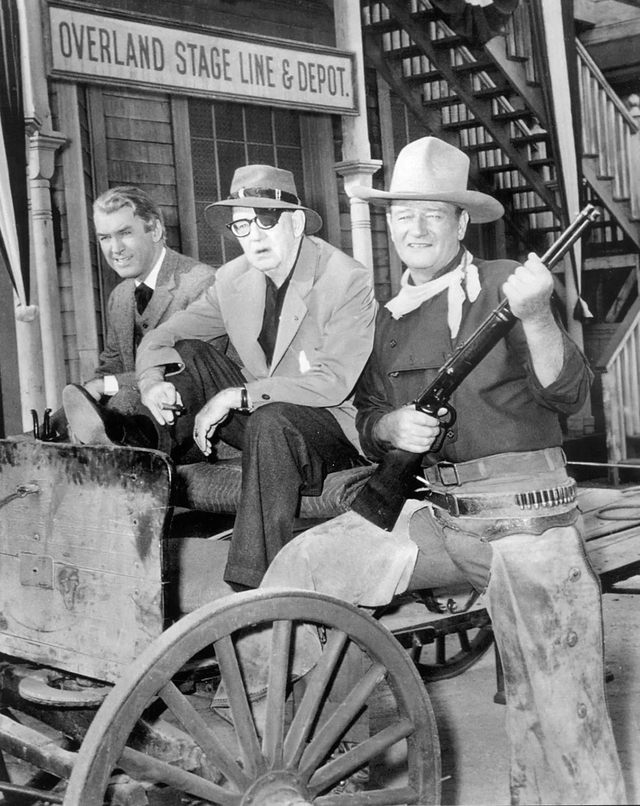
Ford was up to his customary and often cruel psychological manipulation on set; Wayne was, once again, a target despite his immense stature in the industry, and Ford reportedly took to openly comparing the star unfavorably to Strode's football career and Stewart's front-line service in the air force during the war. Old habits die hard and Wayne endured almost all of the abuse out of gratitude and genuine fondness for the old tyrant.
According to Scott Eyman in his Ford biography Print the Legend: The Life and Times of John Ford, the director took an immediate liking to Lee Marvin as both a genuine tough guy and a fellow alcoholic. He filled the cast and crew with regulars like Denver Pyle, John Qualen, Andy Devine and Strother Martin, who lived in awe and terror of the old man, who delighted in calling him "Stroker" instead of Strother.
Sitting around the set with Pyle one day, Ford remarked that Martin seemed to be losing his fear of him. To demonstrate he bellowed out "STROKER MARTIN!"
"Martin levitated out of his chair to a height of approximately three feet and hurried over," Eyman wrote. "Ford turned to Pyle. 'He didn't jump nearly as high as he used to, did he?'"
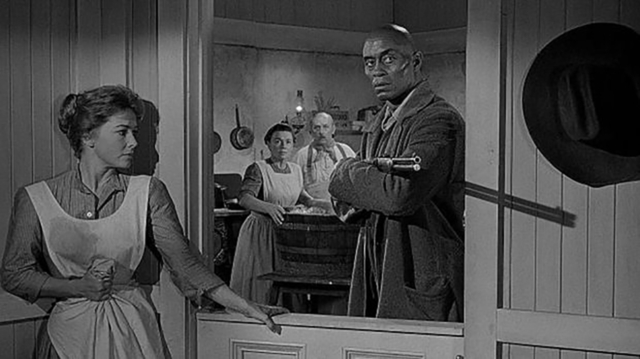
Strode's Pompey is, no surprise, in a frustrating place in the story. It's more than inferred that he's the equal of Wayne's Tom both in toughness and gunmanship, and acts throughout the film as Tom's guardian, confidante and muscle. We can't help but speculate on their backstory: was he a freedman or an ex-slave? Where and how did they meet and why was Pompey loyal to Tom literally unto death? Ford's film lends Strode's character immense unspoken authority but offers no answers.
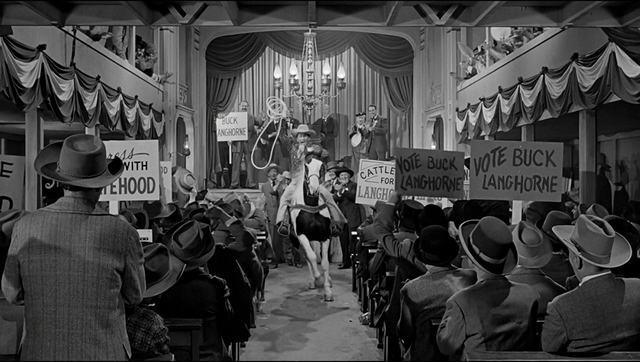
Rance arrives at the statehood convention a hero to homesteaders and townspeople but a villain to the big cattlemen, who arrive with bands and trick riders and a mouthpiece – a bombastic orator named Major Cassius Starbuckle (John Carradine) who tries to paint Valance as an innocent victim while Ranse is trying to ride his murder into a bright political future.
Sickened that the violence he deplores might have succeeded where the law didn't, Stoddard is about to leave the capitol when Tom shows up and tells him that "You talk too much, think too much. Besides, you didn't kill Liberty Valance." In a nestled flashback Tom explains that while Rance was wounded and staggering, he'd used Pompey's rifle to kill Valance in cold blood. If he wants to lead the delegation against the cattlemen – and Tom is insistent that he should – he can do it with a clean conscience.
The long flashback ends as Stoddard finishes his story and the newspaper editor fills in what followed: "Three terms as governor, two terms in the Senate, Ambassador to the Court of St James, back again to the Senate, and a man who, with the snap of his fingers, could be the next vice president of the United States." He might have propelled himself there on a lie, but he was the right man for the job, or so we're meant to understand. The editor burns his notes and Stoddard guesses that he won't print the story. What follows is the most famous quote in Ford's movie – perhaps one of the most repeated quotes in Hollywood history:
"This is the west, sir. When the legend becomes fact, print the legend."
If The Man Who Shot Liberty Valance had begun with the stagecoach robbery and ended with the final showdown with Valance, it would have been an oater – a b-western just over an hour long, meant to play on the bill between the cartoon and the main feature, the work of a b-movie director like Thomas Carr or Edwin L. Marin. It might have even used Gene Pitney's theme song and done serious business for the studio.
The film Ford nestled into his flashback is more like Abilene Town than The Searchers – told with broad strokes, filled with comic relief from Devine and Qualen and big, bad villains like Marvin, Van Cleef and Strother Martin adding a perverse streak to his sociopathic henchman. It's studio-bound and pointedly lacking the epic scope of Ford's signature classics. For long stretches it's undeniably corny.
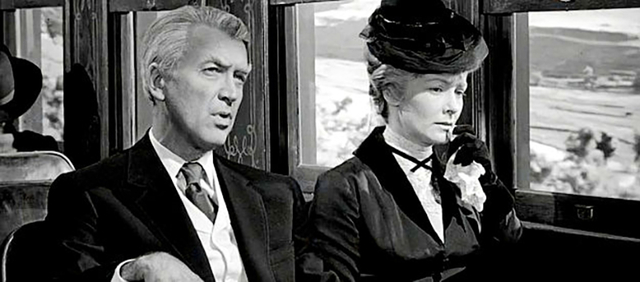
The framing scenes give the film its power. Devine plays the elderly Link like he had the comic relief baked right out of him, and when we meet Tom for the first time we already know where he's going to end – bootless and obscure, headed for a pauper's grave, a man clearly much reduced from the man in his prime, based on the look on Stewart's face when the coffin lid is lifted for him.
When Stoddard asks Hallie what she'd think about moving back to Shinbone instead of being the wife of the vice-president, it's obvious that he wants to make something up to her – to make amends for taking her away from her home and her roots, perhaps even from the man that, in the end, she truly loved. Much of the critical musing over Ford's film is evenly divided about how much feeling, if any, Hallie had for her distinguished husband, and it's only one of the character notes Ford uses to nail the ultimately sorrowful, elegiac tone of the film in place.
When people say that The Man Who Shot Liberty Valance was Ford's last western, they're pointedly ignoring his Civil War segment in the 1963 epic Cinerama anthology How The West Was Won (with Wayne as William Tecumseh Sherman and Raymond Massey as Lincoln) and Cheyenne Autumn (1964), his attempt to make a western wholly sympathetic to Native Americans and a resounding flop.
The Man Who Shot Liberty Valance was Ford's last hit western, and that's probably why so many of his fans want to remember it as his final statement, with a massive performance by Wayne at its centre, "again making rage and disappointment palpable," as Eyman writes. "He knows that on some level, when he kills Valance, he is killing himself."
It's the perfect film to cite if you want to pinpoint the end of the Hollywood western before it was remade by revisionists. "In Liberty Valance," Eyman says, "(Ford) begins with myth and methodically dismantles it on the way to a mournful irony, utterly undercutting the newspaperman's aphorism that has become famous."
"The only true agent of power is time itself," he writes, noting that "the gap between the firmly idealistic Stoddard and the bloviating windbag he becomes is heartbreaking. Stoddard, Hallie, and Link Appleyard are all haunted, and everything is changed, changed utterly, except for the desert. Everybody has gotten what they thought they wanted, but nobody is happy. Welcome to the twentieth century."
Club members can let Rick know what they think by logging in and sharing in the comments below, as access to the comments section is one of many benefits that comes along with membership in the Mark Steyn Club.