There's not much more to say about Christopher Nolan's forthcoming movie, The Odyssey, until it appears this July. Homer fan that I am, I hope the movie turns out to be much better than early indications suggest. If it does, I'll be thrilled my concerns were misplaced.
But regardless of how the movie turns out, there's an odd little side story to this whole thing. It might be of interest to SteynOnline readers.
The story goes like this:
In November 2017, book publisher W. W. Norton & Company released a new translation of The Odyssey. Produced by an unknown classics professor, the new translation in normal times would have attracted little notice.
After all, readers that year had a dozen or so credible in-print Odyssey translations to choose from. The most popular was the 1996 Robert Fagles translation, published by Penguin. Beautifully packaged, and featuring a stellar introduction by renowned classicist Bernard Knox, the Fagles translation had won numerous awards, made its way on to high school and college curricula, and sold over a million copies. It was also available at most bookstores.
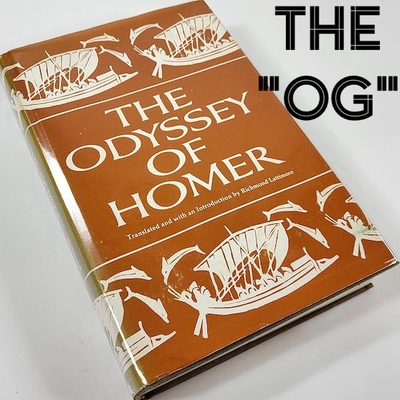
Then there was the 1965 translation produced by Richmond Lattimore, the "OG" American translator of Greek classics. Published by Harper and Row, the Lattimore remained a favorite of university professors keen on the most literal translation possible. Other in-print translations included the Mandelbaum (Bantam), Rieu (Penguin), Murray (Loeb), Shewring (Oxford), Fitzgerald (Vintage/Random House), Hammond (Bloomsbury), Verity (Oxford), Powell (Oxford), Lombardo (Hackett), and a few others.
In addition to all those rival translations, the crew over at W. W. Norton faced another commercial challenge: 2017 readers weren't exactly clamoring for 600 page, 3000 year old Greek epics. Plummeting educational standards; growing indifference to (and antagonism toward) Western civilization; dopamine-hit diversions like YouTube, Instagram, Facebook, Twitter, 800 cable channels, TikTok, Netflix, HBO; plus the advent of doomscroll addiction, all suggested the market would be limited. In that commercial environment, attracting any notice at all for a new version of The Odyssey would be tough.
But as it happened, 2017 wasn't a normal year. November 2017 wasn't a normal month. It wasn't normal, because only one month earlier, an already-rising trend had exploded with Vesuvian intensity: the #MeToo movement.
The movement's founder, Tarana Burke, had started #MeToo over a decade earlier as a way of expressing empathy for victims of sexual abuse. Yet it remained largely unknown until October 15, 2017. That was the day television actress Alyssa Milano tweeted out her support, asking all women everywhere to share the hashtag #MeToo if they'd ever been sexually abused.
Overnight, tens of thousands of women began posting their abuse stories on social media, each seemingly more lurid than the one before. Famous and non-famous women alike began accusing their alleged harassers by name. In a trend which continues to this day, it even became popular for women (evidently with nothing more heinous to report) to begin recounting the "trauma" of being asked out on a date, wolf-whistled, or hit on by unattractive men. Certain countries even began moving to criminalize whistling at women, equating it with physical violence, and even murder.
The many thousands of stories distilled down to a single blunt claim: men everywhere were, in effect, tyrant-rapists. Women were victims. Men were tyrants because they still disproportionately held positions of power and status. They were rapists, because... well, because even if they hadn't actually raped anyone, they secretly wanted to. But also, because they raped women in other ways — metaphorical ways — just about as bad. Like when they"stare-raped" you (gazed in admiration at your beauty). Or "psychologically raped" you by making kissing noises. Or didn't put on a condom during consensual sex when they said they would. In fact, America had a rape culture; it was almost as bad as Afghanistan. Plus, Orange Hitler was now president: that proved we were only months, maybe even weeks, away from The Handmaid's Tale. Misogyny was everywhere. It was so pervasive, even some women had internalized it; the proof was, some women occasionally questioned the veracity of certain abuse stories, or rejected the demonization as false and unfair.
Women were rising up. They'd had enough. Men had benefited from centuries of patriarchal tyranny. Now they needed to atone. How? A million ways. One way was, they needed to stop promoting qualified men in their businesses, and promote less qualified women instead. If they didn't, they needed to be referred to a Human Resources star chamber, where they would inevitably be found guilty and punished.
Another way was, men needed to "believe all women" no matter what they said, evidence be damned (not least because the concept of evidence itself was probably just a "patriarchal construct"). Any man who didn't believe a woman was just like the loathsome criminal pig, Harvey Weinstein.
Through it all, women needed to keep accusing men of sexual harassment whenever they felt like it. Yes, this would mean some innocent men were falsely accused. But that was a price worth paying to destroy the suffocating, Taliban-esque stranglehold men had on women. As Teen Vogue columnist Emily Lindin put it: "I'm actually not at all concerned about innocent men losing their jobs over false sexual assault/harassment allegations. If some innocent men's reputations have to take a hit in the process of undoing the patriarchy, that is a price I am absolutely willing to pay."
And on the tumult raged. For the most part, men either kept their heads down, or loudly echoed the #MeToo broadsides in hopes of winning female admiration and insulating themselves from accusations. Most women exulted.
Now, you might be asking what any of this has to do with Christopher Nolan's forthcoming movie. As it happens, that question has a strange answer. More on this next week.
If you missed Tal's Odyssey Parts I-III, you can read them here, here, and here.