
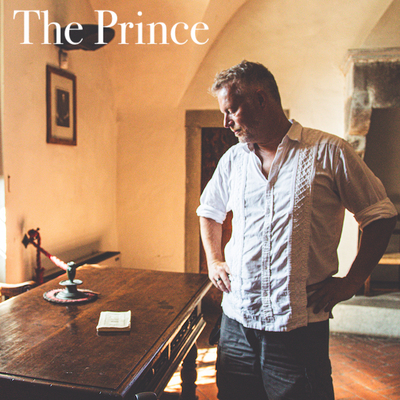
I ran my fingers over the smooth walnut desktop. It certainly looked old enough. Could this really be the actual desk? It seemed very unlikely, but then, this was Europe, Italy, Tuscany. A lot of things - ancient by North American standards - were still around.
I wandered into the next room - a small front room - then into the kitchen, then into a main dining area. I looked inside the small privy, poked around the recessed book shelves, examined the masonry around the fireplace. Everything genuinely looked and felt centuries old: the white plaster, the darkened stairs leading up to the second storey, the timber ceiling beams and wall panels, the hewn stone kitchen counters and basins, the age-rippled window glass, the floorboards, and more. The faint smell of must completed the picture.
But the desk... a desk is movable. Surely that can't be THE desk.
I popped outside into the afternoon sun. A dozen caterers in white criss-crossed the villa's tiled courtyard carrying supplies to the lower yard for a private corporate dinner that evening. I finally spotted someone who looked managerial.
"Scusi, parla inglese?"
"Lee-ttle", he said.
"Do you happen to know if that desk in there is Machiavelli's original desk?"
"Yes", he said. "Desk original from him. Many centuries".
I slipped back inside the house and had a closer look. I wasn't exactly an expert in antique furniture, but I couldn't find any indication of modernity. Maybe, I thought, this really is the very wood on which the most notorious political thinker in history had written his most famous - or should I say, his most infamous - book.
I'd read Machiavelli's The Prince many times. Pondered its fiendish teachings as I watched political events. Wondered how true, or at least universal, the suggestions really were. I'd even started translating the text myself a few months earlier, just for fun. Machiavelli's Italian wasn't all that different from Spanish, so I could get quite a bit of it. With a bit of study, I got the rest. Now, here I was, standing in the very room he'd written the book in, touching the very desk he might have used.
It was in that moment I remembered a letter Machiavelli had written once, to a friend, about writing in that very room:
When evening has come, I return to my house and go into my study. At the door I take off my clothes of the day, covered with mud and mire, and I put on my regal and courtly garments; and decently reclothed, I enter the ancient courts of ancient men, where, received by them lovingly, I feed on the food that alone is mine, and that I was born for. There, I am not ashamed to speak with them and to ask them the reason for their actions; and they in their humanity reply to me. And for the space of four hours I feel no boredom, I forget every pain, I do not fear poverty, death does not frighten me. I deliver myself entirely to them...I have composed a little work (The Prince), where I delve as deeply as I can into reflections on this subject.
The book itself opens with a quick description of the different types of states, and then concludes the first paragraph with an important sentence. New dominions, says Machiavelli, are acquired o con le armi di altri o con le proprie, o per fortuna o per virtù - that is, they're acquired "either with the arms of others or with one's own, either by fortune or by" - drum roll - "virtù". That's the word in Italian. The question is how to best translate virtù into English.
You might say, "virtue". And you wouldn't entirely be wrong: of course the Italian virtù and the English virtue are cognates. The problem is that in the Tuscan Italian of 1513, virtù carried important connotations which no longer exist in contemporary Italian, and don't exist in English. "Virtue" these days, in either language, refers to an ethical attribute; it describes something good or moral. But in Renaissance Italian, it still retained an older meaning - one unaligned with anything specifically ethical. That older meaning merely described a certain kind of manly excellence, skill, power, prowess, or virtuosity: the Latin root of virtù is vir, meaning man; virility, like virtuosity, traces back to the same root. (The only remaining echo of this meaning in English or Italian, that I know of, lies in the idiom "by virtue of" - which attributes some authoritative force to something: "The agreement remained binding by virtue of state law", or "Dan became captain by virtue of his experience".)
To make matters even more challenging for the conscientious translator, Machiavelli pushes this older meaning to its extreme end throughout The Prince. In fact, his use - or as some might have it, his abuse - of the word virtù drives the main theme of the book.
In brief, what Machiavelli argues is that the political realm has its own rules - its own sort of morality, if it can even be called that. This morality is entirely unlike Christian morality, Aristotelian morality, or commonsense folk morality. Thus, the meaning of "virtue" and "vice" in the political realm differs from the meaning in other contexts. Failure to understand this and act accordingly will bring ruin to any aspiring ruler.
So, according to Machiavelli, a "virtuous" ruler isn't necessarily a good man. In fact, he can't be a good man by any normal definition; if he were, he'd inevitably fail as a ruler. After listing off some admirable moral qualities, Machiavelli says this:
"It is not necessary, then, for a prince to have in fact all of the qualities written above, but it is indeed necessary to seem to have them... when these qualities are possessed and always observed, they are harmful; but when they seem to be possessed, they are useful. So it is useful to seem compassionate, faithful, kind, honest, religious... a prince cannot observe all of those things for which men are believed good, since to maintain his state he is often required to act against faith, against charity, against kindness, and against religion".
A virtuous ruler, in other words, is simply a political virtuoso: a ruler who knows what it takes to acquire and use power effectively, and has the guts to do it.
Machiavelli points, albeit with deliberate doublespeak, to a real-life example in Chapter VIII The Prince. After describing the rags-to-riches rise of the Syracusan king Agathocles, he writes:
"Whoever thus considers the actions and life of this man will see nothing, or little, that can be attributed to fortune; for what he gained, as was said above, wasn't from anyone's favors, but from his rise through the ranks of the militia with a thousand hardships and dangers - which principate he then, moreover, maintained with many bold and dangerous acts. Still, one cannot call it virtue to kill his fellow citizens, betray his friends, be without faith, without mercy, without religion... For if one were to consider Agathocles's virtue in entering into and emerging from dangers, and the greatness of his spirit in enduring and overcoming adversity, one sees no reason why he should be judged inferior to any of the most excellent commanders. Nevertheless, his savage cruelty and inhumanity, together with countless wicked deeds, do not allow him to be celebrated among the most excellent men."
I'm not sure if you caught that: in one sentence, Machiavelli concedes that one can't describe Agathocles' wicked actions as amounting to "virtue"; yet in the very next sentence, he does exactly that. In other words, it wasn't that Agathocles' sensational political success occurred in spite of his "savage cruelty and inhumanity", but precisely because of them. And this means Agathocles' wicked acts did amount to virtue; it was just a kind of "virtue", Machiavelli tacitly points out, which can't be openly acknowledged or admired as such: the virtue of doing what it takes.
As you read through The Prince, you can almost hear Machiavelli saying, hey - I didn't create this world. I'm just explaining how it actually works. If that's anyone's fault, it's God's - except there's no reason to believe God even exists. And so, the aspiring ruler can and must do whatever it takes to succeed, without fear of divine disapproval.
This is Machiavelli's conception of, or redefinition of, virtù. It is the main theme of the book. Yet as Harvey Mansfield notes in his book Machiavelli's Virtue, often "Machiavelli's translators have difficulty in rendering virtù". Indeed they do, and where they don't get it right, the reader has no chance to grasp just how radical or disturbing Machiavelli's morality-inverting argument is. Where they do get it right, we get the chance to engage with one of history's subtlest and most challenging political thinkers. This raises the question of whether there's some specific set of principles which ought to guide the translation of great books, and if so, what they might be.
More next time.
If you missed Tal's first Art of Translation column, you can find it here. And if you want to leave a comment, you know the drill!