

Maybe you're wondering why you should care about Machiavelli's virtù, or how it might appear in English translation.
The truth is, I don't know that you should. Maybe I shouldn't, either. After all, it's likely none of us will ever run for office. Maybe Machiavelli's teachings have no relevance in any remotely civilized political system. Maybe they're far worse than irrelevant: maybe they're all entirely evil (as they appear), and in addition, would prove the ruin of both the people and their ruler.
This was, as it happens, the view espoused by one important ruler: the Prussian king Frederick the Great. In his 1741 book, The Anti-Machiavel, he claims Machiavelli's book is "one of the most dangerous that ever appeared in the world", in that the political crimes it encourages would impose "a lasting misery upon whole nations". Truly great rulers, says Frederick, aren't the avaricious, amoral, self-serving, shape-shifting demons that Machiavelli describes. Rather, they are those "whose business it is to administer justice, and to set examples of justice to their subjects; and who, by their magnanimity, mercy, and goodness, ought to be the living images of Deity". Thus, Frederick sees his rebuttal as "a defense of humanity against a monster who would destroy it"; it is "an antidote to poison".
Frederick ruled Prussia for nearly 50 years. Most historians rate him a success. On the face of things, he seems like the kind of critic who knows what he's talking about.
But Machiavelli would say, not so fast. What did Frederick do almost immediately after assuming power? Without any provocation, he launched a war to seize the large, prosperous, populous province of Silesia (now in southwestern Poland) from the Habsburg Monarchy. And he did so on a convoluted, centuries-old dynastic claim which sounded as unconvincing to his contemporaries as it does to us now. In the three Silesian wars which followed (the third turning into the Seven Years War), well over a million soldiers died fighting. Millions more wound up maimed, psychologically scarred, or otherwise ruined. Of course, millions of non-combatants also suffered: wives lost husbands, mothers and fathers lost sons, children lost fathers and uncles and brothers. Those non-combatants also suffered displacement, terror, deprivation, and injury. Over two decades, Frederick's wars — particularly the Seven Years War — convulsed Europe. Frederick gained 30% more territory and 50% more citizens, but the cost was losing 10% of the Prussian population to combat or disease (the modern equivalent of 35 million Americans, 6 million English, or 3 million Australians). The point is: if his actions are anything to go by, Frederick didn't oppose Machiavellian power moves as much as he professed, if at all. Machiavelli might even argue that in taking pains to proclaim his opposition to Machiavelli even as his wars of acquisition injured and killed millions, he was doing exactly what Machiavelli had advised: seeming to be good even as he was doing whatever the hell he wanted, for his own purposes. Most people will buy the act anyway, says Machiavelli, so why not?
This brings me back to Machiavelli's claims about how rulers do in fact act, and how they must act to avoid ruin. And that in turn brings me back to the original wording of The Prince, and what real-world credibility Machiavelli might have as a political commentator.
As it happens, Machiavelli was no armchair quarterback. Even if he hadn't spent nearly fifteen years at the highest levels of Florentine government (which he did), he might well have qualified as a political expert just by virtue of growing up in the tumultuous time and place he did. Between the jockeying Italian states, the myriad (and ever-changing) foreign alliances and enemies and designs, the political influence of the papacy, and Florence's own internal politics, Machiavelli's home city furnished more than enough lessons in how the political world could, and often did, operate.
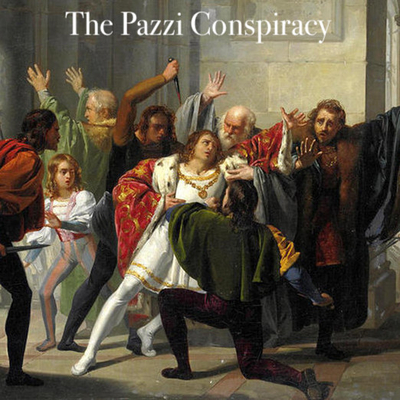
Take, just as one example, the shocking events of a crisp sunny morning in 1478 — Easter Sunday, to be exact. Bell echoing in the distance, churchgoers strolled down the cobblestone streets toward Florence's famous cathedral, looking forward to mass. Among the churchgoers walked two brothers in their twenties, Lorenzo and Giuliano de Medici, members of Florence's ruling family. Alongside them walked their friend, the 34-year-old Francesco de Pazzi (from one of Florence's most prominent families), with a few of his own acquaintances. At one point during the walk, Francesco threw a seemingly comradely arm around Lorenzo, whisking his hand down his friend's side. As the group entered the cathedral, Francesco and his friends made sure to stay close to the Medici brothers.
Mass began; and then, at a predetermined moment, Francesco and his friends slipped daggers out of their coats, leapt upon the Medici brothers, and started stabbing. (Francesco had slipped his hand down Lorenzo's side walking to church to ensure his friend wasn't wearing one of his metal protective vests under his clothes.) One of the assassins thrust his dagger at Lorenzo's throat, but only grazed it. Lorenzo drew his own knife and fought back. After a few seconds, he and a few friends leapt over the pews and ran toward the sacristy in the front of the building. In the commotion, they no doubt thought Giuliano was with them. He wasn't. He was on the floor, bleeding out, dying: one of the Pazzi assassins, Bernardo Bandini, had stabbed him in the heart. Throwing himself on top of Giuliano, Francesco stabbed his friend so furiously, he accidentally stabbed himself in the upper leg, nearly severing his own femoral artery and killing himself.
Lorenzo de Medici, locked inside the sacristy, survived. A few blocks away in the Palazzo della Signoria, another group working for the Pazzi family, including an archbishop, attempted to take over the government buildings. They failed, just as the assassins failed to take out Lorenzo de Medici. (The Pazzi Conspiracy was supposed to wipe out the ruling Medicis and install the Pazzi family in their place. Pope Sixtus IV himself had expressed support for the Pazzi family's aspirations, but hadn't condoned the violence.)
Retribution for the coup conspirators came swiftly and in spectacular fashion. Pro-Medici officials threw coup conspirators out of Palazzo building windows alive. They hanged other conspirators from those same windows. They sawed off the limbs of various conspirators, shoved them on to pikes, and in some cases, had horses drag the limbs through the city. Officials also dragged the self-wounded Francesco de Pazzi naked through the city and hanged him at the Palazzo. When the round-up was all done, the Medici regime had executed over eighty members of the Pazzi conspiracy. And just in case anyone forgot the horror inflicted on the conspirators, the surviving brother Lorenzo afterward hired Sandro Boticelli to paint murals of the conspirators' dead swinging bodies on the side of the Captain's Palace adjacent to the Palazzo. How's that for a town mural?
The last conspirator apprehended was Bandini, the man who had knifed Giuliano in the heart. He had escaped and made his way to Turkey. The Turkish sultan sent him back to Florence a year later upon Lorenzo's request. Lorenzo promptly hanged his brother's killer in the Palazzo (whereupon a local, up-and-coming, 26-year-old designer named Leonardo DaVinci would catch sight of him and sketch out the scene. You can see it here. Leonardo and Machiavelli would become close friends some years later).

In short, it would have been impossible to live in Florence without seeing the hanging dead bodies and spiked limbs, or a dozen other grotesque reminders of the conspiracy. Certainly the nine-year-old Machiavelli, who lived only a few blocks from the Cathedral and Palazzo with his family, would have witnessed the tumult, heard the stories, seen the corpses, even heard eyewitnesses recount what happened. It's even possible he and his family were in the cathedral during the murder of Giuliano de Medici.
By the time Machiavelli sat down to write The Prince nearly 35 years later, he'd not only witnessed all sorts of similar events in and out of Florence; he'd been a key player in many European political events as a top Florentine diplomat and administrator. He'd even grown personally friendly with some of the most powerful European men of his age: popes, kings, movers and shakers, powers behind the throne, and more. He'd seen a lot of ups and downs, and he himself had recently experienced a huge crash in his fortunes.
All of which is to say, maybe we actually should care about what Machiavelli has to say, if for no other reason than to try to figure out how to structure politics so that ambitious men behave better than those praised in his book. But for that, we need to get the clearest sense possible of what he writes in The Prince.
More next time on translating and understanding Machiavelli, and beyond.
You can read Part I and Part II of Tal's The Art of Translation here and here.