


Like all those musicians who say they formed bands because they bought the first Velvet Underground record, there were at least two generations of photographers who chose their profession because they saw Blow-Up, Michelangelo Antonioni's 1966 so-called "murder mystery" starring David Hemmings as Thomas, an arrogant and successful photographer in what was about to be called "Swinging London".
Deputized to stand in for all those photographers is the American Robert Whitman, who recalled in a 2018 interview that "in those days people were very conservative; you couldn't look like this and get a job. I never wanted to wear a coat and tie, and I never wanted to work from nine to five. I didn't know what I was doing. I was just wandering around, living on the beach. I just wanted to be free and have freedom."
"I then saw this lifestyle of the photographer – all the beautiful women – and I said to myself that I want to be a photographer. So, the crazy thing is, I got into photography not because I had a love of photography but because I had a love of the lifestyle that photography could bring me."
Antonioni arrived in London after making the films that established his reputation as a major figure in European art cinema – masterpieces of alienation (or what critic Andrew Sarris dubbed "Antoniennui") like L'Avventura, La Notte, L'Eclisse and Red Desert. As Ali Catterall and Simon Wells recount it in their chapter on Blow-Up in Your Face Here: British Cult Movies Since the Sixties, the director was apparently there to visit Monica Vitti, his star and muse from those preceding films, while she was making Modesty Blaise with Joseph Losey.
But he was really looking for locations and inspiration for what he hoped would be his next project, an adaptation of a Julio Cortazar short story called "The Devil's Spittle" about "a jaded fashion photographer."
"I think that London is, right now, the city that offers the right background," he said in an interview for Italian TV at the time. "There is a freer atmosphere here, a sort of turmoil which is much livelier than anywhere else. London offers the best and worst in the world."
The director had arrived at a pregnant moment in London's history, after Beatlemania had disturbed the compacted soil of British society and culture and was about to re-brand the city – or a few blocks of it – as one of the most vital places to be in the world if you were young. In April of 1966 Time magazine would run a cover story on the city, coining the term "Swinging London" and noting that Antonioni "has been prowling the streets of London, looking toward making a film on – of all things – the swinging London scene."
As the magazine breathlessly reported: "This spring, as never before in modern times, London is switched on. Ancient elegance and new opulence are all tangled up in a dazzling blur of op and pop. The city is alive with birds (girls) and beatles, buzzing with minicars and telly stars, pulsing with half a dozen separate veins of excitement. The guards now change at Buckingham Palace to a Lennon and McCartney tune, and Prince Charles is firmly in the longhair set."
As Catterall and Wells write, "following the phenomenal success of, among other things, the first three Bond flicks, Tom Jones and A Hard Day's Night, United Artists was declaring record profits. American money now poured into the British film industry and all the Hollywood majors and some independents set up production arms in London, which was fast superseding Rome as the world's trendiest capital."
But it's been said many times that while London might have been swinging – or more particularly a few dozen blocks in the west end – but it was still grim up north and pretty much everywhere else. We get a glimpse of this other England when we see Thomas emerge, unshaven and wearing shabby clothes – from spending the night in a homeless men's shelter or "doss house."
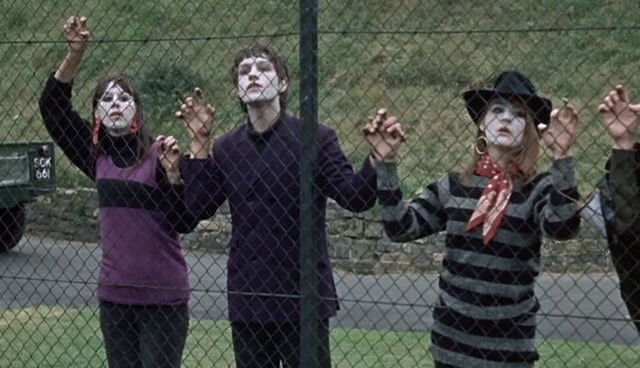
The Camberwell Clinic in Peckham, once the Camberwell Work House and known colloquially as "the Spike" – was a notoriously grim place, closed in 1985 and converted into residential housing, though the graves of former inmates still lie under the tarmac road. This is cut between shots of a group of students celebrating rag week in whiteface mime makeup, clinging to a Land Rover as it careens past the Economist building in St. James.
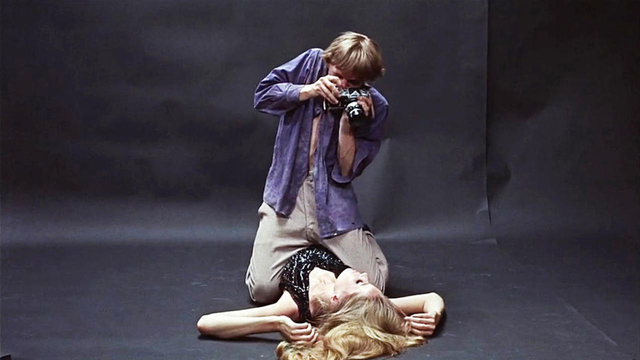
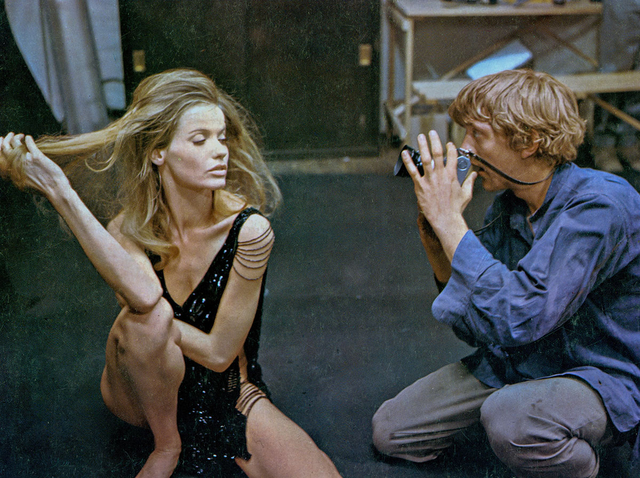
Thomas, who has been taking photos of the doss house inmates with two Nikons concealed in a paper bag, leaves his down and out companions and furtively sprints away to where he's parked his Rolls Royce Silver Cloud, which he uses to drive to his photography studio in Holland Park. Waiting for him is the model Verushka, kept waiting for half an hour, so Thomas gets right to work, straddling the spectrally thin young woman in her beaded shift while his assistant hands him freshly loaded cameras.
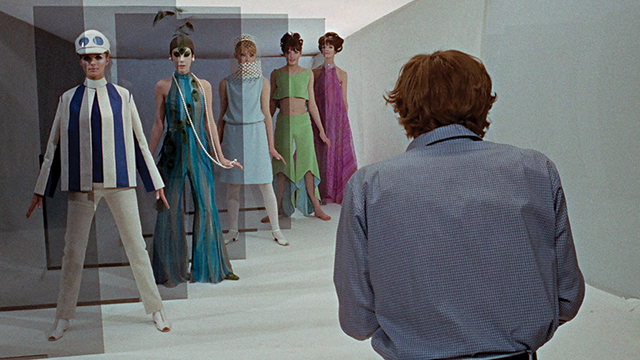
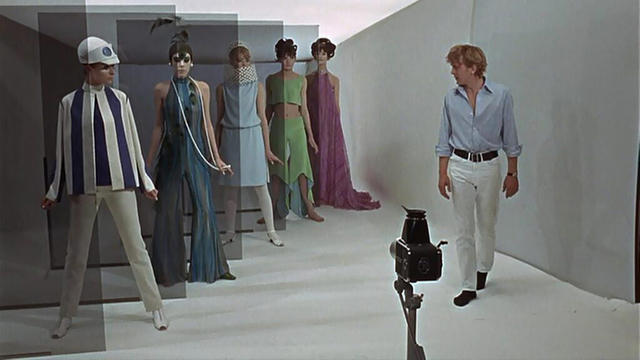
Freshly shaved and changed into his uniform for the rest of the film – white jeans, a blue shirt and a green velvet jacket – Thomas moves on to his next assignment for the day. A quintet of models including Jill Kennington and Peggy Moffitt, dressed in the newest and most outlandish fashion of the moment, pose between panels of smoked plexiglass for the unimpressed photographer, who barks out his disappointment before telling them to take a break and close their eyes.
He leaves them like this and, after holding off a pair of young wannabe models (Jane Birkin and Gillian Hill) who've bluffed their way into his reception, he jumps back into the Rolls to look at an antique shop he wants to buy. The photographer John Hooton worked for fashion photographer John Cowan, whose studio Antonioni had rented for three months as a location; recalled the shoot on his blog in 2010 where he noted that "some photographers were making so much money in the '60s that it became almost compulsory to own another business in order to offset the crippling 90% tax burden for high earners. Antiques or restaurants conveniently fitted the lifestyle," as did writing off the expense of running a Rolls Royce.
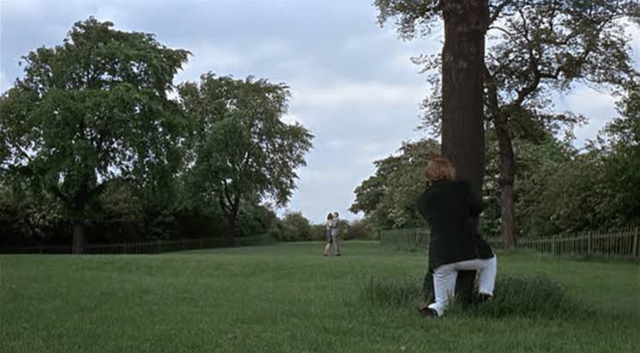
While waiting for the owner Thomas wanders into a nearby park, which is deserted except for a young woman and an older man who are having a romantic rendezvous. Maryon Park in Greenwich was a former sandpit that Catterall and Wells in Your Face Here describe as "a fantastical, primordial place – and largely deserted. When the authors last visited it, one of us saw a ghost, a translucent, rather sorrowful apparition hunched by the top path." Excavations in the early part of the last century revealed the earthworks of a Roman camp, while nearby woods once hosted public hangings.
Thomas follows the couple and begins snapping away while the woman, Jane (Vanessa Redgrave), becomes increasingly distracted and agitated by him. She follows him as he leaves the park and asks him why he thinks he has the right to intrude on her privacy with his camera. "I'm only doing my job," he replies. "Some people are bullfighters. Some people are politicians. I'm a photographer."
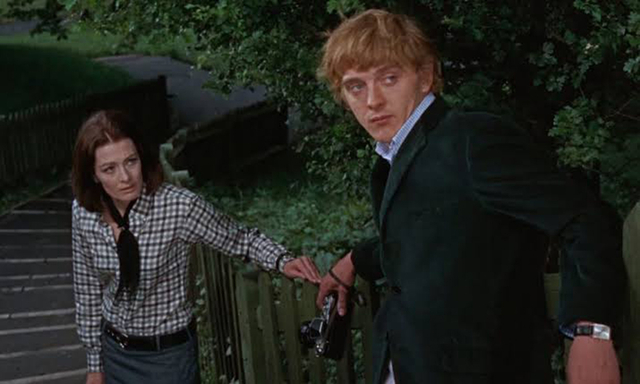
She tries to take his camera unsuccessfully, then turns and runs back up the paths to where her male companion is presumably waiting while Thomas keeps snapping. The park is a hauntingly stark space, which Antonioni accentuated by having a row of nearby houses painted white, the paths black, the fences a darker shade of green and, according to production designer Assheton Gorton, even the grass a more vivid hue.
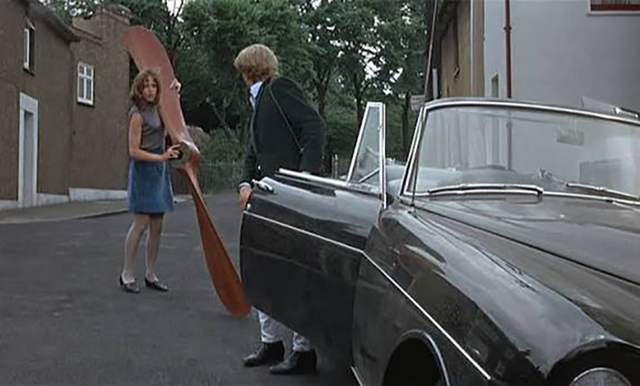
Returning to the antique shop, Thomas finally meets the owner, a young woman (Susan Brodrick) who says she's gotten tired of old things and running the place and wants to go to Nepal. Thomas tells her that Nepal is just full of even more old things and she asks if Morocco might be a better spot. He sees an old wooden propellor, becomes more enthusiastic than we've seen him at any point in the film and insists that he has to have it.
While preparing to make the film Antonioni had read an article by Francis Wyndham in a May 1964 Sunday Times Magazine about the new generation of hip young photographers who were injecting new energy into fashion with their energetic work, in particular the "black trinity" – a trio of bad boys and friends: Terence Donovan, Brian Duffy and David Bailey. Bailey in particular wanted to get into filmmaking and producer Carlo Ponti had tried to turn Wyndham's article into a film to be directed by Bailey. And then Antonioni showed up in London talking about making a film about a photographer.
Terence Stamp, co-starring with Vitti in Modesty Blaise and a friend of Bailey's, was meant to play Thomas and even said later that the role had been written for him. His famous model girlfriend Jean Shrimpton, formerly the girlfriend and muse of Bailey, was offered the part of Jane, but two weeks before shooting was to start he was phoned by an assistant director and told that he and Shrimpton were out. Stamp sued Antonioni, Ponti and MGM for breach of contract and defamation of reputation and won, and said later that "I never saw Antonioni again. There was not a word of apology or anything."
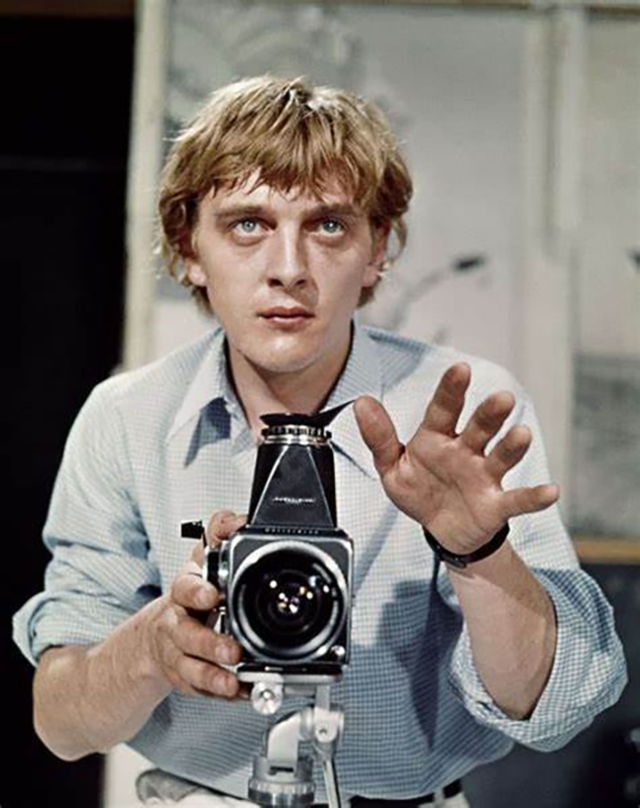
Antonioni had decided on a relative unknown – a young man who had mostly appeared on TV and in b-movies who the director had seen in a production of Dylan Thomas' Adventures in the Skin Trade. David Hemmings had been a child actor, a cabaret singer and a painter and turned out to be a quick study, capturing the essence of a photographer like Bailey while being tutored on handling cameras by photojournalist Don McCullin, who shot the doss house photos as well as the other arty documentary work that we see Thomas discussing for a future book with Ron, his agent (Peter Bowles).
It's assumed that Thomas is modeled on Bailey, thanks to the faint resemblance between Hemmings and the photographer, and because Bailey was by far the most notable of all his hip photographer peers. His work had something to do with it – he has produced some iconic images to be sure – but Bailey's good looks were no small factor. Duffy and Donovan might have been his equals in talent but they simply didn't look as good in front of the camera.
The director had met with Wyndham as well as Bailey and Donovan, but according to Catterall and Wells the photographers hadn't been particularly helpful. "I never talked to Antonioni," Bailey said. "He didn't like me because he thought I was after his girlfriend."
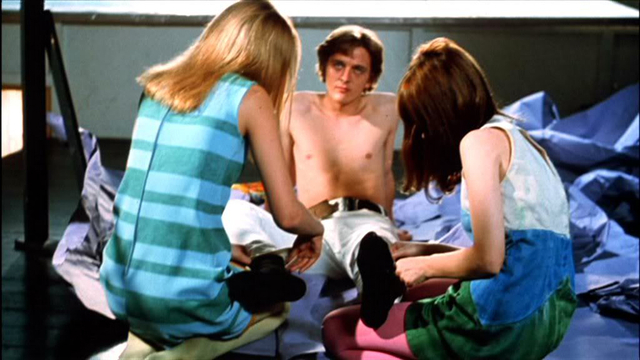
Back at the studio Thomas finds the two aspiring models at his door again. He invites them in and tells them to go through the clothes on the racks in the studio, which turns into a very rough seduction, with Thomas pulling the clothes off Birkin and Hills before they do the same to him. The National Catholic Office for Motion Pictures in the United States – a more effective censor at that time than the nearly-dead Production Code – demanded cuts in this scene; Antonioni refused and Ponti worked some diplomacy in Rome that somehow got Blow-Up around a ban.
Birkin, of course, would go on to become a major face of the youthquake in Britain and France, while Hills would reprise her role in a similar threesome with Malcolm McDowell and another blonde in A Clockwork Orange (a film that Bailey had tried to make before Kubrick got the rights to Anthony Burgess' book). The scene – indeed, most of the film – is remarkably unsexy, but that didn't stop it becoming a big draw for male audiences and MGM noticed later that prints were being returned to them with Birkin and Hill's scenes pruned "by rampant projectionists for later, more private use" as Catterall and Wells write in Your Face Here.
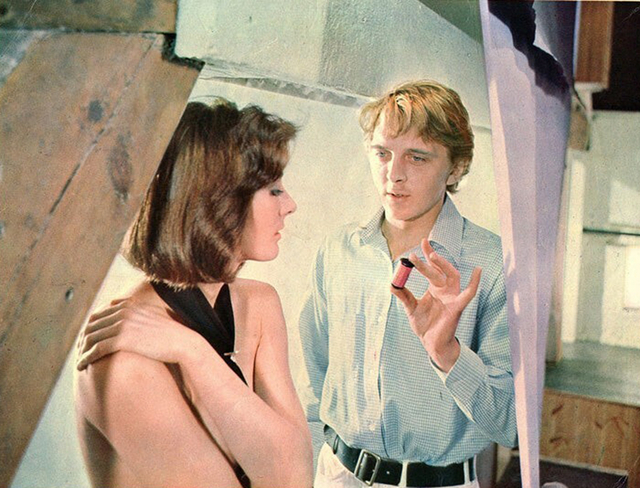
Thomas also gets a visit from Jane, still intent on getting his photos from the park. Redgrave was part of a theatre and acting dynasty, the daughter of Michael Redgrave and Rachel Kempson, whose birth had been announced by no less than Laurence Olivier from the stage of the Old Vic, where her father was playing Laertes opposite Olivier in Hamlet. She was married to Tom Jones director Tony Richardson and had just got an Oscar nomination for her part in Karel Reisz' Morgan: A Suitable Case for Treatment. She was a known quantity as an actress and it's no surprise that Antonioni would choose her over an untested talent like Shrimpton.
Jane tries to steal Thomas' Nikon again and, growing desperate, takes off her blouse (though Redgrave is allowed to hide herself more modestly than Hills or, especially, Birkin). Thomas gives her a roll of film after switching out the one from his camera in his darkroom. She, in turn, gives him a telephone number that turns out to be false.
Piqued by all the interest in his photos, Thomas spends a long night in the darkroom enlarging and blowing up details of the pictures, at one point using a camera to take a picture of a detail of an enlargement – taking a photo of film grain, basically. He sees Jane looking pensively into the bushes and picks out a man's hand holding a gun there, and finally spots what looks like the shape of a man's body lying on the grass.
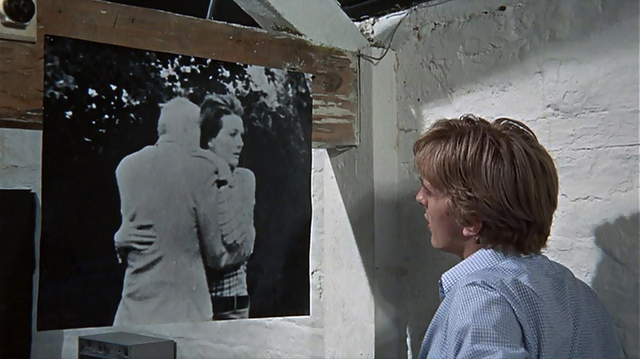
He goes to the park – without a camera, for the first and only time – and finds the corpse of Jane's older lover under a bush but is scared by a snapping twig and leaves. He returns to finds his studio ransacked and his enlargements gone. Driving along Regent Street he sees Jane looking in a shop window but loses her by Heddon Street (location of the cover of David Bowie's Ziggy Stardust album cover) where he enters the Ricky Tick Club (which was actually in Windsor, though Antonioni had the interior recreated at Elstree Studios because the ceiling in the club was too low for his lights).
The director had originally planned to have The Who (co-managed by Terence Stamp's brother Chris) perform on the stage at the Ricky Tick but they turned him down, and after considering the Lovin' Spoonful and the Velvet Underground he settled on The In Crowd, later known as Tomorrow, a band now relegated to footnote status. He had them record two songs for the soundtrack, but he was alerted to the availability of another group who were briefly making a big impression on both sides of the Atlantic.
The scene with the Yardbirds performing for a dead-eyed crowd of hipsters is another reason for Blow-Up's popularity over the years, as it's one of the few documents of the band's lineup with both Jeff Beck and Jimmy Page on guitar, though it mostly serves to give rock nerds a chance to complain. First of all, Antonioni wanted Beck to copy The Who's Pete Townsend's trademark guitar smashing, which he does using a cheap prop guitar Beck was never known to play, and with unconcealed distaste.
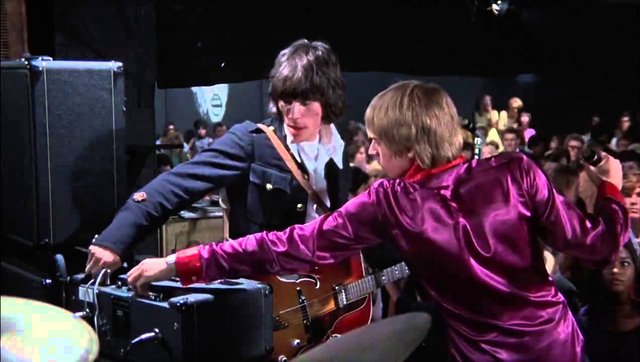
While the band lip-syncs indifferently to one of their live set highlights, a cover of "Train Kept a Rollin'" – the lyrics rewritten as "Stroll On" for copyright reasons – Beck sullenly pretends to lose patience with a faulty amplifier and busts up his guitar before throwing it in the crowd, who turn into a crazed mob. Thomas jumps into the fray to grab the guitar neck and runs out of the club with the crowd in hot pursuit. Back on Regent Street he immediately loses interest in his prize and discards it on the sidewalk.
Thomas finds his agent, Ron, nearly insensible at a party at ultra-fashionable Cheyne Walk in Chelsea, for which Antonioni had MGM cater a week-long blow-out for what turned out to be the London scene's elite. One partygoer recalled that "I was flung into this bedroom, plonked on the front of this bed with about nine people on it as Antonioni tossed a couple of kilo-bags of grass on the bed and said 'Right, get on with it.' It took five days. It just went on and on. Nobody wanted to stop...people would just stumble out going 'yeeeaahhh' and go gibbering back."
Thomas wakes up the next morning in an empty house and makes his way back to the park to find the body gone. The rag week students on their Land Rover return and Antonioni conspires to make his film end with the assistance of mimes. Two of the students pretend to play a game of tennis on the park's court while their friends watch raptly. When the imaginary ball is hit over the fence, one of the mimes asks Thomas to pick it up and throw it back; he continues watching the game as the sounds of real volleys fade on to the soundtrack. The camera cuts to a wide shot of Thomas standing on the grass, from which he fades – a classic Antonioni ending, more erasure than climax.
"When Blow-Up appeared in 1966," Peter Bondanella wrote in Italian Cinema from Neorealism to the Present, "the critics and reviewers reacted as if Antonioni had tackled – and largely resolved – most of the weighty problems of Western metaphysics." It's a bold claim, and one it's hard to imagine six decades later, but the film was a hit, earning $20 million on its $1.8 million budget. Andrew Sarris judged it "a mod masterpiece" and Time called the film a "far-out, uptight and vibrantly exciting picture", which read today like uncles showing up at a wedding in a Nehru jacket.
What impresses viewers now is how hard Antonioni works to make sure everything lands to the most deflated effect possible, from the putatively sexy scenes to the gig-turned-riot to the murder drained of any mystery – less a "whodunnit" than a "whocareswhodunnit". The film's abiding cult appeal, write Catterall and Wells in Your Face Here, "(apart from its period iconography, attitude and style) surely lies in its inscrutability – those who 'get it' and those for who it remains a gorgeous/irritating enigma. The real charm of this film lies in the fact that, beyond such worthy meditations on the nature of perception and urban alienation, it isn't really about 'anything'. Ambience is all."
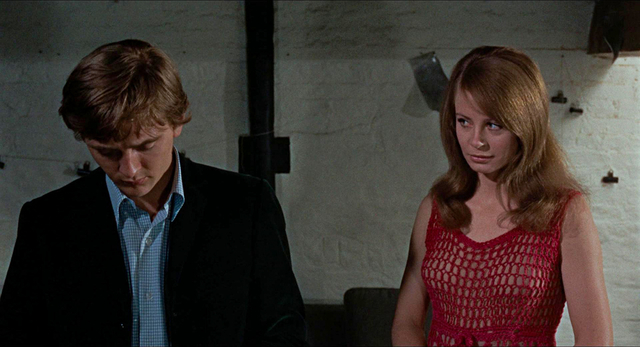
The films is carried largely by Hemmings' performance, and he perfectly balances barely contained energy with an increasingly sour realization that he's succeeding beyond his wildest dreams without a new, more fulfilling dream to see him out of his twenties. Redgrave's Jane is probably the weakest one; she's unconvincing and committed to an awful lot of acting.
And then there's the subplot that's supposed to lend Thomas some emotional heft – a hint of a threesome involving the photographer, his artist/best mate (John Castle) with whom he shares a cottage adjacent to his studio, and Patricia (Sarah Miles), the artist's girlfriend/wife with whom Thomas has some undefined romantic connection. The whole subplot could have been excised from the picture without being missed and Miles swapped into Redgrave's part; she has a better grasp of the picture's mood and presents an honest, aching vulnerability that Redgrave rarely displayed over he whole career.
It's hard to account for Blow-Up's abiding appeal without suspecting that audiences, then and now, are projecting their own private fantasy about photography or countercultures or Swinging London on to Antonioni's emotionally null but visually engaging canvas.
What can't be denied is the film's central role in a moment that it shared with pictures like Darling, The Pleasure Girls, The Party's Over, Alfie and The Knack...And How to Get It while serenely occupying the high ground in this subgenre. The moment would pass quickly enough, as revealed in Peter Whitehead's 1967 experimental documentary Tonite Let's All Make Love in London.
A year later the zeitgeist that looks so crisp and sharp in Blow-Up has burst its skin and is leaking psychedelic goo all over the linen. Irish writer Edna O'Brien gives an intermittently articulate and ultimately depressing interview about the status of young women in the new morality ("...falling in love, it's a nuisance...") while Redgrave delivers a tribute to Castro and the glories of the Cuban Revolution at a political rally, reciting Spanish with aggressively rolled 'r's as a prelude to her a capella rendition of "Guantanamera".
Julie Christie opines that "a good time is much easier had by all now than ever before." Michael Caine bitterly points out that private clubs frequented by him and his elite, swinging friends are allowed to stay open later than working class pubs whose clientele have to be at their factory posts the next morning. The soundtrack is loaded with the Stones, Vashti Bunyan, Chris Farlowe, the Animals, the Small Faces and Pink Floyd. It's the film that I think most people think they're seeing when they watch Blow-Up.
Club members can let Rick know what they think by logging in and sharing in the comments below, as access to the comments section is one of many benefits that comes along with membership in The Mark Steyn Club.