
Programming note: Notwithstanding recent health challenges, Mark hopes to be back in the chair for our Clubland Q&A tomorrow - and, at a new time! So, fingers crossed, please join Mark on Wednesday for an hour of questions from Mark Steyn Club members live around the planet at 10am North American Eastern - that's 3pm British Summer Time/4pm Central European. We hope you can swing by.
Quebec's provincial election will take place in early October, but what could be a pivotal influence on Quebecers' vote, namely the Supreme Court of Canada's decision on Bill 21's legitimacy may not be handed down before that date, according to Chief Justice Richard Wagner. At his annual press conference in June, he told reporters, "Honestly, I don't know when the verdict will be delivered. [...] it could be delivered in several months," setting Nov 30 as a deadline, seven weeks after the Quebec election Oct 5.
Bill 21 has been officially before the Supreme Court of Canada since the court agreed to hear the challenge in January 2025. Oral arguments concluded in late March 2026. Bill 21 bans civil servants in positions of authority (such as teachers and police officers) from wearing visible religious symbols in their workplace, commonly considered a violation of the Charter right to freedom of religious expression. Does a legislature have the unlimited right to use the Notwithstanding Clause in Canada's constitution (Section 33) – which Quebec has depended on since Bill 21's conception and passage in Jun 2019 – to bypass Charter rights? That is the core issue.
If the decision nullifies the Constitution's amending formula: that is, by allowing judicial fiat to supersede Section 33 with the express purpose of prohibiting Quebec's covenant with state secularism, thus enshrining the primacy of multiculturalism as a permanent, unassailable Canadian value (a theory acknowledged as "failed" in several European countries), that would be quite a revolutionary moment in this country. For the Notwithstanding clause is the only reason the provinces agreed to sign on to the Charter in the first place.
Which naturally leads me to suspect that Chief Justice Wagner's apparent insouciance as to whether the decision comes down before or after the Quebec election is disingenuous. It even leads me to suspect – cynic that I am – that he knows what the decision is going to be, and wanted to avoid handing a Get-Out-of-Canada card to the Parti Québécois, who would have leaped on it to campaign on the promise of an immediate third referendum. Which, under such circumstances, they would likely win.
Getting down to brass tacks on Bill 21 and "minority rights," the law was created, as every thinking person knows, to curtail Islamist ambitions. Nobody in Quebec feels threatened by Christians wearing crosses or Jewish men wearing kippas. Because nobody believes they are anything more than expressions of personal faith.
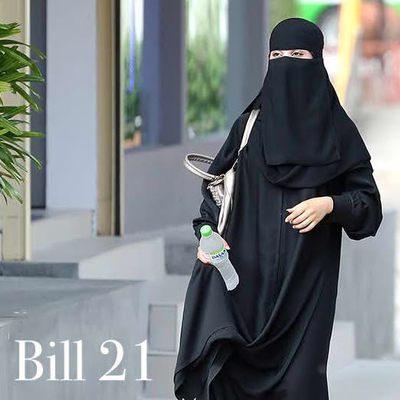
We – I say "we" because I am a Quebecer, and the law has majority support amongst francophones (though not anglophones) – feel threatened by the hijab and the niqab. We regard them as symbols of cultural transformation through Islamist colonization of Quebec's civic institutions. Today it's the hijab, tomorrow it will be the niqab. You cannot separate the hijab and the niqab. If the hijab is permitted as a religious or cultural or identity "minority right," then the niqab must also be permitted. And that is where the canker gnaws. Face cover is anathema – or should be – to all free people.
But 99 percent of the media have accepted the "religious symbol" story. Vehemently at times. My onetime colleague at the National Post, Andrew Coyne, referred to Bill 21 as a "depravity." Prime Minister Justin Trudeau declared that it was "unthinkable to me that in a free society we would discriminate against people based on their religion." (This from a national leader who would not allow anyone with pro-life views to sit in his caucus.)
Even though the stunt only became popular years after these remarks, I guess both of them would have to stick to that line of reasoning with regard to mass Islamic prayer in the streets in Montreal, a newly-proscribed practice in Quebec, tacked onto Bill 21.
The cross and the kippa are uniform across nations and time. They were not imposed by fiat, or meant to serve as a political weapon. But the hijab and the niqab were. The religion of Islam has been around for 1400 years, and the dress codes for women in Muslim-dominated countries have for most of that time been varied, colourful and attractive. That all changed with the rise of modern political Islam in the last century – Islamism. The hijab and the niqab are their billboards. Face cover must become anathema, just as polygamy did, even though both practices can cite cultural "identity" as pertinent to a Charter right claim.
I've argued in the past that although it may not rank so existentially as basic human rights like freedom of speech, and equality under the law, in free societies citizens have the "social right" to see each other's faces in the public forum. The European Court of Human Rights (ECHR) agrees. In 2014 the ECHR, considering a challenge to France's 2010 ban by a niqb'd woman, ruled that the secular ideal of "vivre ensemble" (living together) trumps a woman's right to "disappear," endorsing both France's and Belgium's niqab bans, as well as France's off-road ban on full-face bike helmets. I emphasize the bit about the helmets because the ECHR decision proves that the issue is not only religious freedom or "identity" or "belief" of any kind. It is about the discomfort and fear that inappropriate face cover incites in the majority, corroding the nation's social health.
It is appropriate to protect your face from flying objects when hurtling down the highway. It is inappropriate to walk around in the public forum still covered. It is appropriate for a surgeon to wear a mask in the operating room. It is inappropriate to converse, still masked, with the patient's family after the operation. Infection masks? Appropriate but transient. Hallowe'en masks? Only on Hallowe'en, when everyone is in on the joke.
Teaching children? Never in a free society. It is a child's social right to interact with a fully present teacher. In protests? In unfree societies where dissenting speech is punished, yes. In free societies where dissenting speech is permitted, no. The freedom to dissent should not be weaponized to protect incitement to hatred of individuals or of a specific minority group.
Quebec is the only province in Canada that never signed on to multiculturalism. It's the only province in Canada whose ethnic super-majority is not ashamed of its patrimony. So it makes sense that – apart from its share of far left intellectual useful idiots in the universities – most of its citizens can see a threat to that patrimony and name it without regard to political correctness.
I would love to have my suspicion about the Supreme Court's eventually forthcoming decision regarding Bill 21 and Section 33 proved wrong. It's too bad Quebec had to use the Notwithstanding clause to pass what should be and is regarded by other Canadians – those who can see which way the anti-West wind is blowing - as a law that falls well within the boundaries of rationality and cultural self-defence. But past experience with Canada's institutionally woke impulses, including the Supreme Court of Canada, warns against hope.
Log into SteynOnline and share your thoughts with Barbara. Commenting privileges are among the many perks of membership in The Mark Steyn Club. Please do stick to the other rules as you engage: no URLs, no profanity, and no ad hominem attacks. Thank you.