
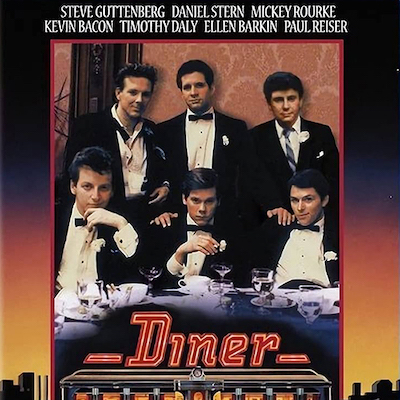
Barry Levinson's 1982 film Diner is set in Baltimore at the end of 1959, in the final days of what had been a momentous year, and just before what would be a pivotal decade. The year had begun with the success of the Cuban revolution and its recognition by both the US and Soviet governments, and Barry Gordy's founding of Motown. Pope John XXIII announced the Second Vatican Council and Buddy Holly, Ritchie Valens and the Big Bopper died in a plane crash in Iowa.
Later in the year China abolished the Tibetan government and replaced the Dalai Lama, NASA introduced the first seven Mercury astronauts, Miles Davis released Kind of Blue and Hawaii was made the 50th state. Nikita Khrushchev was invited to tour the United States by President Eisenhower and, later that same month, met with Mao Zedong in Beijing. The Guggenheim Museum opened in New York City, the Clutter family were murdered by Richard Hickock and Perry Smith in Kansas, Ben Hur topped that year's box office and Bell Labs invented the MOSFET transistor.
But none of these events are mentioned in Levinson's film, which concerns itself entirely with a half dozen young men, brought together by the democratizing machinery of the American public school, barely a few years past graduation and living in a holding pattern on the threshold of real adulthood. For a period picture set during the lives of the culturally dominant baby boomer generation, it's remarkably free of nostalgia; its focus is on these six friends, and Levinson could have swapped the cars, clothes and music with that of any point in time ten or even twenty years on either side of 1959.
Or as Fenwick (Kevin Bacon), one of the friends, wonders aloud to Boogie (Mickey Rourke): "You ever get the feeling there's something going on that we don't know about?"
The film begins at a dance in what looks like a church or legion hall, with a local band teasing out the Isley Brothers' "Shout" to keep the crowd on the floor dancing. We're introduced to the friends gradually, starting with Modell (Paul Reiser), Boogie and Fenwick, who's in the basement, drunk and smashing windows. Boogie tells him he's not being very mature.
"Fuck mature," Fenwick replies.
Fenwick, it turns out, has sold his date for the night to another young man for five dollars; Boogie, the most emotionally adept member of the group and its designated ladies' man, convinces the buyer to forget about the transaction and the girl to let Fenwick take her home. After playing a practical joke on his friends by pretending to roll his car – one of the idiotic "smiles" that Fenwick lives for – they convene at the diner on Baltimore's harbour that is ground zero of their lives together.
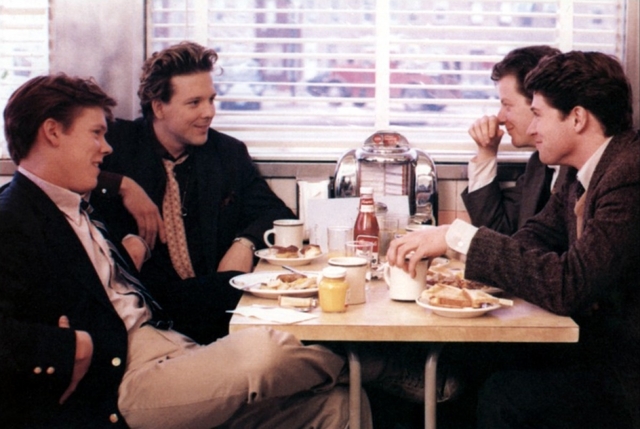
Shrevie (Daniel Stern) is the only married member of the group; he sells TVs for a living and defines himself by his record collection. Eddie (Steve Guttenberg) is the next one to go – his wedding is scheduled for New Years Eve but his fiancée Elyse (whose face we never see) has to pass a grueling quiz about his beloved Baltimore Colts or it'll get called off.
Modell is the designated wiseass; Reiser only had a few dozen lines in the original script but his background in stand-up allowed him to improvise and Levinson eagerly expanded his part. Fenwick comes from a family with money – not a lot, but enough to give him a hundred dollars a month until he's twenty-three and allow him to be jobless and alcoholic. Boogie works at a hair salon and goes to law school at night, but he has a gambling problem that's put him deep in debt to the local bookies.
The only member of the group who's escaped Baltimore is Billy (Tim Daly), who goes to school in New York City and has come home for the holidays to be Eddie's best man. Boogie, Fenwick and Shrevie meet him at the train station and catch up at the diner just before the sun rises; you know for sure that they've been doing this almost every day since they had enough money to pay for a plate of fries with gravy and a coffee.
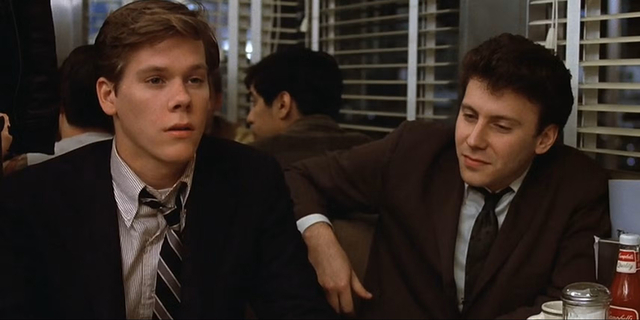
Billy catches up with Eddie later that morning; the groom lives with his parents, a grown man living in a boy's room, tormenting his mother for as long as he's still living under her roof. Billy, on the other hand, is the smart, apparently level-headed one, a favorite of everyone's parents.
Levinson was a veteran of TV and movie comedy, with a resume that included Mel Brooks pictures (Silent Movie, High Anxiety) and the Carol Burnett Show. He got an Oscar nomination for his script for Norman Jewison's ...And Justice For All (1979) and did uncredited work on the screenplay for Tootsie; that probably explains how he was able to get $5 million in backing from MGM/United Artists for his first picture, an autobiographical story starring a cast of unknown actors. Or perhaps it says something about Hollywood in the '80s, still coasting on the fumes of the risk-taking, renegade ethos of the previous decade.
Ever since it came out, Diner has been a favorite of screenwriters and directors, and the way Levinson introduces his main cast and sketches in their shared backstories is textbook character-based movie making. In a 2012 Vanity Fair article about the movie for its 30th anniversary, New Yorker TV critic Nancy Franklin writes that "Levinson should get royalties any time two or more men sit together in a coffee shop."
The main cast came to the film with varying degrees of experience, though they were all in the struggling phase of their careers – Bacon was sleeping on a piece of foam in a New York SRO hotel. Stern had the most onscreen experience, making his film debut in Breaking Away (1979) followed by small parts in picture like Stardust Memories, One-Trick Pony and Honky-Tonk Freeway.
Guttenberg came a close second with small roles in Rollercoaster and The Boys from Brazil before starring alongside The Village People in Can't Stop the Music. Bacon had his film debut in Animal House before roles in Starting Over and Friday the 13th; while Mickey Rourke had just made a big splash in Body Heat after bit parts in 1941 and Heaven's Gate.
For Daly (the brother of actress Tyne Daly) and Reiser Diner was their film debut. Ellen Barkin, who plays Shrevie's neglected wife Beth, had just one uncredited role as "Woman Playing Guitar" in Cheech and Chong's Up in Smoke on her resumé.
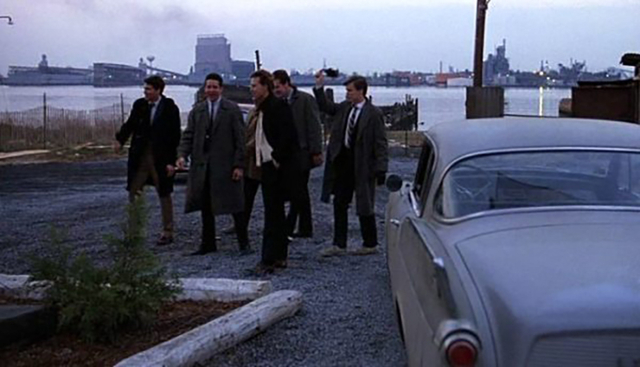
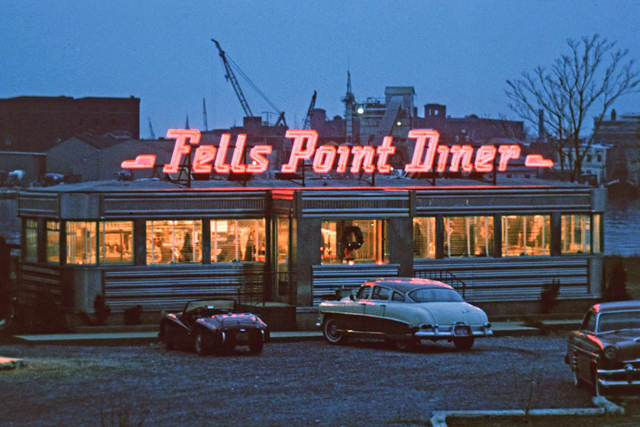
The hardest part that Levinson had to cast was the diner. The youthful experiences that inspired the film took place at the Hilltop Diner in Northwest Baltimore but it had been turned into a nightclub and a substitute in the city fell through when the owners kept asking for more money. Levinson and cinematographer Peter Sova were driving around the city when the director saw an empty lot by the water with the Domino Sugar sign on the far shore and decided it was perfect.
The director and executive producer Mark Johnson discovered a "diner graveyard" in New Jersey and arranged to have an old diner from Long Island trucked to Baltimore and placed on site. It was so convincing that production crew had to wave off truckers who tried to pull up at night when they were shooting.
When shooting was over they returned the diner to New Jersey but it had become so important to Baltimore that WBAL, the local radio station, bought it for $34,000 and had it parked two blocks from city hall. Initially it was to be run by the city to help train students in the hospitality trades but it lost money consistently and the Hollywood Diner now sits empty, maintained but unused except for occasional rentals as a film location.
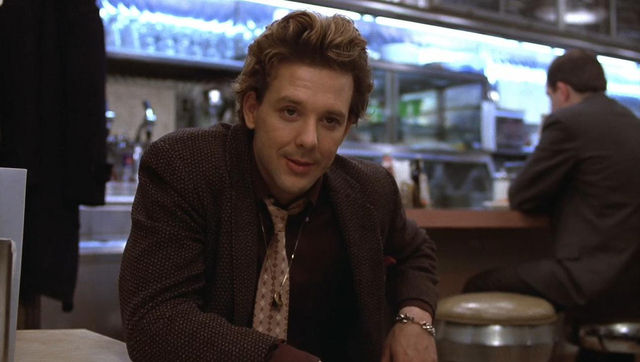
It's not hard to see how the film's cast all went on to subsequent fame; Levinson handed each of them at least two or three great scenes from which they could build a career. Rourke was the obvious standout – his Boogie not only had the most compelling character but the most to do, from the infamous "popcorn box" scene to his desperate decision to sleep with Beth to win a bet and avoid a beating.
Bacon teases the self-loathing barely concealed behind Fenwick's self-destructive behaviour and Levinson even drops a broad hint that he's hiding real intelligence when we see him ace every question while watching GE College Bowl. Shrevie and Eddie seem like the most unformed and emotionally stunted of the gang, the latter with his obsession with the Colts (who would leave Baltimore for Indianapolis the year after the movie came out) and the former willing to pick a fight with his wife when she misfiles his record collection.
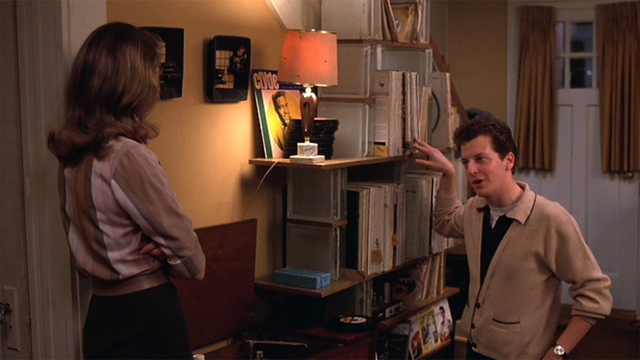
"This is important to me," he shouts at her. "You never ask me what's on the flip side... Every one of my records means something to me. When I listen to my records they take me to some place in my life." When you consider that this life spans barely two decades this sounds like an unwitting cry for help, and it's likely that anyone writing Shrevie today would probably take the easy and terribly contemporary way out and place him firmly on the autism spectrum.
You don't need to have known your share of serious collectors – I've known more than I can count – to recognize the anxiety about change and fear of time's passage that informs Shrevie's rant, but Barkin is heartbreaking in this scene, baffled by his oversized rage and what seems like a wholly inappropriate reaction.
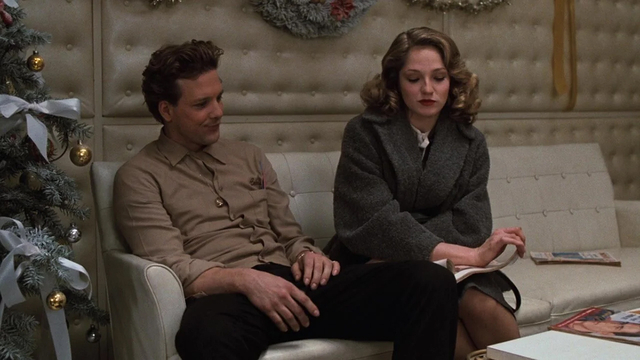
Barkin bears a heavy burden in the picture as the only woman with a character drawn with similar depth to the half dozen men at centre stage. Billy has a deep but platonic friendship with Barbara (Kathryn Dowling) that's threatened by a pregnancy after their one-night stand earlier that fall, but she doesn't have much to do but reject his offer to "do the right thing" and in any case Daly's Billy is the least interesting of all the boy-men in Levinson's film.
He's presumed to be the point of view character for the audience, and in a "making of" documentary produced for the film's twentieth anniversary most of the cast speculate that Billy was Levinson's surrogate. Ultimately, though, he's less crucial to the picture than Reiser's Modell, the group's most vestigial member and the smallest part on paper when filming began, but the performance that helped Levinson commit to film the banter that he admitted was the real point of a movie where story and plot took a distant second place.
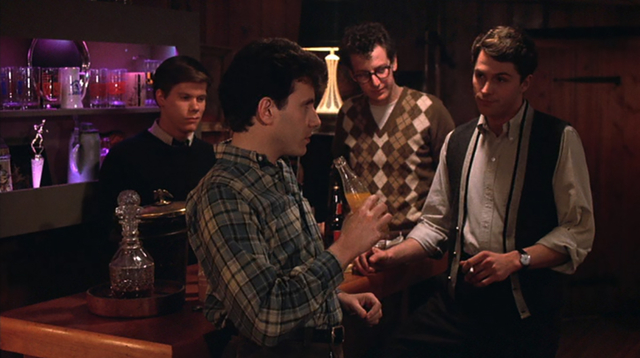
"I wanted the piece to be without any flourish, without anything other than basically saying, 'This is all it was,'" Levinson told Vanity Fair. "These conversations that can go on endlessly through the night – bets over the stupid fucking things that you can bet on – is it. Without gimmicks: nothing. Without gimmicks. This is it. Period."
The Vanity Fair piece goes so far as to call Diner the most important film of the subsequent decade – its reliance on dialogue over action and plot a direct line to Seinfeld, The Office and the films of Quentin Tarantino and Judd Apatow: "More than any other production, Diner invented ... nothing. Or, to put it in quotes: Levinson invented the concept of 'nothing' that was popularized eight years later with the premiere of Seinfeld.
"In Diner (as well as in Tin Men, his 1987 movie about older diner mavens), Levinson took the stuff that usually fills time between the car chase, the fiery kiss, the dramatic reveal – the seemingly meaningless banter ('Who do you make out to, Sinatra or Mathis?') tossed about by men over drinks, behind the wheel, in front of a cooling plate of French fries – and made it central."
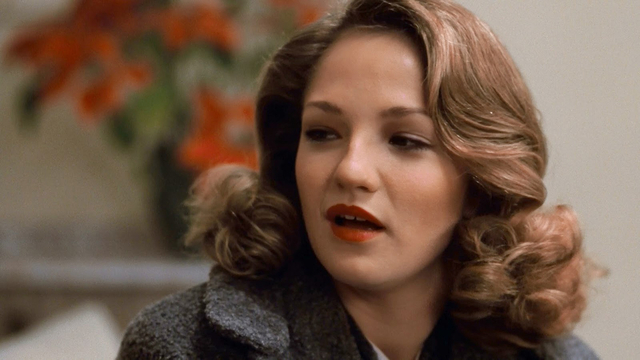
Writing about the film in Baltimore magazine three years ago, Max Weiss notes that the film doesn't get the attention it once did and wonders if a film about six young men hasn't slipped to the far side of acceptable subject matter. "I have no patience for the phrase 'They couldn't make this film today'" she writes. "Of course, they couldn't! Norms change. Sensibilities change. You need to put films like this in their proper historical and cultural context and stop judging old films by modern-day standards – it's a recipe for missing out on a lot of great art."
There's a lot of behaviour in the picture that would be flagged as "toxic masculinity" now – mostly by viewers whose knee-jerk reaction is the only one they trust, but Weiss insists that "it's important to make a distinction between depiction and endorsement. Diner is very explicitly about the fact that these guys are afraid of growing up – and women come to represent one of two things to them: an object of lust to be chased or a potential wife, i.e., a jail sentence to be avoided at all costs. (They view Shrevie as a bit of a cautionary tale, even though he seems to hang out with the boys as much as ever.) They cling to each other, to the diner of their teen years, to their jokes and their games and their banter, as a way to fend off the inevitable."
This contemporary reaction is notable considering how disappointed MGM was with the finished film. "The studio didn't like it," recalled Johnson in an oral history of the movie in another Baltimore magazine story. "They wanted it to be one those screw-around movies, they wanted it to be Porky's – those crazy kids in Baltimore, trying to get drunk and laid, driving around. And it wasn't one of those at all. They didn't know what to make of it."
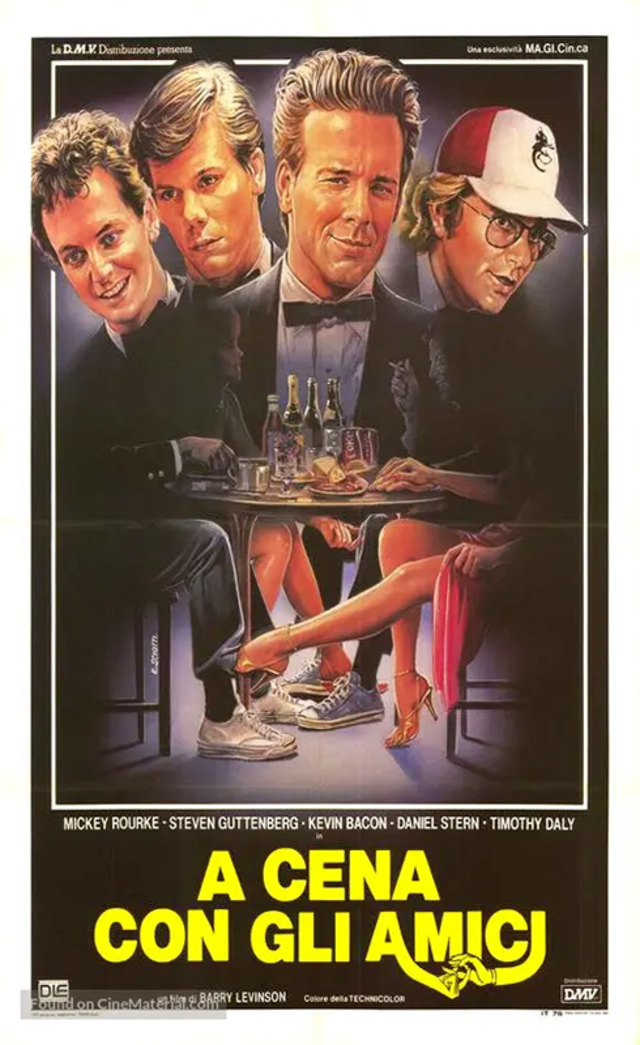
The film was such a low priority for MGM that they couldn't be bothered demanding changes or re-editing the picture, opting ultimately to cut their modest losses and bury it without a trace. But thanks to a bit of luck – Johnson's mother happened to be best friends with Pauline Kael, the New Yorker's wildly influential movie critic, who gave it a rave review – MGM was shamed into a wider release. Still, if you want some idea of what the studio wanted you only have to look at the Italian poster for the film, released there as At Dinner with Friends.
(As a footnote, Mel Brooks told Levinson to watch Fellini's I Vitelloni when he suggested he write a script based on the stories Levinson told him about his friends. But Levinson couldn't find a copy. "Back then it wasn't like you could pull it up on streamers." Regardless, it's the film Diner is compared to more than any other.)
My reasons for defending the picture are personal. I saw Diner when it came out, just as I was graduating high school, and couldn't ignore how much it resonated with my own life, even if the characters were a few years older than me. I had spent the better part of my last few years at St. Michael's College School in a group whose personalities and dynamics were remarkably like Levinson's gang of friends.
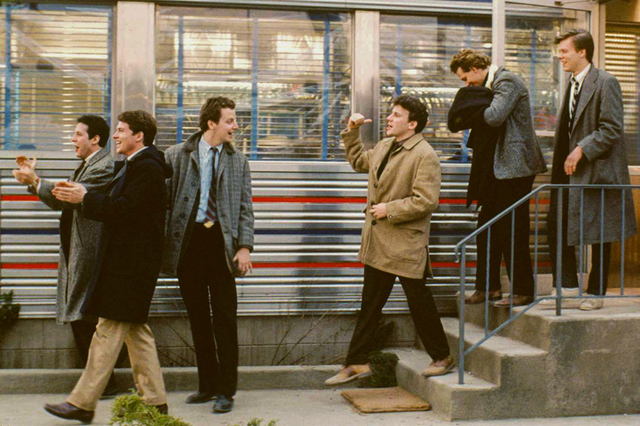
We were a strange assortment of boys from different backgrounds (but all Catholic), and while I'm not sure we had our own Boogie we had at least two Fenwicks and swapped the roles of Shrevie, Eddie and Modell depending on the time of day and subject. It's fun to speculate on what the future held for Levinson's boy-men; it's hard to imagine Shrevie and Beth making it but Eddie and Elyse might have stood a chance. Billy's visits to Baltimore will probably be more and more infrequent until they're finally reserved for funerals.
One of our Fenwicks has wholly reformed, the other just enough to make it to the verge of senior citizen discounts relatively unscathed. Some of us have moved away; others have fallen into distant orbits and a few new members have joined but we still get together several times a year for dinner and the same easy ball-busting and banter. If we ever had our diner it closed many years ago.
In a scene in a strip club near the end of Diner Billy confides to Eddie that "the whole thing with girls is painful. And it seems like it's getting more painful instead of easier." My first serious girlfriend once told me that she didn't think men made real friendships but, looking back, I don't know that she knew much more about men than I knew about women. But I do have a circle of friends who remember when we shared this kind of confidence, and from over forty years' distance I'm confident enough to disagree with my old girlfriend.
Log into SteynOnline and share your thoughts with Rick. Commenting privileges are among the many perks of membership in The Mark Steyn Club. Please do stick to the other rules as you engage: no URLs, no profanity, and no ad hominem attacks. Thank you.