Recovering from a heart attack I had time to re-watch the recently restored and updated Beatles Anthology miniseries on Disney+, which includes a new, ninth episode that features the three Beatles still alive in June of 1994, lying about on the grounds of Friar Park, George Harrison's Oxfordshire estate. Well into late middle age, they're long past the legal issues and bitterness that marked the years after the band's dissolution; if you were a Beatles fan when the series first came out in 1995 it was a happy sight.
Sitting on a picnic blanket by an ornamental pond they have a little sing-along, and one of the tunes they attempt – Paul McCartney singing while Harrison accompanies him on ukulele and occasional harmony – is Milton Ager and Jack Yellen's 1927 Tin Pan Alley classic "Ain't She Sweet". Gene Austin made it a hit, but it was covered over a dozen times the year it came out and frequently for years after that, with versions by Annette Henshaw, Paul Whitmean, Lilian Roth, Jimmie Lunceford, Pearl Bailey, Eddie Cantor, Tommy Dorsey, Erroll Garner, Ferlin Husky, Frankie Lymon, Enoch Light, the Modernaires, Gene Vincent, Big Joe Turner, Lawrence Welk, several Looney Tunes cartoons, Frank Sinatra – and the Beatles, who played it at their first professional recording session in Hamburg in June of 1961, where the group learned to their mild dismay that they had been hired to back singer Tony Sheridan.
The band had apparently been performing the song in their live sets since 1957 and McCartney, in the coffee table book that came out with the release of Anthology, said it was part of their late night "cabaret" set and "showed that we weren't just another rock'n'roll group." When Beatlemania was raging a few years later producer Bert Kaempfert put it out on a French EP, Les Beatles, and it became a staple on "early Beatles" compilations and bootlegs for decades, lingering in the Beatles' own memories long enough to reappear on that picnic blanket in 1994.
As any Beatles fan knows, before McCartney and John Lennon became a songwriting juggernaut their live sets and records were full of cover tunes – an equal mix of unimpeachably hip tributes to musicians that influenced them ("Baby It's You", "Twist and Shout", "Long Tall Sally", "Roll Over Beethoven", "Words of Love", several Carl Perkins numbers and Motown singles like "Please Mr. Postman", "You Really Got a Hold on Me" and "Money"), as well as the kinds of songs that demonstrated what record label executives and bookers called "range". That would be tunes like Meredith Wilson's Broadway hit "Till There Was You", Stephen Foster's "Beautiful Dreamer", W.C. Handy's "St. Louis Blues", "Besame Mucho", "Red Sails in the Sunset" – and "Ain't She Sweet", a song that was a hit when Clara Bow was a major movie star, Charles Lindbergh flew across the Atlantic and The Jazz Singer premiered in theatres.
Far from being a cultural artifact in a growing generational divide, "Ain't She Sweet" in the context of the Beatles is really part of a shared generational memory that, at least from my perspective, has narrowed considerably in the last couple of decades. Growing up on the far edge of Generation X, tunes like "Ain't She Sweet" were kept alive by variety shows and movies on late night television and old cartoons, even after it had passed in and out of the Beatles' repertoire (though not out of the memories of McCartney and Harrison, obviously).
Depending on what you read, the Beatles are either still loved by Generation Z or are on their way to becoming a trivia question. But there's no denying that the cultural memories shared by the band and their fans have been shrinking – something that I couldn't help but notice when I spent the last few weeks thinking about W.C. Fields (as a way of not thinking about myocardial infarctions).
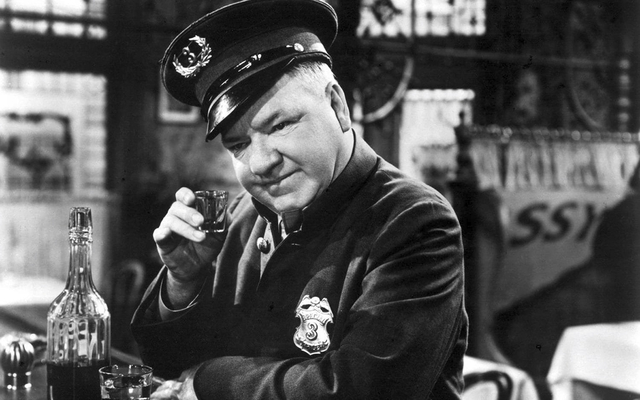
During my youth, over two decades after his death, W.C. Fields was still famous enough that anyone could attempt and recognize an impersonation of the comedian, drawling out lines like "My little chickadee..." or "children should neither be seen nor heard" or "I never drink water because of the disgusting things fish do in it". An image of him gazing through hooded eyes over his cards in a poker game was iconic, blown up poster-sized on the walls of bars, dorm rooms and head shops.
He even appeared on Jann Haworth and Peter Blake's psychedelic pop art cover for Sgt. Pepper's Lonely Heart's Club Band, between Karlheinz Stockhausen and Carl Jung and just above Tony Curtis, sharing space in a crowd that included Bob Dylan, Marilyn Monroe, James Joyce, Oscar Wilde, Lewis Carroll, T.E. Lawrence and his onetime co-star Mae West.
But nobody millennial or younger would recognize Fields today or attempt an impersonation of Larson E. Whipsnade, Cuthbert J. Twillie or any other Fields character from his heyday. West endures as a camp icon, but Fields' celebrity half life has declined far past the Marx Brothers though nowhere near as in the weeds as Will Rogers, a friend of Fields who was once the sagacious counterbalance to his comic misanthropy. And it might be a measure of how quickly fame recedes that, despite a childhood where West, Rogers and Fields remained recognizable, their onscreen personas abidingly familiar, I had never seen one of their films from beginning to end.
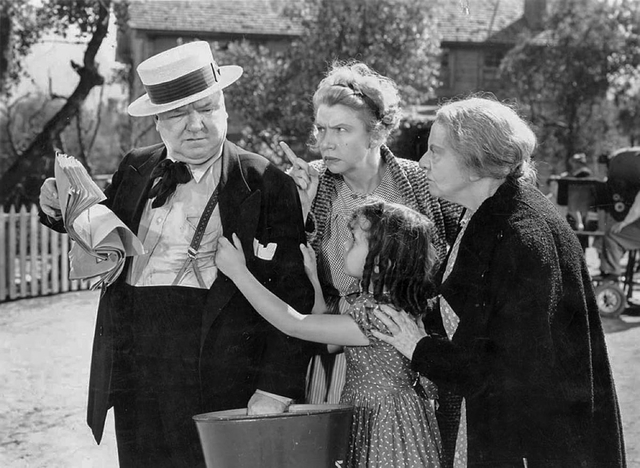
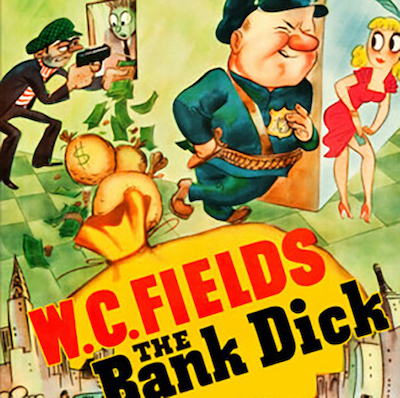
Sudden, forced idleness gave me a chance to become familiar with at least one Fields performance, and I chose The Bank Dick from 1940, made during a second, late period of success onscreen, just after illness and depression kept him out of the movies while remaining popular on radio. After the success of You Can't Cheat an Honest Man (1939) and My Little Chickadee (1940) with West, he got nearly complete control over his next picture, which he wrote under the absurd nom de plume Mahatma Kane Jeeves.
The Bank Dick is set in the real-life California burg of Lompoc, a typically mid-sized, middle-class town afflicted with the usual American Babbittry, to which Fields' Egbert Sousè ("accent grave over the e" as he constantly insists) lives in instinctual opposition. He's a lone man in a household of women who, like the feminine energies loose in the town, live to thwart him: his slovenly wife Agatha (Cora Witherspoon), his shrewish mother-in-law (Jessie Ralph) and spoiled brat youngest daughter Elsie Mae (Evelyn Del Rio), whose relationship with her father constantly teeters on the verge of violence.
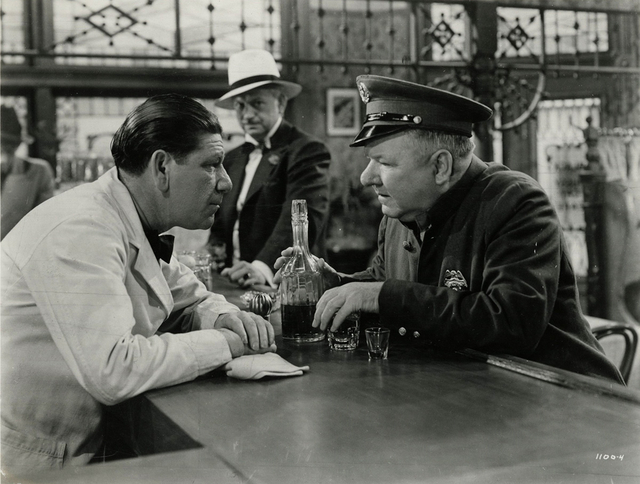
He lives only to smoke, read detective stories and drink at the Black Pussy Cat Café, run by barkeep Joe Guelpe (Shemp Howard giving the sole understated performance in the whole picture). His only respite at home is his sweet but simpering daughter Myrtle (Una Merkel), who's in love with a shapeless lump of a teller at the bank, Og Oggilby (Grady Sutton). The young lovers are planning an engagement made possible by a $500 bonus Og has been promised by the bank.
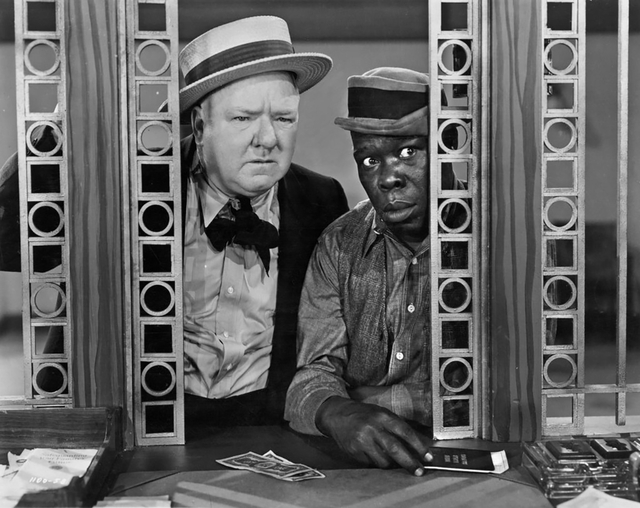
It would be fair to say that whatever passes for plot in The Bank Dick doesn't happen as much as it occurs. While holding down his stool at the Black Pussy Cat, Egbert makes the acquaintance of a Hollywood producer in town making a film whose director, A. Pismo Clam (Jack Norton) – only slightly the most ridiculous character name in the picture – has incapacitated himself after a bender. A few mumbled remarks about working for Mack Sennett gets Fields hired to replace him, leading to a scene whose sole purpose is to highlight the vast difference in height between the leading man and lady and the unearned status of a director on a movie set.
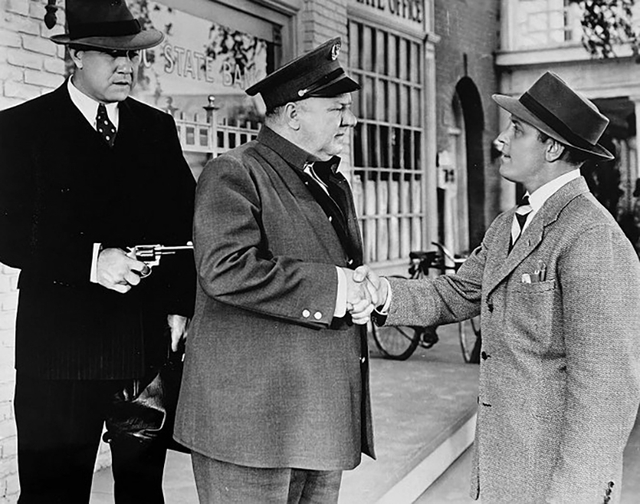
A further occurrence puts Egbert in the path of a pair of stick-up men who rob Og and the bank – a woozy slapstick sequence involving a tossed handgun, a newspaper and a wobbly bench that makes it appear as if Egbert has displayed reckless bravery instead of feckless luck in foiling the thugs. As a reward he's given a "firm hand clasp" and a job as a security officer by the bank manager.
While fortifying himself for his shift at the Black Pussy Cat, Egbert is targeted by J. Frothingham Waterbury (Russell Hicks), a con man peddling worthless stock in the Beefsteak Mine to the precise value of $500. Egbert convinces the spineless Og to "borrow" that amount from the bank until he can replace it with his bonus in a few days, confident that the stock's value will match the telephone as an investment.
In March of 1947, The Atlantic published a tribute to the recently deceased Fields written by J.B. Priestley, who recalled seeing Fields in a music hall in England in 1914 performing his act as the "tramp juggler".
"He was very funny even then," Priestley wrote, "and I seem to remember him balancing a number of cigar boxes and staring with horror at a peculiar box, in the middle of the pile, that wobbled strangely, as if some evil influence were at work. All his confidence, which you guessed from the first to be a desperate bluff, vanished at the sight of the one diabolical box, which began to threaten him with the nightmare of hostile and rebellious things."
Priestley saw the germ of Fields' comic persona during this onstage turn: "Nobody could suggest the malice of objects better than Fields. At his best moments, an ordinary room, empty of other human beings, could turn itself into a mined mountain pass. He could start a bitter feud with two chairs and a sideboard. When he arrived in places like golf courses or billiard rooms he would be plunged into an Arabian Nights of sorcery."
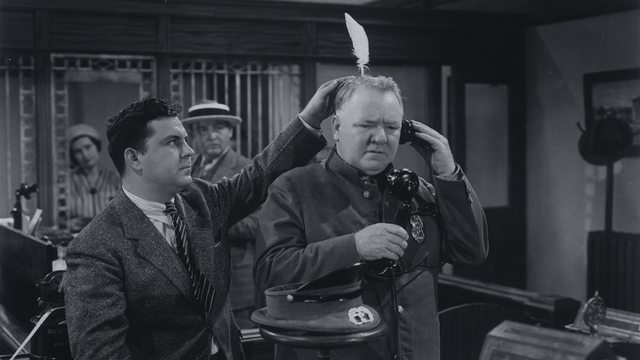
What passes for pacing in The Bank Dick frequently stutters and stops for a bit of physical business, like the belligerent duel between Egbert and his youngest daughter, a similar battle between his walking stick and hat, or a white feather quill pen that launches itself from a desktop in the bank and sticks into place into the top of an oblivious Egbert's skull. (Did anyone, never mind bank clerks, even use quills to keep books in 1940? It obviously didn't matter, especially when Fields had free run of the film's gags.)
Fields played men doomed to swim upstream from birth by nature or inclination, born into circumstances designed to bend men's heads down to dubious industry or unwanted roles. One online essay on Fields wonders why the comedian's reputation hasn't sustained itself like his peers and suggests that "other comedians of his generation have lasted longer and better because they often come with a single big symbolic idea, one that's more readily apparent and digestible to the (mostly liberal) chattering classes. With Chaplin it's socialism or simple sympathy for the underdog. With Laurel and Hardy it's the eternal dynamics of friendship. With Mae West it's about sex and feminism and she's also a gay icon. With the Marx Brothers it's anarchy, and ethnic identity – they're heroes to every Jewish comedian you've ever met."
"But what is Fields' big idea?" the writer asks. "The idea is freedom. Sometimes (in the domestic comedies) he is deprived of it, to his misery. In some of the other films (where he portrays an itinerant showman) he exercises and enjoys his freedom to a downright criminal extent."
Fields, he asserts, is a libertarian hero. Libertarians love to claim nearly everyone as a hero, so desperate are they to find a champion – any champion – but this argument is as good as anyone's:
"As we have intimated, the most obvious manifestation of this is his character's vices: smoking, drinking, gambling, socializing with the boys, laziness. To a certain extent, political correctness has made this element of his films less popular. But it has also remained influential: Cheech and Chong, Animal House, Absolutely Fabulous, The Big Lebowski, Amy Schumer and Broad City all owe him a debt. A subculture continues to love this, but the overarching tone of our society for some time has remained disproving. 'Isn't it sad?' people cluck. I mention this element first because it is the best known aspect of Fields' comedy. It is the best loved (and, nowadays also the most dismissed and disparaged) but it is also the most superficial. But obviously Fields' philosophy here is laissez-faire: what I do is none of your goddamned business."
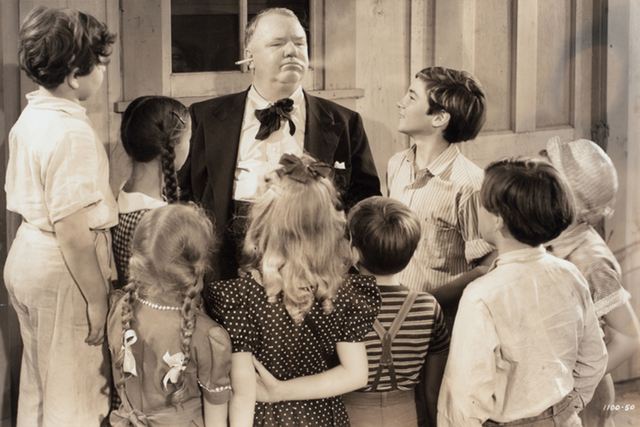
Despite his famous antipathy to children they often adore Fields. In The Bank Dick a crowd of youngsters gather around him after he foils the bank robbery, helping him embroider the story with its minute-by-minute retelling. He demonstrates how to smoke through your nose and ear, to further admiration. It's no surprise though as men like Egbert Sousè are big children, fighting to shrug off the weight of adult expectations and responsibility that fit them as well as their cheap, out-of-fashion suits.
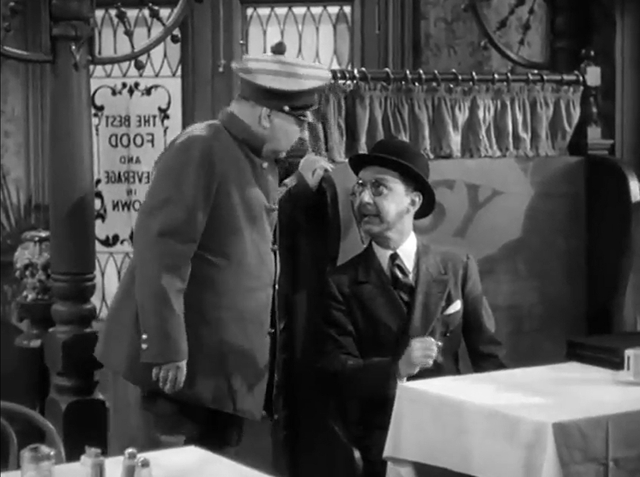
Nemesis arrives in the form of J. Pinkerton Snoopington (Franklin Pangborn), the bank examiner sent to examine the books. Og is ready to confess to everything but Fields takes the bank examiner to the Black Pussy Cat where Joe slips him a Mickey Finn and, working in partnership with Stall, the town sawbones, tries to persuade him to take four days' bed rest, just long enough to slip Og's bonus money back into the bank coffers. But the dutiful Snoopington rises after one day intent on checking the ledgers, which prompts Egbert to begin "accidentally" smashing his reading glasses.
The ruse is nearly exposed when they discover that the Beefsteak Mine has struck it rich, but before they can set things right, one of the bank robbers returns to finish the job he started. Og's till is cleaned out along with his mine shares and Egbert is taken hostage, which leads to a car chase through the streets of Lompoc and onto the dusty switchback roads outside town.
The sequence is chaotic and surreal, with the car coming apart while Egbert drives and the rear screen projection playing in a conspicuous loop that has Egbert wheel deliriously through the same curve over and over, until a tree branch knocks the bank robber cold.
"Of course, none of this matters," writes Tynan at the 4 Star Films blog. "Not the embezzlement. Not the bank robbery. Not any of it. Because their mine is actually a bountiful lode, and they strike it rich as only W.C. Fields can. It's an instantaneous, convenient reversal of fortune, but then again, Fields' pictures always defy conventional logic. It's in their very nature to shirk the normal rhythm for whatever behooves them at any given moment."
J.B. Priestley writes that "like so many Americans whom we think of with gratitude and affection, he showed what he thought of the American way of life by drinking and thumb-nosing himself clean out of it. Always a ripe character off the stage, he became fruitier and more fantastic in his later years, turning his whole existence into one huge comic character part. He began as a waif and ended as one. The vast pretensions of Hollywood withered away at his glazed look and contemptuous mutter."
At the end, Egbert is rewarded for his sloppy deviousness and shiftless ways, not just with a substantial share of Og's mine stock but a reward for foiling the robbery, a substantial payment for his tossed-off idea for a film story from the Hollywood producer and a contract to direct the picture. He ends in the lap of luxury, his family transformed by their fortune and in worshipful thrall to their paterfamilias. It's a wholesale violation of the moral calculus of the Production Code and it would have been buried under official protests if anybody really believed in the damned thing.
Club members can let Rick know what they think by logging in and sharing in the comments below, as access to the comments section is one of many benefits that comes along with membership in the Mark Steyn Club.