
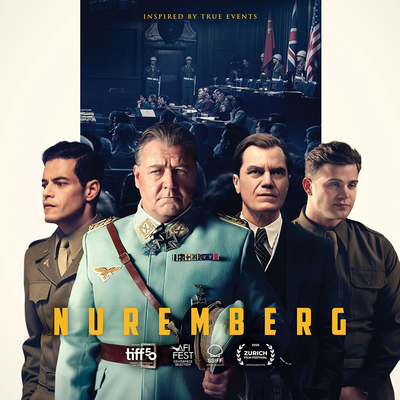
Nuremberg, the new film directed by James Vanderbilt, begins with a card telling us that "What follows is based on the accounts of those who lived through it. And those who didn't." This is followed by a shot of an American GI pissing on a swastika. Vanderbilt's film is full of this kind of call and response: edits that answer a question or leap over a stretch of plot or simply provide a rimshot for ideas it passes off as gags in a story that isn't, from any perspective you can imagine it, funny.
Because Vanderbilt's film is about the first war crimes trial held in the immediate aftermath of the Second World War – the first of several, but the only one where all four Allied powers presided from the bench and contributed to the prosecution. And in the absence of the principal quarry of that trial – Adolf Hitler, who had taken himself out of the game in the last days of the war, several months earlier – the "star", both at the time and in Vanderbilt's story, is Hermann Göring, Reichsmarshall of Nazi Germany, Hitler's second-in-command, and head of the Luftwaffe.
We meet Göring when that GI is interrupted by a big staff car driving against the tide of refugees choking a road on May 7, 1945 – the last day of the war, as we're informed. There's a standoff between the GIs and the passengers in the car who have to improvise a white flag of surrender so Göring (Russell Crowe) can make his entrance in his one-of-a-kind, robin's egg blue reichsmarshall uniform and present himself for surrender to the Americans, before requesting that they carry his luggage.
The Nuremberg war crimes trials were controversial at the time: called "victor's justice" by anyone who could potentially be a defendant, criticized as a legal invention that could ricochet back against the victors should they establish abiding legal precedent with a successful prosecution. These controversies linger eighty years later for that small but consequential group of people who have to professionally remember Nuremberg; for the considerable majority who don't, Vanderbilt's film provides a confused introduction.
If Nuremberg is a war movie it qualifies only by association as the action happens after the shooting is over. At a glance it's more neatly understood as a courtroom drama since its story culminates with a trial and its verdict. At its heart, however, it's a morality tale of a particularly modern kind – self-righteous yet ambiguous and designed so its audience is spared unease or anxiety in the face of making a real choice about where they stand at any moment of decision.
Ideally a morality tale should allow you to imagine yourself in any number of roles before it reveals the sum of the moral equation it's been asking you to work out. Nuremberg, however, ultimately only allows the self-respecting viewer one plausible proxy to identify with as it treads steadily to a conclusion. But I'd guess that this is only a failing for a minority of its audience; for everyone else buying a ticket or charging a stream to their credit card, it's a steady, reassuring ride whose finish line is never out of sight.
After Göring's entrance the camera cuts to a rainy night across the Atlantic where Supreme Court associate Justice Robert Jackson (Michael Shannon) is informed of the reichsmarshall's capture – the highest-ranking member of the Nazi regime to fall into Allied hands. Jackson, with the tentative backing of President Truman, wants to set up a tribunal to try senior Nazis on war crimes but also unprecedented charges like crimes against peace and crimes against humanity.
At the war's end there was a loose consensus among Allied leadership that high-ranking Nazis in both the military and the government should be shot upon capture; it was one of the few things that Churchill and Stalin agreed upon, and the only limitation proposed by the Soviets was that these executions not exceed a hundred thousand. The idea's appeal diminished with the German surrender and Jackson was able to get backing for his tribunal and a summer to organize the proceedings.
While canvasing support for a war crimes trial Jackson searches for an authority higher than the U.S. government and ends up in Rome making an appeal to Pius XII, who is initially opposed until Jackson recalls that, as Papal Nuncio in Germany in 1933, he had signed a Concordat that recognized Hitler's government; thanks to him the Vatican led the world in diplomatically legitimizing the Nazi regime. Jackson points out that whatever the Holy Father's justification at the time, it certainly didn't look good from the perspective of 1945 and he effectively blackmails the Pope into backing the Nuremberg trials.
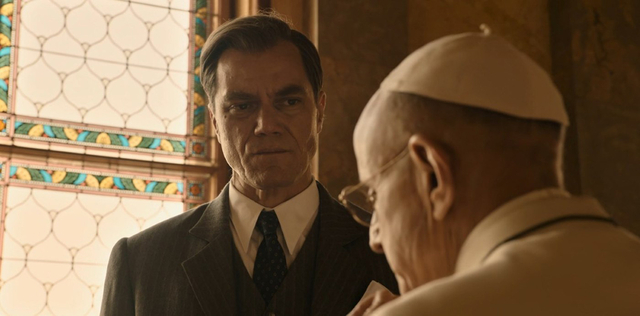
It's a sharp dramatic move that will elicit wry chuckles and a shiver of outrage from Nuremberg's audience by summoning some evergreen anti-papistry. The only problem is that while the Concordat was real (and has attached itself indelibly to Pius' reputation), this scene never happened, and it's an example of how Vanderbilt and his film do business with historical fact.
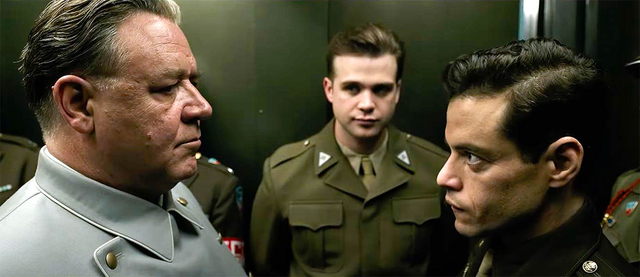
Back in Germany the Allies are corralling senior Nazis under the supervision of Burton Andrus (John Slattery), the commandant of the prison where the Nuremberg defendants are held. He in turn assigns Douglas Kelley (Rami Malek), an army psychiatrist, to ensure that the defendants can be certified sane enough to stand trial.
As the film's protagonist, Malek's Kelley comes fully accessorized with a potential love interest (a glamorous and mysterious British journalist played by Lydia Peckham), a hobby (sleigh-of-hand card tricks) and a sidekick, Sgt. Howie Triest (Leo Woodall), who acts as his driver and translator. He apparently needs to travel onscreen with a lot of business to compete with Crowe's Göring as he sits in his jail cell, still with menace, the lord of the prison block.
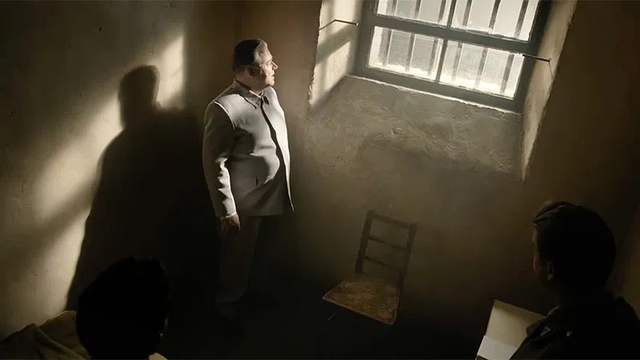
Kelley arrives with an agenda: he wants to anatomize the mentality of the defendants under an assumption that there was some kind of "Nazi virus" that infected them and by extension the whole country. "What makes the Germans different? From us?" he asks Triest, who withholds his own opinion because, it will turn out, he had knowledge all along that Kelley has to learn painfully while making himself a confidant of the Nazi prisoners and Göring in particular.
Göring enters captivity overweight and addicted to paracodeine, an opiate. A heart attack has Andrus wean him off the drugs and Kelley flatters him into demonstrating his superior discipline and willpower to rise to the challenge of getting into shape for the literal trial of his life. It's the first of an endless series of games the doctor and the reichsmarshall play with each other throughout the film, persistently hinting that Göring might have the upper hand.
"No man has ever beaten me," Göring warns Kelley at the start of their relationship, adding that there are books full of the names of those who failed. Kelley responds, reasonably, that he's nonetheless the one in jail facing a likely death sentence. "This is exactly where I desire to be," Göring responds – a threat that extends past Kelley to Jackson and the whole international team of prosecutors. Given his day in court and the chance to testify, they're afraid he has the potential to subvert the purpose of the trials and justify the Nazi side of the story to an eager audience inside and outside Germany.
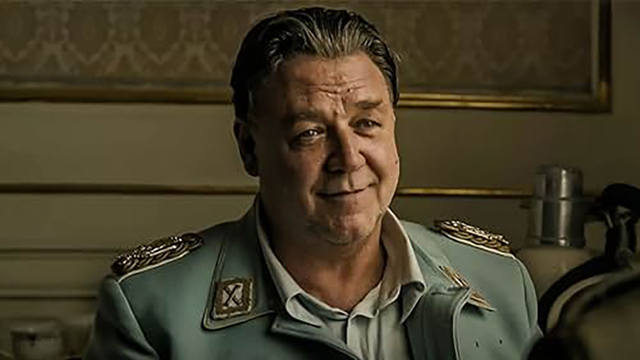
There's a peculiar duality to the way Hermann Göring is presented in both movies and the historical record. He's regarded as a major liability to the Nazi regime (though nowhere as big as Hitler himself): as head of the Luftwaffe he overpromised and underdelivered at every crucial point in the war, as his energies were apparently diverted by drinking and eating and enriching himself with art plundered in the kleptocracy that comprised much of the Nazi economy.
He was too famous and popular to punish but by the last two years of the war he had been sidelined in favour of more competent men such as Albert Speer. He was a gift to Allied propagandists – a self-parody, his obese bulk stuffed into his custom uniform, a Ruritanian figure with his gold braid and field marshal's baton. That image persisted for years after the war in buffoonish portrayals like Hein Reiss in The Battle of Britain (1969).
Then from defeat emerges the Göring of Nuremberg, cleaned up and slimmed down, the natural leader of all the defendants and the chief threat to the prosecution's case. Brian Cox plays the same Göring, a bit more blustering perhaps, in the 2000 miniseries about the trial, with Alec Baldwin as Jackson and Michael Ironside as Andrus. (An American-Canadian co-production that looks, unfortunately, very Canadian.)
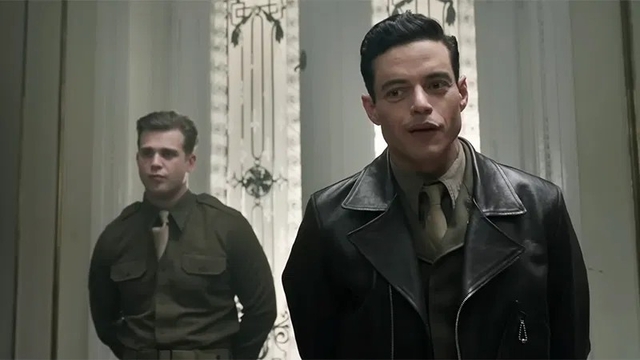
To give the prosecution an edge Jackson approaches Kelley and asks him to share his insights on Göring and his defense strategy with him. Kelley protests that he'll violate doctor-patient confidentiality but it's hard to see how that's strictly relevant to a doctor in uniform sharing the confidences of an enemy.
By this point, Kelley is collecting conflicts while he's acting as a secret courier between Göring and his wife, with whom he becomes friendly, even flirtatious. He reports that one of the most troublesome defendants, Robert Ley, has turned a corner just before Ley strangles himself to death in his cell – a failure that damages his reputation with his superiors, who call in another psychiatrist, Gustave Gilbert (Colin Hanks), a team player where Kelley is a rebel (complete with leather motorcycle jacket). He even teaches Göring a sleight-of-hand trick that Vanderbilt has him use to cheat the hangman's noose.
It's hard to avoid concluding that Kelley is out of his depth – with Göring, with the trial, with his understanding of evil. Reviewing the film on the Word on Fire website, Dr. Tod Worner writes that this is one reason why Nuremberg fails to mine real conflict from the relationship between Crowe's Göring and Malek's Kelley, thanks to a "high-toned, all-too-credulous, worn-out notion that evil can be medicalized or that, quite simply, 'science can answer this.' The bright-eyed devotees of scientism believe all too easily that the intangible, the ineffable, the materially inexplicable notion of evil could simply be submitted to the 'infallible' scientific method and solved with studied effort followed by delicious satisfaction."
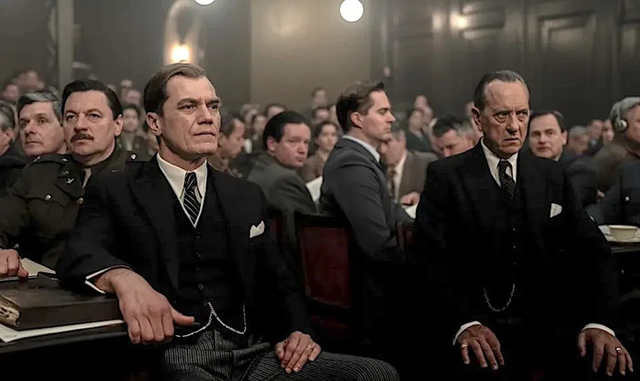
There was, of course, another movie made about the Nuremberg trials. Stanley Kramer's Judgment at Nuremberg (1961) isn't about the first trial but one of the subsequent, American-led tribunals. It was released at the same time as Israel's trial of SS officer Adolf Eichmann, one of the architects of the Final Solution, but unlike Nuremberg it told a fictionalized story, of the prosecution of German lawyers and judges who enforced Nazi racial laws.
Like Kramer's film, Nuremberg's moral punch comes when films of Nazi labour and extermination camps are shown in the courtroom. This footage – shot and assembled by filmmakers like John Ford and George Stevens – was largely unseen before the first Nuremberg trial and still rarely screened by the time Kramer's film came out. It's hard to imagine how devastating it was months after the war ended, though Vanderbilt does his best to convey the shock and shame it created.
It was still shocking in 1961, but it's been embedded in our visual record of World War Two since then. And despite the best efforts of the cameramen and directors who captured the footage and men like Jackson and Gen. Dwight Eisenhower who considered it a definitive rebuttal to anyone who would deny what happened in the concentration camps, there are more people now than ever who are willing to imagine, like one of the defendants in the movie, that "anyone can fake an atrocity", at a time when antisemitism is having a resurgence once considered unimaginable.
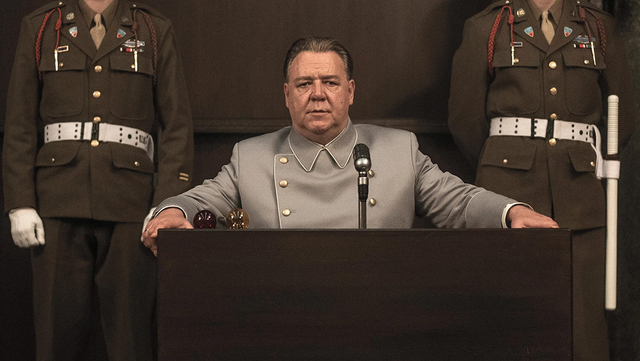
As anticipated, Göring credibly defends himself on the stand, mostly by disputing the accuracy of Jackson's rushed translations of Nazi documents. In real life, Jackson's evidentiary strategy – entering mountains of documents into the court records, sometimes twice when they pertained to different charges – was considered a tactical mistake that threatened the prosecution's case, and Jackson often found himself on the back foot when examining Göring.
In Vanderbilt's film Kelley ends up saving their case with his insights into Göring's character, specifically that he would never disagree with or deny Hitler's authority even when it led to atrocities, which Jackson's British colleague Sir David Maxwell Fyfe (Richard E. Grant) uses against Göring during examination.
But like the betrayal of Kelley's confidence by the pretty journalist, his dismissal from the trial and discharge from the army by Andrus, Kelley's final meeting with Göring, the sleight-of-hand trick Kelley teaches Göring and his use of it to commit suicide minutes before his execution, it didn't really happen.
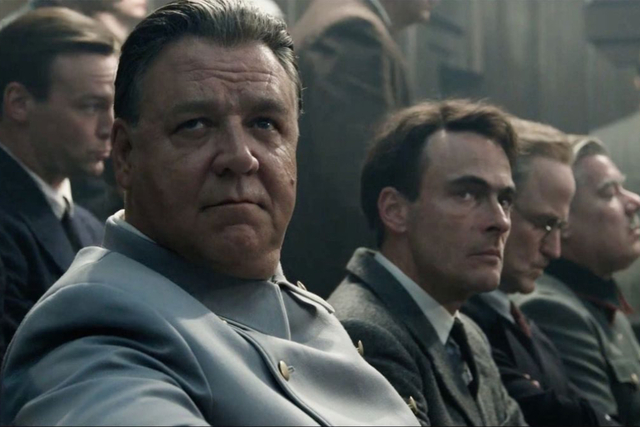
While Crowe does an admirable job investing Göring with menace, cunning and charm, it's Malek's overclocked performance as Kelley, and how the script makes his motivations confused and baffling, that makes Nuremberg so unsatisfying. The only character we're able to find sympathetic by the end is Leo Woodall's Sgt. Triest, who reveals that, far from being some all-American boy from Detroit who learned German from his mother, he's actually a Jewish refugee who escaped Germany at the last minute but lost his parents in Auschwitz.
Crowe might have done his best to humanize Göring but he nonetheless remains the face of one of the last century's most unspeakable evils, and Malek's Kelley is too arrogant for an audience to identify with. Which leaves us with Triest, who can recognize evil but doesn't share his insight until late in the film. Or as Armond White put it in his review of Nuremberg in the National Review, the film's "ambivalence is as much a sign of Vanderbilt's perplexity as it is proof that he's in too deep. The mix of sentimentality and skepticism – cherubic Triest's personal confession and Kelley's professional discomposure – defeats the movie."
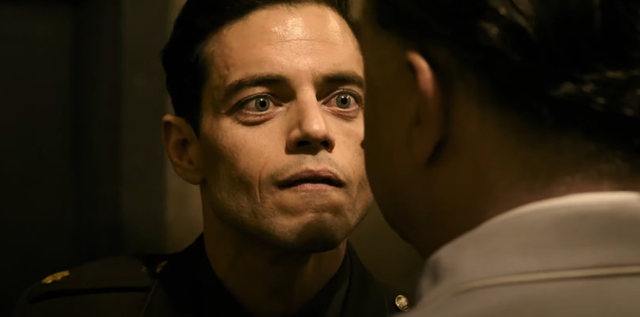
Which leaves me with one nagging question: Why Nuremberg, and why now? A film about war crimes and national guilt doesn't get made for fun, though Vanderbilt waits until near the end to tip his hand, with a scene where Kelley, now an angry alcoholic trying to publicize his book about Nuremberg, rails during a radio debate that anybody, even Americans, could follow the Germans to that evil place.
I asked several friends why they thought Nuremberg was made and they all gave the same answer: Trump. I'm sure they believe it, but I can't help but recall how nearly every American president I can recall in my lifetime – not to mention several prime ministers – has been called a war criminal or a harbinger of some imminent fascism.
So we have a film where the main character wonders if evil can be diagnosed and cured, while witnessing a war crimes trial that imagines laws that outlaw war forever. A film apparently concerned with how one government used fear to move its citizens to become monstrous, making a last-minute appeal for us to be afraid of the unspoken intentions of our neighbours and imagine them as monstrous.
Club members can let Rick know what they think by logging in and sharing in the comments below, as access to the comments section is one of many benefits that comes along with membership in the Mark Steyn Club.