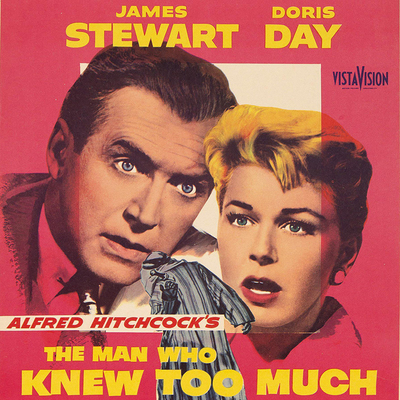
Sometimes momentum counts for more than we imagine in creative careers. When Alfred Hitchcock released The Man Who Knew Too Much in 1956 he was in the middle of what is now considered a golden period that began with Strangers on a Train in 1951, continued with Rear Window (1954) and To Catch a Thief (1955) and would be followed by Vertigo (1958), North by Northwest (1959) and Psycho (1960) – films upon which much of his popularity and critical reputation rest.
James Stewart, Hitchcock's preferred leading man during much of this period, had started the decade with a series of westerns directed by Anthony Mann (Winchester '73, Bend of the River, The Naked Spur, The Far Country, The Man from Laramie) that have passed the test of time as genre classics. And nothing becomes an American legend more than playing legendary Americans like Glenn Miller (The Glenn Miller Story) and Charles Lindbergh (The Spirit of St. Louis).
But the secret weapon would turn out to be Stewart's leading lady in The Man Who Knew Too Much. Doris Day arrived in Hollywood as a band singer recruited for her voice and wholesome good looks, and made a string of films for Warner Bros. that made it look like she was coasting on these two attributes – nearly a decade of perky fluff punctuated by one notable dramatic role as a Klan member's wife in Storm Warning (1950). But her performance as Ruth Etting in Love Me or Leave Me proved what she was capable of – and provided Hitchcock with a gift he didn't anticipate.
You could argue that The Man Who Knew Too Much was the director coasting on his momentum – the only remake in his whole career, of a film he made in 1934, a highlight of his career in Britain and the beginning of a string of thrillers that would make his reputation and send him to Hollywood just as war descended on Britain: The 39 Steps (1935), Secret Agent and Sabotage (both 1936), Young and Innocent (1937) and The Lady Vanishes (1938).
The film began as a favor for an old friend: Angus MacPhail was one of Hitchcock's collaborators when he made the original film for British Gaumont in 1934 and despite contributing to the scripts of Ealing films like Whisky Galore and Train of Events his alcoholism was getting the better of him and he wrote to his old friend for help, which Hitchcock provided in several ways, one of which was collaborating on a remake of the earlier film. The work would get him membership in the Screen Writers Guild and access to its health and insurance benefits.
Hitchcock and MacPhail began by updating the historical context of the story. Like much of Hitchcock's thriller output during the '30s, it had been made against the backdrop of growing Nazi power in Europe; both men were anti-communist in varying degrees and were caught up in Cold War news like nuclear espionage by Klaus Fuchs and Bruno Pontecorvo, and by Hungarian prime minister Imre Nagy's attempt to defy Stalin and liberalize his country. (Which would end badly for Hungary and Nagy, with Soviet tanks crushing the 1956 Hungarian Revolution and the arrest, secret trial and execution of Nagy in 1958.)
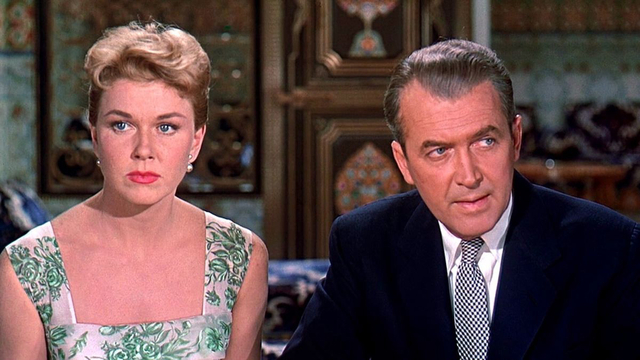
For the remake an English family, Bob and Jill Lawrence and their daughter Betty, on vacation in the Swiss Alps, were replaced by the McKennas and their son, on a trip to Morocco after Ben McKenna (Stewart) had attended a medical conference in Paris. He's a surgeon at a hospital in Indianapolis and a veteran of the North African campaign and their jaunt through Europe and down through Casablanca to Marrakesh is a sort of sentimental journey for him.
His wife, Jo (Day), is a retired singer whose fame had taken her on tours through England and Europe – a change apparently necessitated by Day's casting, at the insistence of MCA, the agency that represented both the singer and the director as well as Stewart. Hitchcock had wanted Grace Kelly for the picture but her contract with MGM and meeting with Prince Rainier of Monaco at Cannes in 1955 made that impossible. Day's onscreen persona – one at odds with the star in real life – meant a few changes.
In the original film Jill Lawrence is a bit of a flirt, dancing with Bernard, the French spy (Pierre Fresnay in the original, Daniel Gélin in the remake), while Day's Jo is suspicious of him, stoking her husband's distrust of the man after his initial good impression. The new film also filled in a lot of the McKenna's personal life, notably two conflicts that you would assume incompatible: Jo's wish to return to her career and relocate to New York, and her desire for another child.
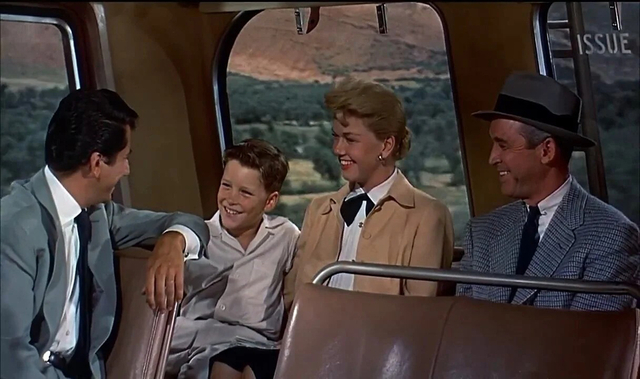
This simmering tension is felt from the moment we meet the McKennas, riding in the back of a bus traveling the dusty roads south from Casablanca. (A landscape that Jo sarcastically compares to the one they'd crossed the previous year while driving to Las Vegas.) This is international travel in its first golden age, of Thomas Cook, travellers' cheques, full-service concierge service, ocean liners, the DC-7 and the Super Constellation.
Their son Hank (Christopher Olsen) is your classic tow-headed American lad, full of awkward questions, brimming with self-esteem and restless energy. While wandering through the bus he accidentally pulls off a Muslim woman's veil and enrages her husband, which threatens to turn into an incident until Bernard, an Arab-speaking Frenchman, intervenes and defuses the situation. "The Muslim religion allows for few accidents," he explains to the McKennas.
(Guiltily, I must admit that I found Hank so irritating that it interfered with my ability to invest myself in his safety during the rest of the picture.)
Bernard invites the couple to be his guests for an authentic Moroccan dinner that night, but from the moment they arrive at their hotel Jo is certain they're being watched, and her budding paranoia infects her husband later that night after Bernard excuses himself from dinner, then shows up at the restaurant with a date and ignores them. By this point they've made the acquaintance of the Draytons, Edward (Bernard Miles) and Lucy (Brenda de Banzie), an English couple who get Jo to let down her guard, mostly by professing to be fans.
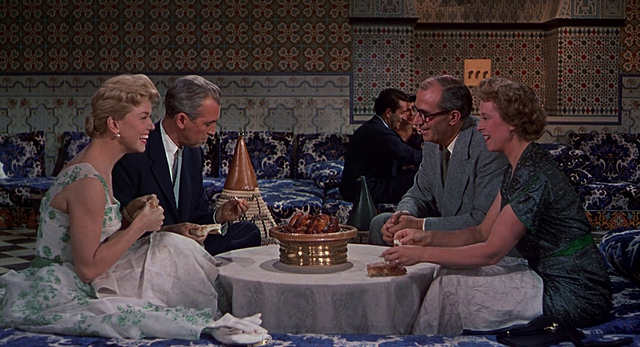
There's considerable business at dinner centred on Ben's clumsiness – with the low cushions they're sitting on, with the peculiar etiquette of the Moroccan table and its lack of utensils. Hitchcock loved to insert comedy into his thrillers and relies on Stewart's lankiness for most of it in the picture – an awkwardness that underlines his particularly American candour and lack of guile. Taken just a bit further it would have painted the McKennas as "Ugly Americans"; try to imagine these scenes in the hands of, say, Billy Wilder or Stanley Kramer.
In his biography of the director Alfred Hitchcock: A Life in Darkness and Light, Patrick McGilligan writes about the location shooting in Morocco and that despite Stewart's "well-rehearsed rube persona for the film, in real life it was Day who more closely resembled the 'typical American'. At the time of The Man Who Knew Too Much, she had never been outside the United States; she was petrified by airplanes, traveling whenever possible by boat. Arriving in Marrakech, she found the climate 'ungodly hot,' and was shocked by the 'poverty and malnutrition.' There wasn't much she could do about the poverty, but as an animal lover the star used her clout to demand that all the hoofed and feathered creatures used in the production be well fed on the film budget."
The next morning the Draytons host the McKenna's on a tour of the city's souk – a sequence cut with a strange mix of location shooting and obvious rear projection shots with Day and Stewart standing in front of second unit footage. Suddenly they see the police chasing some men through the crowd; one of them is stabbed and staggers across the square toward the Draytons. It's Bernard in disguise, in a djellaba with his face darkened with makeup, and as he dies he whispers to Ben that a diplomat will be assassinated in London, and that the key to stopping it is at "Ambrose Chappell."
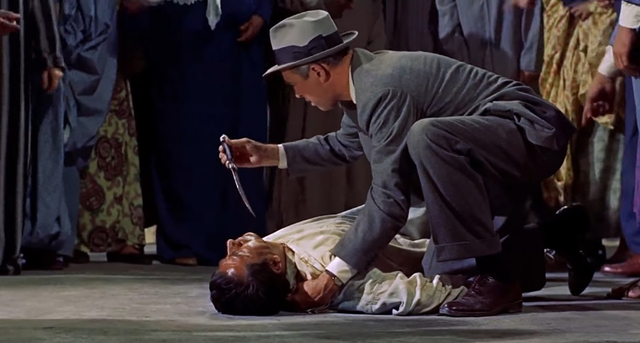
Bernard, it turns out, was a French secret agent, but the manners of the French detective who questions Ben rubs him the wrong way, and before he can be persuaded to share Bernard's last words he gets a phone call warning him that his son has been taken, and that he'd better keep whatever he knows to himself. Arriving back at the hotel he discovers that not only did Lucy Drayton not return with Hank, but that the Draytons have checked out.
This sets up one of the two scenes that make The Man Who Knew Too Much stand out above mere Hitchcock. Back at their hotel Ben has to break the news of Hank's abduction to his wife, and he starts by gaslighting her about her nerves. He makes a cruel bargain with Jo – that he'll tell her what's actually happening if she takes some pills that will help her relax.
In his biography Considering Doris Day Tom Santopietro says the scene is "the single best piece of acting Doris Day ever performed. Period." He also judges that her performance gets much of its resonance because "Jo seems unnaturally attached to son Hank" and that "her maternal devotion verges on the smothering, (as) if the child is the compensation for giving up her career."
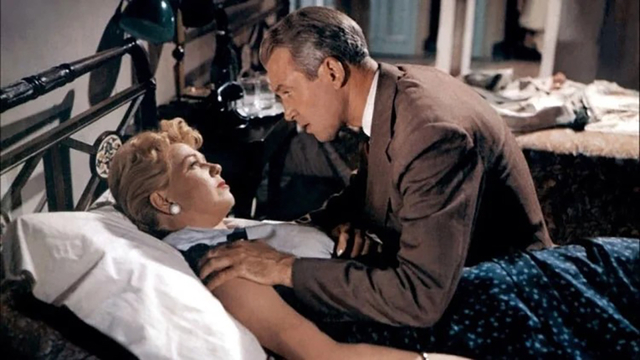
In his biography of Hitchcock, McGilligan says that Hitchcock disliked the "soap-opera quality of certain scenes" and edited down the despair and anger Jo expresses when she realizes what her husband has done. He quotes film scholar Bill Krohn on the first draft of the screenplay, written by John Michael Hayes, where "Jo tells off Ben in no uncertain terms for drugging his own wife, sobbing as she loses consciousness that she hates him with all her heart for what he has done."
The scene as it plays in the film didn't need to be so "melodramatic", as Hitchcock judged it. Day is devastating in portraying Jo's fear and grief and anger and confusion, and the betrayal at her husband's manipulation. Sedated, she sinks into lethargy while her husband packs and makes arrangements for them to travel to London, where he has discovered the Draytons have gone on a private plane.
On location in Morocco and London Day said she felt like a "lost soul", working day after day without any acknowledgment from her director. "I had an eerie feeling that I wasn't even being recorded on the film – that when the rushes were shown all there would be was Jimmy Stewart and some invisible presence who moved glasses around and opened doors, like Topper."
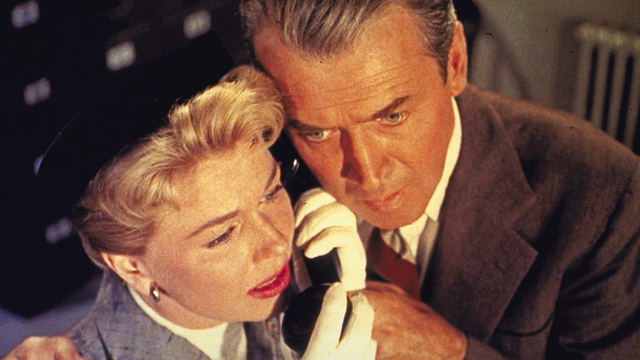
Back in Hollywood to shoot interiors she confronted Hitchcock, telling him that she felt like she had been "left to my own devices."
"But, dear Doris, you've done nothing to elicit comment from me," he replied. Day discovered, as so many other actors would before and after her, that Hitchcock only felt it worth intervening on set when things weren't playing out like the film he already had in his head.
"I mean that you have been doing what I felt was right for the film and that's why I haven't told you anything," he told her. This exchange apparently took place just before the filming of the scene with the pills, and according to McGilligan the master shot was done in one take.
While Hitchcock was pleasantly surprised by Day's talent as an actress – something quite a few people were startled to discover at that time – he was not as keen on showcasing her singing, though his agency was adamant that Jo sing a song in the picture. (Keep in mind that by the mid-'50s the power of studios like Paramount had waned and the power of agencies like MCA had grown to fill that void. It was the beginning of the movie "package" and not even Hitchcock could escape it.)
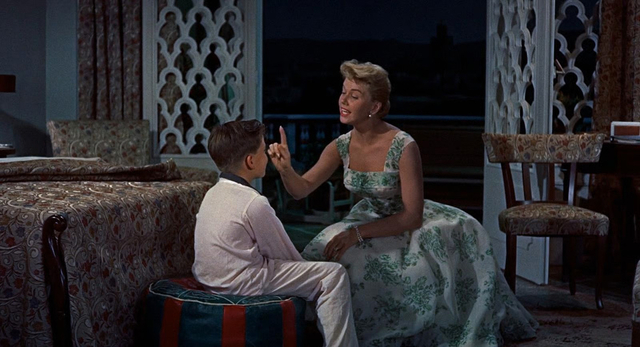
Jay Livingston and Ray Evans, two other MCA clients, were brought in to provide a song for Day, and the director told them that he wanted something simple enough for a child to sing. Livingston had noticed a motto – Che Será Será – engraved in stone on Rossano Brazzi's ancestral home in The Barefoot Contessa. He made a note of the words, changed them to "Que Será Será" and wrote the song with Evans quickly – so quickly that "we waited two weeks to let him feel that we had taken a lot of time. When I sang it for him, he said 'I told you I didn't know what kind of song I wanted. That's the kind of song I want,' and walked out."
Also known as "Whatever Will Be (Will Be)", the song wasn't a musical number but a piece of diegetic music, sung in character as part of the action – in this case as a lullaby early in the picture, sung by Jo to Hank in their hotel room in Marrakech, then later during the last major scene, when the boy is being held hostage in a foreign embassy in London.
Lyrically it's a stoic lullaby about resigning yourself to what fate provides, which flies in the face of a story about action and agency despite the odds. Writing about it here after Day's centenary, our host Mark said that "it's one of those numbers that sounds as if it's been around longer than it has" but that "the philosophy is bunk. Whatever will be is not what will be: We have the capacity to shape events and, if we don't, they may well turn out to be far less congenial for us than they were for Doris Day."
Day herself didn't think much of it and only bothered with a single take when pressured by Paramount and MCA to record the number for release. "That's the last time you'll hear that song," she reportedly said, but it won the Oscar for best song and became Day's signature tune and the theme of her TV sitcom when it ran for five seasons from 1968 to 1973.
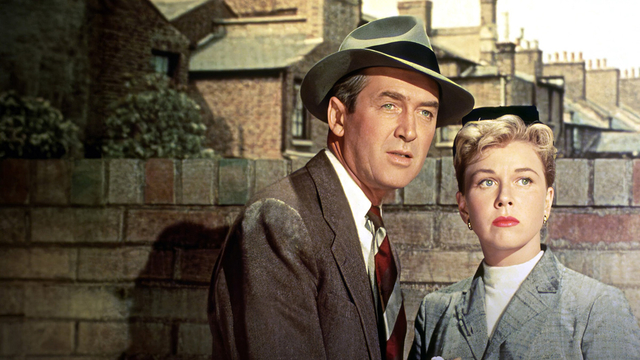
Arriving in London they run off after a red herring; assuming that Ambrose Chappell is a man and Ben tracks him down to a taxidermist's shop in Camden Town. In his original film it was the office of a dentist who was involved in the criminal conspiracy; in the remake there's no connection and Hitchcock has Stewart embroiled in a comic melee that does nothing to advance the plot.
At the same time Jo is back in their hotel room entertaining some showbiz friends (look for Carolyn Jones in a small part) and realizing that they shouldn't be looking for "Chappell" but "Chapel". This sends her to a Nonconformist church in Bayswater where Edward Drayton is a minister preaching to a dour, aging flock. (A notable change from the original film where the villain's front was a temple for sun worshippers, who nobody would mistake for Baptists.)
Ben confronts Drayton but gets coshed and locked in the chapel for his trouble while Jo – unable to persuade the police to intervene without a search warrant – heads to the Royal Albert Hall where Inspector Buchanan (Ralph Truman), their contact at Scotland Yard, is attending to security while a foreign prime minister from some unnamed and presumably Eastern European country is attending a concert. Searching the lobby, she recognizes a man who knocked on their hotel door in Marrakech while they were entertaining Bernard – the assassin hired by Drayton to kill the prime minister.
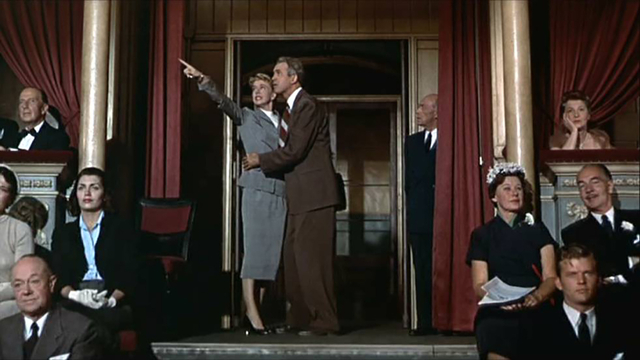
It seems that the main reason Hitchcock was so interested in remaking The Man Who Knew Too Much was to get another shot at the concert hall scene, this time in the real Albert Hall and with a budget that British Gaumont didn't have twenty years earlier. He even reuses the original music from the first film – Arthur Benjamin's Storm Clouds – with an extra minute added by Benjamin to help stretch the whole sequence to twelve minutes, and with soundtrack composer Bernard Herrmann playing the conductor; his only onscreen cameo.
The scene is textbook Hitchcock, tautly edited to ramp up the tension while the music plays and the dialogue fades, cutting between the prime minister, the conductor, the killer, the orchestra's cymbalist, Ben frantically trying to get help and searching the opera boxes for the killer and Jo, standing at the back of the orchestra seating where she has a perfect view of both the assassin and his target.
McGilligan writes that "the look on Jo's face when she realizes what is about to happen – as she writes futilely and sobs uncontrollably – fulfilled every hope for Day's performance." You might not make this speculation about another director, but there's also something unsettlingly erotic about Day's hysterical helplessness in the scene, which climaxes (there's no more suitable word) with, as Santopietro writes in his Day biography, "a piercing scream that startles the assembled throng and causes the assassin to miss his target. This sequence alone should have guaranteed Day an Academy Award for Best Actress; she wasn't even nominated."
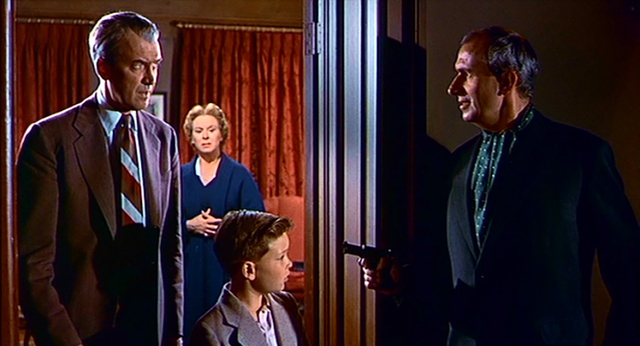
This is technically the culmination of the movie but there's one more scene, at the embassy, where Jo sings "Que Será Será" for the prime minister and his party – including the ambassador who's behind the attempted coup – in the hope that Hank, locked away somewhere in the building, will hear her and make some sign that will lead his father to him.
"Ultimately, the second Man Who Knew Too Much belongs to Day more than Stewart," McGilligan writes, and it's true, even if Jo doesn't get to dispatch the villain with a dead shot from a rifle, like Edna Best's Jill in the original. The film's flaws – it's too long (like most Hitchcock films during this period) and has several pointless scenes, with a villain that pales next to Peter Lorre in the original – don't detract from the performances the director got from Stewart and Day in particular, and it did well with critics and the box office, making back ten times its $1.2 million budget.
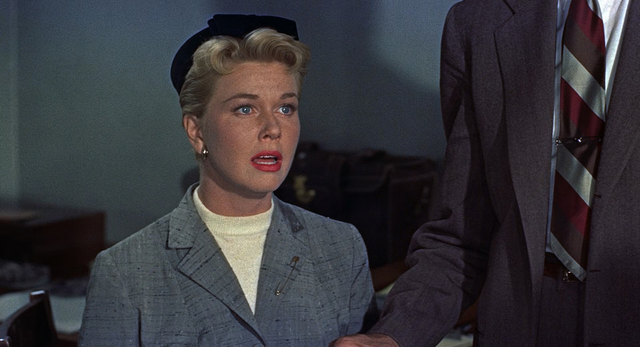
And while Day would become a much bigger star in the next few years, she'd never really top the performance she gave here. Santopietro speculates that Hitchcock noted the "tightly wound quality inherent in many of Day's performances ... a marked tendency to oversell some of the production numbers, smiling too brightly as if telling herself and the audience 'We're having a good time, right?'" and used it "to suggest the unhappiness in her marriage."
That Day was really trapped in an unhappy marriage (how unhappy wouldn't be public knowledge until her husband Marty Melcher died, revealing a string of bad deals and business decisions that left her bankrupt) was just something hidden in plain view. What was clear was how nobody looked better than Day while being driven to despair and grief – hardly the image of the star that would harden in the public's mind in just a few years.
Club members can let Rick know what they think by logging in and sharing in the comments below, as access to the comments section is one of many benefits that comes along with membership in the Mark Steyn Club.