
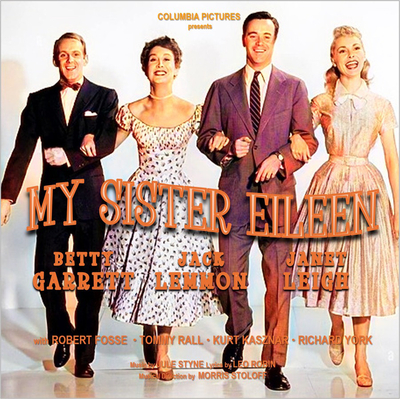
Bob Fosse was up to his usual tricks when he was asked to do some extra work with Janet Leigh during pre-production on My Sister Eileen, his fourth Hollywood movie role and his first as a choreographer. Leigh was nervous and asked Columbia, her studio, if she could rehearse with him "to get sort of seasoned" and started three weeks of what amounted to a private tutorial with the man who would become the most famous choreographer in American musicals.
(Leigh has said she had never made a musical before but that wasn't true: in 1951 she had starred in Two Tickets to Broadway alongside Tony Martin and Ann Miller, an RKO film produced by Howard Hughes and choreographed by Busby Berkeley. Two years later she was in Walking My Baby Back Home with Donald O'Connor. The pictures weren't exactly memorable, but why she forgot them is a mystery.)
Remembering the experience in Martin Gottfried's biography All His Jazz: The Life and Death of Bob Fosse, Leigh recalls Fosse as "almost angelic, sensitive, so gentle and patient." But although he was married to his second wife, Joan McCracken, and Leigh was married to Tony Curtis, Fosse was notably affectionate with Leigh whenever they worked alone.
"Both Bobby and I knew," Leigh said, "even without talking about it, that an affair would have happened if we let it. There was that much electricity between us." It would be decades before Fosse's infidelity was so infamous that it was crucial to his working method, as he would immortalize it later in his excruciatingly autobiographical All That Jazz (1979). But at the time it was hardly even notable: just another dancer from out east seeing what he could get away with in Hollywood.
My Sister Eileen is not a film that gets mentioned in lists of classic Hollywood musicals. It's a fun but not overly confectionary film that fits in with pictures like Royal Wedding, Skirts Ahoy!, Hit the Deck or Tea for Two. If it's remembered at all it's for giving audiences their first full look at Bob Fosse's work outside Broadway.
He had just come off The Pajama Game, a big hit on Broadway, but his dream of Hollywood stardom was still strong. "I wanted to succeed Gene Kelly in the movies," he said. "I thought it was a fair bet that I would succeed him." He had presented himself to MGM, the marquee studio for big budget movie musicals, with this ambition at the forefront of his mind.
His roles at MGM were in pictures made outside the prestige production unit overseen by Arthur Freed. The Affairs of Dobie Gillis (1953) was based on Max Shuman's popular short stories and starred Bobby Van and Debbie Reynolds, with Fosse as the titular hero's best friend. Give a Girl a Break, released the same year, also starred Reynolds and dancers Marge and Gower Champion, and was directed by Stanley Donen.
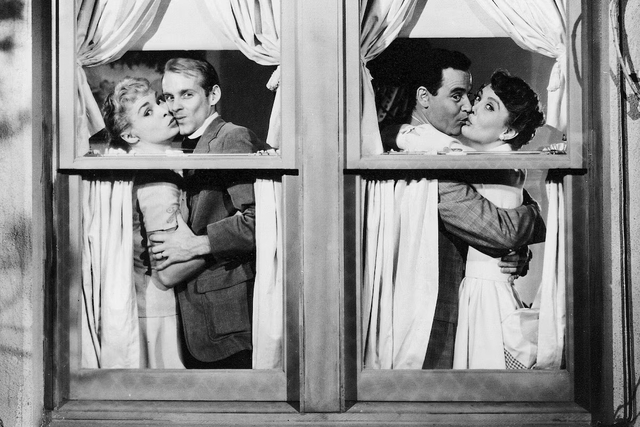
Kiss Me, Kate was based on a 1948 Broadway musical and starred Kathryn Grayson, Howard Keel and Ann Miller. Fosse had a small part and convinced choreographer Hermes Pan to put him in charge of his duet with Carol Haney in "From This Moment On". It's the first filmed record of a recognizably Fosse number; Haney had starred in "Steam Heat", the showcase number in Pajama Game, and would return to perform it when Donen and George Abbott directed the movie adaptation of the show. Both numbers are staples in any highlight reel of Fosse's iconic work.
Gottfried writes that Fosse's supporting role in My Sister Eileen "as one of Eileen's devotees was no bigger than he'd had in Give a Girl a Break; he still was no leading man, and he had to wear the hairpiece he had always dreaded would be his Hollywood destiny. He'd yank it off every chance he could, replacing it with a hat, which at least wasn't fake. His baldness was the reason that he wore hats, and was doubtless why he put hats on his dancers."
(Fosse is billed in the film as "Robert Fosse", apparently in imitation of his friend Jerry Robbins, who was credited as Jerome when he had his first major success at around this time.)
The film began production in a curious legal limbo. It was based on a series of autobiographical short stories by Ruth McKenney that had originally appeared in the New Yorker. They had been adapted into a Broadway play in 1940 and then a 1942 film, also called My Sister Eileen, which starred Rosalind Russell, Janet Blair and Brian Aherne. A musical adaptation called Wonderful Town opened on Broadway in 1953, with lyrics by Betty Comden and Adolph Green set to music by Leonard Bernstein.
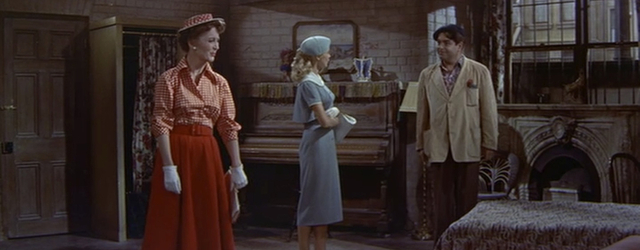
Columbia, which owned the rights to its earlier film version, had been cautioned not to copy any aspect of Wonderful Town, and so director Richard Quine (who had been an actor in the 1942 film) was forced to work with a lawyer sitting next to his camera, making sure that nothing in his film – not the music or dialogue, or even the placement of musical numbers – duplicated the Broadway musical.
With a script by Quine and Blake Edwards and new songs written by Jule Styne and Leo Robin, the film begins in Greenwich village and a montage of second unit footage of the bohemian New York neighbourhood, scored to a number simply titled "Atmosphere" and a chorus informing us that:
This is Greenwich Village
The Latin Quarter of New York
Oh what a pleasure it is to see
Washington Square
Where the air is purer
It's a haven for the tourists
But if you're a pleasure seeker
Go to Barrow Street or Bleecker
It has a flavor of Gay Paree
Art everywhere
The original short stories were based on the real life of Ruth McKinney and her sister Eileen, who left Ohio for a basement apartment in the Village to begin careers as a writer and actress, respectively. After the travelogue prologue ends the camera settles on Ruth Sherwood (Betty Garrett) and her sister Eileen (Leigh) as they're waylaid by Papa Appopoulos (Kurt Kasznar) while looking for an apartment.
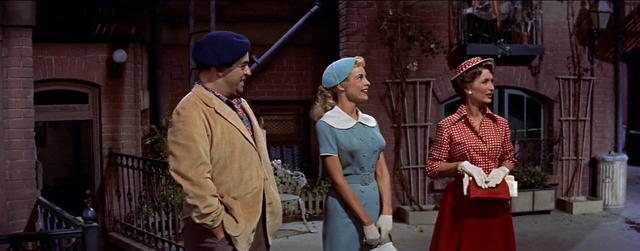
He takes them to his own building and shows them a vacant basement studio whose principal charm is its access to a courtyard garden – the same sort of place (albeit far less sinister) that Alfred Hitchcock used for the setting of Rear Window. Tired of looking for a place, Eileen begs her sister to take the apartment for at least a month, with the option of leaving with refunded rent if they don't like it. Just as Papa runs up the stairs with their money the building is shaken by an explosion from the subway tunneling going on beneath them.
In The Village: 400 Years of Beats and Bohemians, Radicals and Rogues, a History of Greenwich Village, John Strausbaugh describes this as the Renaissance of the Village: "After the war Greenwich Village served again as a tiny speck of American real estate where nonconformists, individualists, bohemians, progressives, avant-gardists, experimenters, gays and lesbians could gather and feel at home. Bringing creative and iconoclastic individuals together in a small area stoked the Village's cultural engine to a new level of creativity."
It also returned the Village to the mainstream consciousness as a bohemian epicentre, albeit just as San Francisco's North Beach was taking on the same role. But the Village had earned this distinction late in the last century and had already gone through what Strasbaugh describes as its golden era in the 1910s, and McKinney arrived to immortalize its creative charms in the '30s. It would hold out long enough to foster the folk music boom of the early '60s, but as the lyrics to "Atmosphere" inform us, the tourists had already arrived.
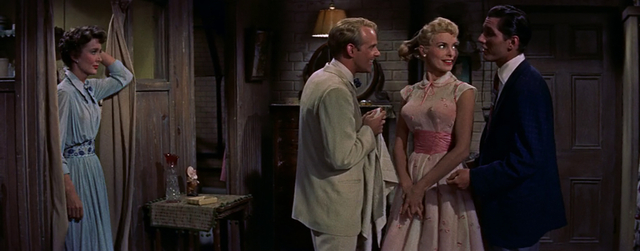
But all this is background to the central premise of the story – how the clever Ruth has lived her life in the shadow of her beautiful sister Eileen. Garrett is well cast as Ruth, the film's de facto protagonist, and Leigh is aided considerably by the lethal-looking cones of the brassieres she wears for much of the picture.
Quine underlines this on their first morning in New York when they begin job hunting, as Leigh's Eileen is a magnet for (often unwanted) male attention while Garrett's Ruth is virtually invisible. With a month's worth of savings to live on until they can find jobs, the sisters have a firm deadline in the big city.
Ruth has a letter of introduction from her newspaper boss in Ohio to an old army buddy. She's already sent an envelope full of short stories to Bob Baker (Jack Lemmon), an editor at the New Yorker-esque Manhatter magazine. Unfortunately he's just on the way out of his office for a fishing vacation when she arrives, but they talk just long enough for Bob to tell her that she writes well but her stories aren't believable, and that she should write something from experience.
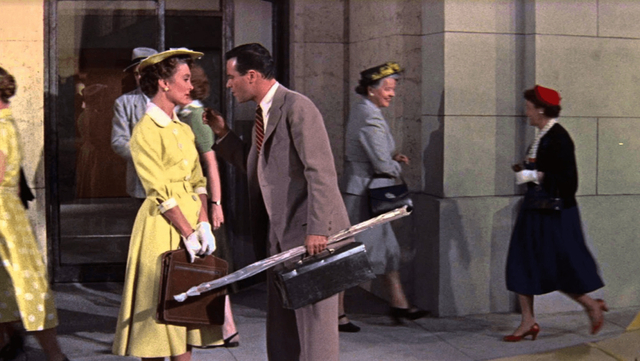
Eileen gets plenty of propositions but no job offers, though she finds at least one friendly face at the soda fountain of a midtown Walgreen's. Frank (Fosse) is the manager of the counter and offers to let her know when he hears about any casting calls at the nearby theatres.
He's sure he has a lead when a friend who works as an audition pianist mentions auditions, but he's immediately crowded by his buddy Chick (Tommy Rall), a newspaper journalist who claims to be friends with the show's producer. They accompany her to the theatre but get told to wait outside until she's done.
This is the set-up for a dance sequence that might probably be the only scene in My Sister Eileen most people have seen. Like Bobby Van in Dobie Gillis, Rall was an accomplished dancer, with a background in ballet and acrobatics that made a perfect sparring partner for the ultra-competitive hoofer, Fosse.
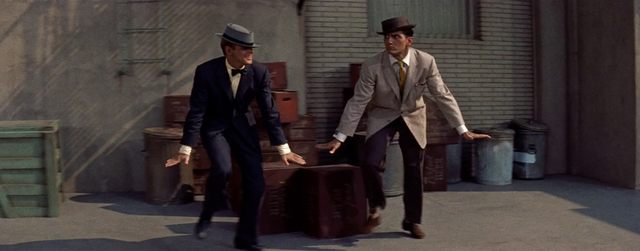
In the alleyway outside the stage door, the two men begin what can only be described as a territorial pissing match over Eileen. It begins with a bit of business with their hats, then high jumps on the spot over a rolled-up hankie. Soon they're leaping and twirling all over the pavement, then their jackets are off and the competition begins in earnest.
Fosse is already showcasing the vocabulary of moves that would make him famous – the small, tight movements of the hands and feet, the almost cartoon-like parodies of classic showbiz dance moves, and all that business with the hat.
Writing about the film in his biography of Fosse, Gottfried describes how "in a duet with Tommy Rall, he graciously allowed his better-trained partner to outshine him in ballet technique but, in compensation, he gave himself his favorite learned trick (perhaps because it was so uncharacteristic of him), a back flip."
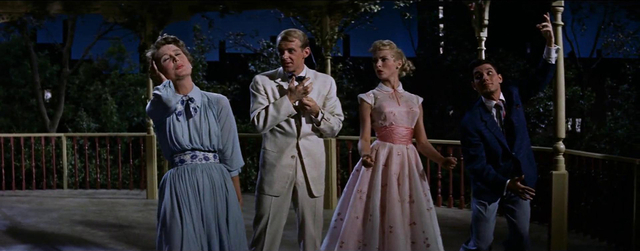
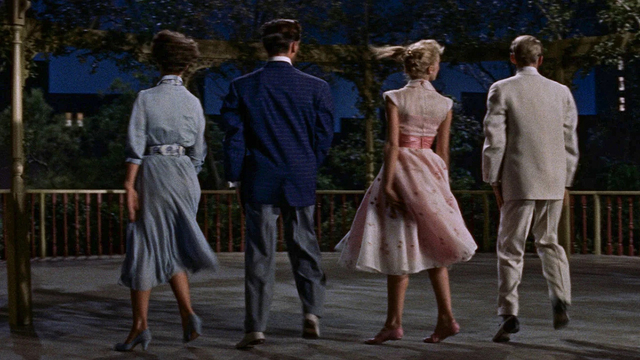
"Inevitably," Gottfried continues, "he drew on 'Steam Heat,' since, after all, it had just established him with such affirmation. He rehearsed Garrett and Leigh until they were ready to drop, having them endlessly repeat a wriggly, knock-kneed, slithering dance that they did in a gazebo. He kept telling the women, 'You have to do this very tight,' and he said it so frequently that Betty began to call all the thigh-rubbing choreography 'shaving your hairs.'"
Garrett was an old Broadway hand who had been under contract to MGM when she appeared with Gene Kelly in two Freed Unit hit musicals – On the Town and Take Me Out to the Ball Game. She and her husband Larry Parks had been unofficially blacklisted because of his membership in the Communist party, but thanks to some wise investments in Los Angeles real estate they rode out six years without any film roles. Garrett gives what's probably the best performance despite a thankless role that requires her to sing about living as the ugly duckling orbiting her sister.
She takes Bob's advice by writing a story about her sister, recalling all of her suitors and their desperate ploys to win her over, but stung by Bob's speculation about her inspiration she lies and says that it's really about her. He's not entirely convinced but, still intrigued, he sets about trying to win her over.
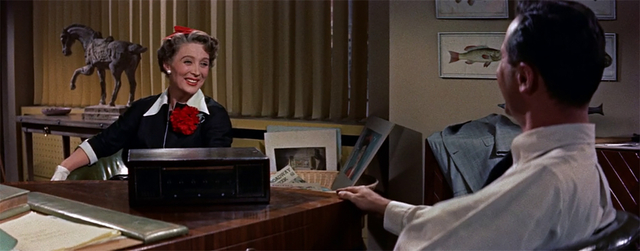
He tries to seduce her in a scene set after dinner in his very mid-century modern bachelor pad ("It's Bigger Than You or Me"), which serves to remind us that Lemmon was not a singer; it would have been merciful if Styne and Robin had written it as a duet. Apart from that it's a great example of the persona that Lemmon rode to stardom as a comic actor – the very average man living with aspirations inherited from movies and movie stars.
He pursues Garrett around his apartment, turning off lights to set the mood and doing his best impersonation of a lothario. He even copies Paul Henreid's famous move, lighting two cigarettes before giving one to Bette Davis in Now, Voyager. It would have worked better if Ruth smoked.
The film's climax happens on the sisters' last day in New York, after Ruth is called away to write a newspaper story about a Brazilian navy training vessel arriving at the Brooklyn Navy Yard – a ruse by Chick to get her out of the apartment so he can make one last move on Eileen. Thanks to the language barrier Ruth ends up being chased from Brooklyn to the Village on the subway by the whole of the ship's compliment of officers.
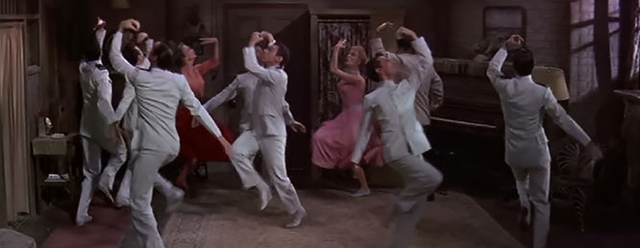
They crowd into the basement studio and converge on Eileen until Ruth has an inspiration: she starts a "monkey see, monkey do" exchange that transforms into a surreal circular jape and then a haunted house scene before the whole street is drawn into the apartment for a conga line that spills back out into the street where the police wait to arrest everyone. It's inspired madness, and you can't help but imagine how much fun it must have been for Fosse.
It gives us a chance to see what Fosse's work looked like before he gained control of the camera. He'd make two more films as a choreographer – The Pajama Game and Damn Yankees – before taking charge of direction with Sweet Charity in 1969 and, crucially, Cabaret in 1972.
"Where the Freed unit talents of Minnelli/Kelly/Donen brought the moving camera into the choreography," Jeanine Basinger writes in The Movie Musical, "Fosse in his musicals brings in the editing table, cutting with a rhythm and making the beats of the dance the cuts of the film."
"Bob Fosse modernized the musical," Basinger continues. "He also changed the idea that the dancer, in particular, had to be respected by the camera. On the contrary, his movies said, the camera can sit still and let the cutter do the dancing or at least be the partner of the dance. The result changed the dynamic of the musical for a viewer. No longer was the audience lifted up into a vicarious participation, a release into freedom of movement. Now the audience was a watcher of a rhythmic assault, in which the dancer paired with his or her own destruction."
I will let you decide whether this was a good thing. Ultimately it was hardly healthy for Fosse. And while My Sister Eileen isn't a masterpiece like Cabaret or (in my humble opinion) All That Jazz, it (along with Damn Yankees) provides a glimpse at Bob Fosse's work before it turned in on itself. These are the last moments of the hoofer, trying to impress an audience that he hasn't come to hate nearly as much as he'd hate himself.
Club members can let Rick know what they think by logging in and sharing in the comments below, as access to the comments section is one of many benefits that comes along with membership in the Mark Steyn Club.