
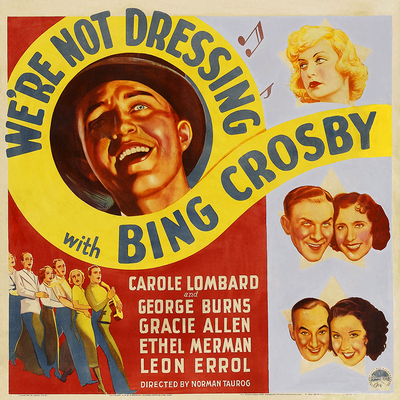
During filming of We're Not Dressing, a 1934 musical comedy that came out a month before Carole Lombard ascended into the top rank of screwball comedy heroines with Twentieth Century, her co-star Bing Crosby discovered that the actress had a rather extreme reaction to her one notable phobia.
As recalled by Gary Giddins in Bing Crosby: A Pocketful of Dreams: The Early Years 1903-1940, Crosby had to slap Lombard in one scene. "At her request, he refrained during rehearsal, but when the scene was filmed, she responded violently. Howard Hawks liked to take credit for creating Lombard as a comic actress by encouraging her to kick John Barrymore in the balls in Twentieth Century.
"According to Bing, she required no coaching: she kicked, punched, bit, screamed, tore off his toupee, and finally 'wept hysterically'. Bing recalled that she refused to do a second take and that some of the tantrum was actually used, but it wasn't. In the film, she returns his slap with a kiss."
Crosby got top billing for We're Not Dressing, which wasn't surprising as he was the bigger star at the time. Lombard had been playing small parts since she was a child actress in the early '20s, doing time under contract to Fox and as a Mack Sennett bathing beauty before roles in films like High Voltage and The Racketeer got her enough attention to return to Fox for a western, The Arizona Kid, which was a big enough hit to get her signed again, this time to Paramount.
She co-starred with Buddy Rogers – now obscure, once a big star dubbed "America's Boyfriend" – in a comedy, Safety in Numbers, that proved her talent as a comedienne, and she (briefly) married a much bigger star, William Powell. She bounced around between comedies, dramas, musicals and even a war film (The Eagle and the Hawk, starring Frederic March and Cary Grant) but in retrospect Lombard spent most of the pre-Code period waiting for the dawn of the Production Code to create the circumstances for the birth of the screwball genre and, even more importantly, the screwball heroine.
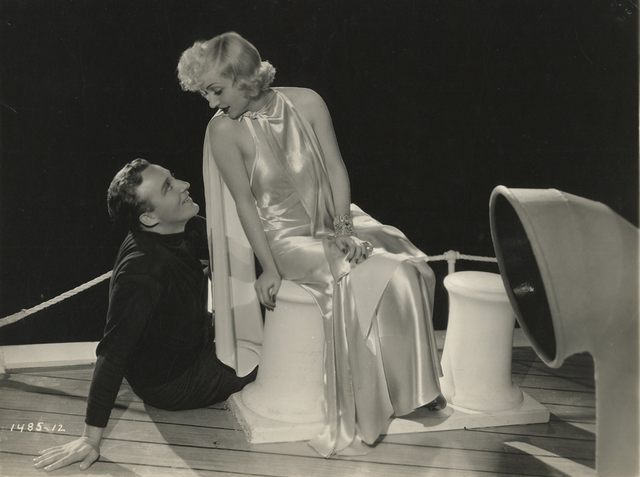
Let's be frank – We're Not Dressing is a charming, silly and very dated film that has nothing particular to recommend it in the context of either Lombard or Crosby's careers, except that it was made in the moment before movie comedy coalesced into the kind of vehicle that would end up suiting quite a few actresses like Lombard.
Myrna Loy, Jean Arthur, Claudette Colbert, Ginger Rogers – they were all in the same sort of career limbo as Lombard until a handful of films like Twentieth Century, It Happened One Night, Design for Living and The Richest Girl in the World came out in 1934 and created a kind of female lead that would come to suit their talents and onscreen personas perfectly.
We're Not Dressing isn't one of those films, even though it came out in the same year. It's a film where a chaotic mood in search of a genre alights fitfully; much of the comic heavy lifting is done by members of its secondary cast, and while Lombard is only allowed to show brief flashes of her comic potential, nobody would try to imagine Crosby as a screwball hero, even though that job would be taken by actors as varied as Cary Grant, Joel McCrae, Fred McMurray and Robert Montgomery.
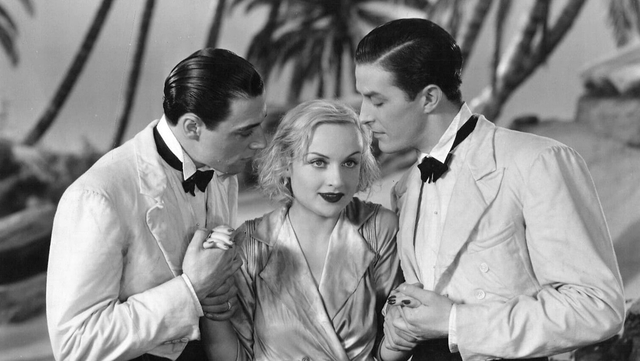
We're Not Dressing opens with the luxury yacht Doris sailing the Pacific. On the upper deck is its owner, heiress Doris Worthington (Lombard), her dipsomaniac Uncle Herbert (Leon Errol) and best friend Edith (Ethel Merman). Doris is being pursued by Prince Michael and Prince Alexander, two typically gold-digging specimens of European royalty who are indistinguishable except that one of them is played by Ray Milland.
Below decks is a rather enormous crew of sailors, including Stephen (Crosby), whose main job is to take care of Droopy, Doris' pet bear – who depending on the scene was played by Bruno, a real bear, or a man in a costume. The bear has developed an excessive attachment to Stephen and gets out of control until the sailor can soothe the beast by serenading it with "Good Night Lovely Litle Lady". (Most of the film's tunes were written by Mack Gordon and Harry Revel.)
It would turn out that Bruno would be less of a physical threat to Crosby than his co-star.
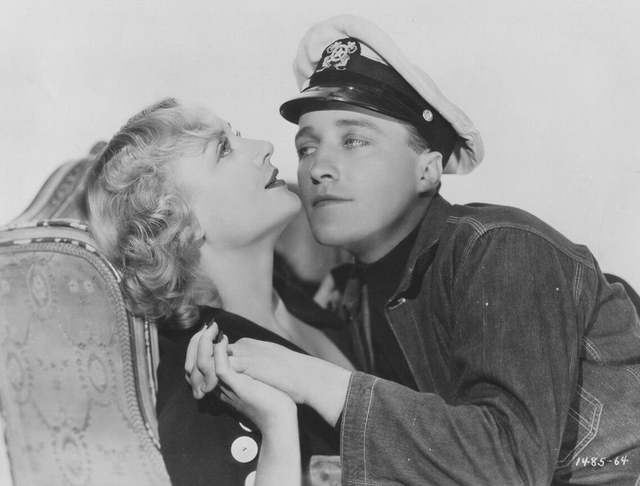
While ostensibly on the voyage to decide which prince she'll marry, Doris has been mooning over Stephen since they weighed anchor, but the inappropriate attraction has meant that she's spent the voyage tormenting him. She hasn't fooled her friend Edith, who nonetheless wants her to pick a prince so she can marry the spare for his title, then divorce him and shack up with Uncle Herbert.
When Uncle Herbert insists on putting roller skates on Droopy, sending the poor creature rolling all over the decks like a loose, furry cannon, Stephen shoves Doris out of the way of the careening bruin, outraging the haughty heiress. Their confrontation results in a slap and a kiss and she fires him, telling Stephen that he'll be put ashore at their next port of call.
But that night while the Doris sails through a fog bank, Uncle Herbert gets drunk and decides to pilot the ship, which founders on a reef. The princes jump overboard before they can save Doris, who has been knocked cold and lies unconscious in her stateroom. Stephen, after making sure Droopy gets overboard in a life jacket, heads back to save Doris and both of them abandon ship just as Doris' namesake goes under.
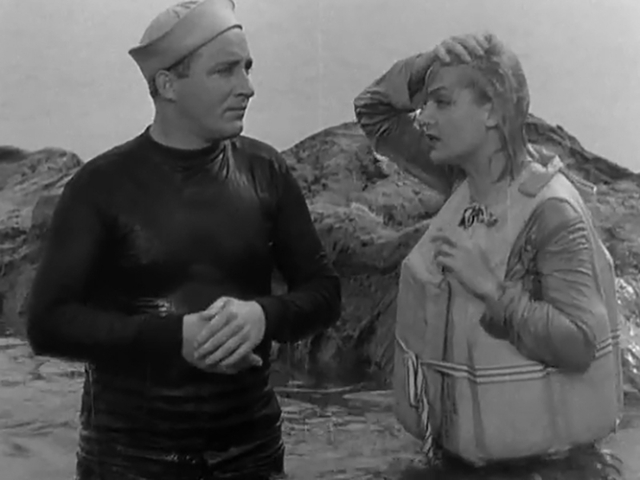
Stephen ends floating in a barrel, towed by Droopy, and they find Doris floundering in the sea before washing ashore with everyone else from the upper decks on a desert island. They begin ordering Stephen to build a fire, cook them breakfast and build a shelter until he reminds them that even if they were still on a boat, he was fired the night before.
A trained architect – or so we learn late in the film – and all-around handyman, Stephen sets to making himself comfortable and fed while the socialites shiver and starve. Eventually everyone from the upper deck defects to Stephen's half of the beach, choosing to live by his egalitarian rules if they want to eat – everyone except Doris, who sulks in the surf and tries to trick Stephen by trading a bag full of empty shells for some grilled clams.
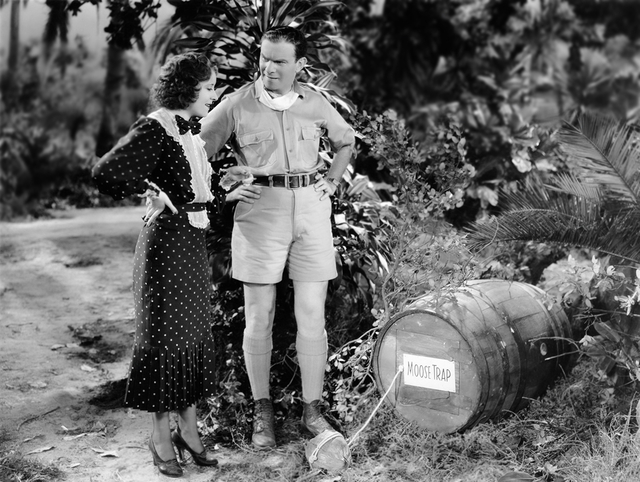
Driven out of camp by her selfishness, Doris wanders the jungle until she falls into an animal trap built by George and Gracie Martin, a naturalist and his wife who've made camp on the island, played by comic duo George Burns and Gracie Allen. They offer to alert the authorities and get the castaways rescued but before they can do that, Doris asks if she can borrow some dry clothes – and a took kit so she can get Stephen to make good on his boast to build a city with all modern conveniences on the island.
We're Not Dressing was based on J.M. Barrie's evergreen 1902 stage hit The Admirable Crichton, a property so well-known at the time that Stephen and Doris even refer to it in the movie. Audiences at the time would have been very familiar with the frequently staged play, which makes this an only slightly meta move.
It was made into a film in the UK twice, as a silent picture in 1918 and again in 1957 with Kenneth More as the titular Crichton. Cecil B. DeMille adapted it as Male and Female in 1919, starring Gloria Swanson. More recently the story was adapted by Italian director Lina Wertmuller with her 1974 art house hit Swept Away, starring Giancarlo Giannini in the Crichton role. Garry Marshall adapted the story again in 1987 as Overboard, starring real-life couple Goldie Hawn and Kurt Russell, and Madonna remade the Wertmuller film as a star vehicle for herself in 2002 with her then-husband Guy Ritchie directing and Giannini's son Adriano playing the sailor.
It's a story about class and privilege, told with varying degrees of political intent, from the polite subversion of the British class system in the 1957 More picture to the critique of communism in the Wertmuller film. I haven't seen all the different versions, but I'd venture that We're Not Dressing might be the most politically gentle, even while being made in the middle of the Great Depression.
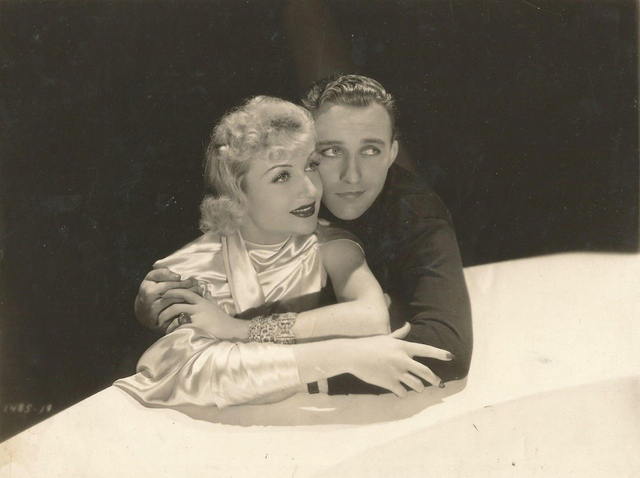
Crosby was a star in the early '30s more because of his singing than his acting. After his success with Paul Whiteman and the Rhythm Boys and hits like "I Surrender Dear" and "Wrap Your Troubles in Dreams", he had gone solo and started hosting a CBS radio show, 15 Minutes with Bing Crosby. More hits followed – "Out of Nowhere", "At Your Command", "I Found a Million-Dollar Baby (In a Five and Ten Cent Store)" – and his first major picture, The Big Broadcast, in 1932.
As an actor he had a lot going against him. "He was appealing, to be sure, with azure eyes and handsome features," Gary Giddins writes in A Pocketful of Dreams," but he had those wingy ears, a rapidly receding hairline, and an expanding waist. Bing was consistently modest about his abilities as an actor...He insisted that all he ever did was play himself.
"The wonder is that he was so certain playing himself would do the trick. Bing quietly, pragmatically weighed his strengths and limitations, confident that the former would carry the day. In the long view, he probably shortchanged his dramatic talents by clinging too closely to the Bing Crosby persona. Yet in 1930 that persona existed only in his mind. His belief that he could beat the odds by himself followed from his conviction that he could remake himself as a 'type,' a new movie genus, Bingus crosbyanis. In learning to play himself, he had to invent himself. And he invented himself as a man whose decency others might want to emulate."
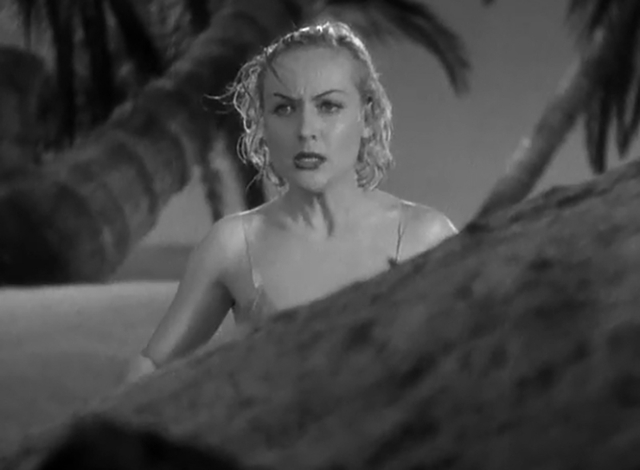
In Romantic Comedy in Hollywood from Lubitsch to Sturges, James Harvey describes how in Lombard's pictures before Twentieth Century "a strain begins to show: a hectic, inchoate quality in her performances that gets worse rather than better as the movies roll by, one after the other. More and more her emotions seem discontinuous, disproportionate. She tries posturing but never seems to get away with it. Her face is almost haplessly expressive, sending messages she can't control.
"She talks about hope, and the eyebrows rise hopelessly. She smiles and the eyes look angry. He variableness is so marked that We're Not Dressing tries building one of its song routines around it: as Bing Crosby croons a love song, she looks fierce each time her gaze is on her, melting and love-struck each time he looks away."
On set, however, Lombard's famously raunchy personality was already in full force. Giddins writes that Crosby "enjoyed her dedicated swearing – 'colorful epithets' he described as 'good, clean and lusty. Her swear words weren't obscene. They were gusty and eloquent. They resounded, they bounced. They had honest zing!'"
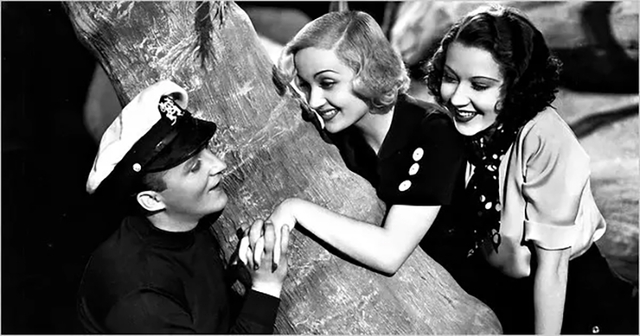
"She occasionally livened the set by flashing him," Giddins writes. "While breakfasting at Catalina's St. Catherine Hotel, where elderly regulars stared disapprovingly at the movie clan she 'came slinking in' and loudly cried, 'Bing! Did I leave my douche bag in your room last night?' For two days she sent Bing a one-word telegram every fifteen minutes or so: the word was NOW.'"
"She was the least prudish person I've ever known," Crosby wrote later.
There is, sadly, not much romantic or comic rapport onscreen between Crosby and Lombard. The real comic spark in the film is in the brief scenes with Burns and Allen, who by this point had refined their act to the form that made it famous, with Burns as the exasperated straight man constantly struggling to make sense of his wife's cosmic daffiness.
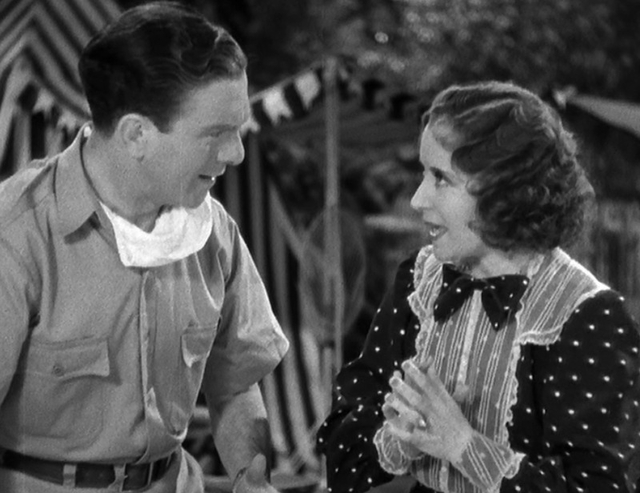
It would be a few years before Burns started pretending he was too cool for Gracie's blessed madness. Whether explaining to George how her "moose trap" works or assuming that he'd taken to wandering through the jungle in a bear costume, Gracie Allen worked at a level of nearly pure absurdity equalled in comedy only by the Marx Brothers at the time, to nowhere near the same level of critical acclaim or hip approbation.
We're Not Dressing was beautifully shot and briskly told, thanks respectively to cinematographer Charles Lang (The Uninvited, The Ghost and Mrs. Muir, Sabrina, Some Like it Hot) and director Norman Taurog, who delivered the picture with a swift 77-minute runtime. Taurog had won a best director Oscar in 1931 with Skippy and he would have a big hit later with Boys Town and introduce Judy Garland in her first adult role in Presenting Lily Mars.
But by the '50s he'd partner with Dean Martin and Jerry Lewis for vehicles like Jumping Jacks, The Stooge, The Caddy, Living it Up, You're Never Too Young and Pardner, and he'd spend the following decade at the helm of Elvis Presley films like G.I. Blues, Blue Hawaii, Girls! Girls! Girls!, Tickle Me, Spinout, Speedway and Live a Little, Love a Little. The last film provided him with an excuse to retire, but who wouldn't?
Club members can let Rick know what they think by logging in and sharing in the comments below, as access to the comments section is one of many benefits that comes along with membership in the Mark Steyn Club.