The real horror of most western movie stories is that the frontier exists in a lawless state that's particularly obscene as it's the leading edge of America moving west – a country founded on an almost divinely inspired Constitution and the expectation that law will create the conditions for democracy as the country fulfills its manifest destiny.
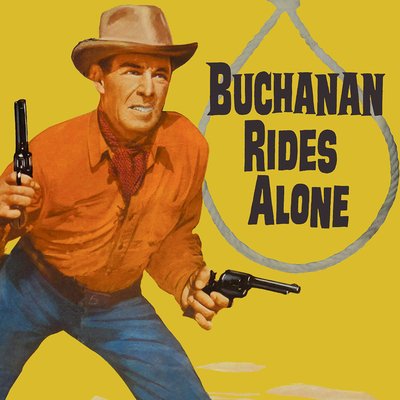
I couldn't help but think of this during one particular scene in Budd Boetticher's 1958 b-western Buchanan Rides Alone – the fifth of six (or seven, depending on what you read) films in the director's Ranown Cycle (including 7 Men From Now, The Tall T, Decision at Sundown, Ride Lonesome, and Comanche Station, and possibly Westbound – again, depending on what you read).
There are scenes that come standard issue with nearly every western: the stagecoach chase, the saloon brawl, the hanging – roughly from a convenient tree or formally on a gallows in the town square – and the main street showdown at high noon. One you don't see often is a jury trial, not because there were no judges or juries on the frontier but because they sit uncomfortably amidst all the canonical stereotypes of the lawless west.
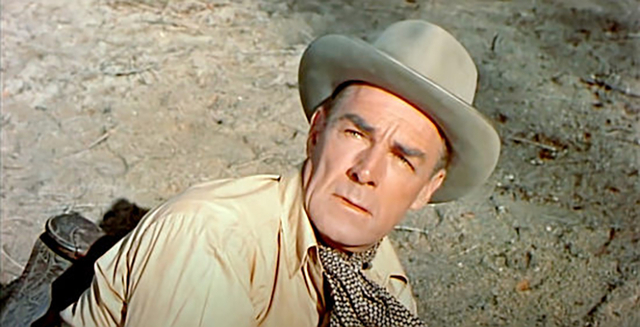
Buchanan Rides Alone has been described as the closest thing Boetticher gets to a comedy in the whole Ranown Cycle and if you're familiar with the films you'll see why just moments after the credits roll. Tom Buchanan (Randolph Scott) rides out of the desert and up the main street of Agry, a California border town run by a single family where the border isn't a 20-foot-high wall but a sign on a wooden bridge.
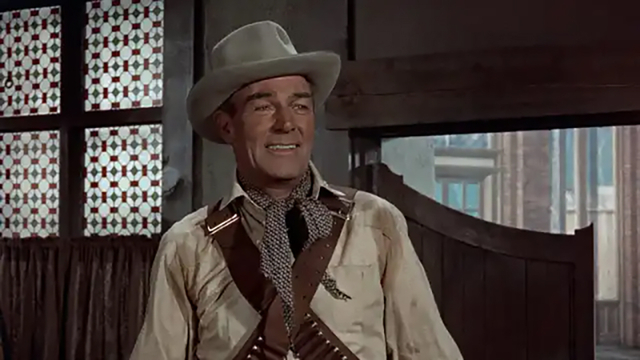
Scott's Buchanan is a far cry from the grimly driven roles he usually plays in Boetticher's films – such as the bounty hunter out for vengeance in 7 Men From Now, the bounty hunter out for vengeance in Ride Lonesome and the bounty hunter out for vengeance in Decision at Sundown. Buchanan rides with two gun belts across his chest and a big smile on his face. He greets the hostility of sheriff Lew Agry (Barry Kelley) affably and takes to being fleeced for accommodation by hotelier Amos Agry (William Leslie) – everything in the town apparently costs ten bucks – with good-natured sarcasm.
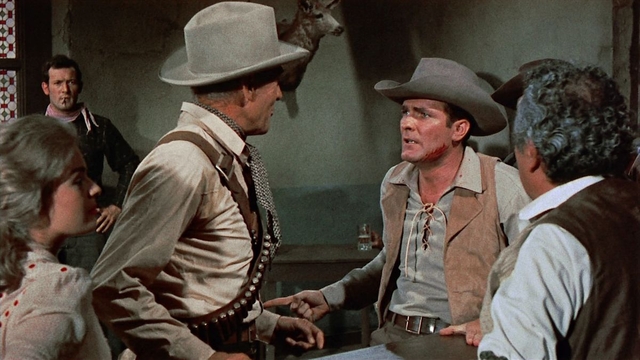
He's just as nonplussed by the threats of a belligerent young cowboy, Roy Agry (William Leslie) in the saloon, knocking him cold when he tries to pull a gun and tucking into a steak while the punk finishes off a bottle of whiskey he stole from the older man, promising to kill Buchanan when he drains the bottle. But he's emptied the young hothead's revolver while he was on the floor and just winks at Carbo (Craig Stevens), the enforcer working for the town's judge and big man Simon Agry (Tol Avery), sent to see what trouble his son is getting into.
Buchanan is a hired gun – a mercenary just back from selling his services amidst the revolutionary turmoil in Mexico. He's done well enough to have a gun belt loaded with $2000 in coins, and he's on his way back home to west Texas to buy the ranch of his dreams. That this professional killer has such an untroubled conscience is the bedrock premise of whatever comic conceit runs through Boetticher's film.
(You have to wonder if the Coen Brothers had Scott's Buchanan in mind for the relentlessly upbeat singing gunslinger played by Tim Blake Nelson in their recent western anthology film, The Ballad of Buster Scruggs.)
Boetticher's film was based on a 1956 novel, The Name's Buchanan, written by Jonas Ward, and adapted by Charles Lang, and though his script was discarded by the director and mostly re-written by his longtime collaborator Burt Kennedy, Lang was meant to be given the screen credit to help him out while his wife was sick.
Or at least that's one version. Another gets told by Robert Nott in The Films of Randolph Scott, which has it that Lang was in the middle of a divorce and drinking. Boetticher recalls that his own wife walked out on him during a Christmas vacation in Mexico and while scouting for locations in Tucson on his way home, cinematographer Lucien Ballard stormed into breakfast and threw down his copy of the script, calling it a "piece of shit."
Boetticher says that he called Kennedy to come to Tucson where "we ad-libbed the whole goddam picture." Craig Stevens' part was substantially expanded in the process but the director noted later that "there are no credits because they couldn't say what we did. They couldn't say, 'Written, directed, produced and ad-libbed by Budd Boetticher and Burt Kennedy.' That's a true story."
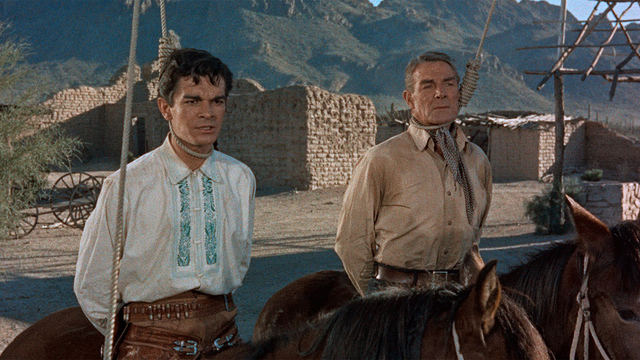
Buchanan is on his way out of the saloon when he sees a man ride furiously into the town and charge into the bar. Juan de la Vega (Manuel Rojas) has come to avenge his sister, who was raped by Roy; he gets the drop on him and guns him down, but the sheriff and his deputies are on hand and begin beating Juan ferociously. Incensed, Buchanan steps in and gets in a few good shots before he's taken down.
Sheriff Lew lets the two men recover from their beating but as soon as they're awake they're taken out to the dusty town square to be summarily hung. In the meantime Carbo breaks the news to his boss that his son is dead; nobody seems either shocked or sad at his passing – the general consensus is that it would have happened sooner or later.
But Carbo tells his boss that a lynching will do more harm than good to his campaign for governor, running on a law-and-order ticket. He advises him to step in and put the men on trial. Carbo is apparently the brains as well as the muscle behind Simon Agry's operation, though the judge has at least one gift, useful in a politician – a loquacious stream of emollient rhetoric that coats his manipulation and self-interest in high-minded language.
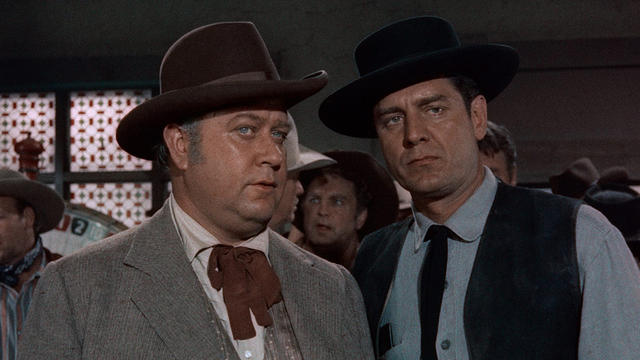
This is when Buchanan and Juan go to trial. It would be an exceptional western that strove for historical accuracy when its audience is perfectly content with genre archetypes but Buchanan Rides Alone shows us a frontier trial that overlaps with the type described by Christopher Knowlton in Cattle Kingdom: The Hidden History of the Cowboy West, which involved "the most rudimentary and arbitrary forms of criminal justice."
"The local justice of the peace or the police-court judge handled all the minor cases, and these men were, as likely as not, also the local saloonkeepers. District judges, who handed federal and state crimes, from robberies and holdups to rapes and murder, served the larger territories. But these judges had to travel vast distances to dispense justice, and they struggled to convene juries: an offender had no guarantee of a timely trial, let alone a fair one."
Knowlton quotes Mark Twain's description of a jury composed of "two desperadoes, two low beerhouse politicians, three barkeepers, two ranchmen who could not read, and three dull, stupid human donkeys! It actually came out afterward that one of these latter thought that incest and arson were the same thing."
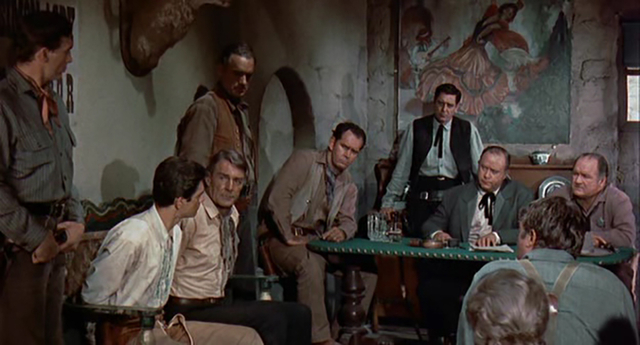
The trial of Buchanan and Juan happens in the local saloon – in all likelihood owned by an Agry like most of the town's businesses – with the father of the victim presiding as judge. The jury sits on the stairs leading to the second-floor rooms and the defendants are unrepresented by legal counsel.
Juan admits openly to killing Roy Agry but Buchanan has to defend himself against Sheriff Lew Agry's contention that he was working with Juan to rile up Roy and ply him with liquor, before waiting to step in and defend the murderer when he was unlucky enough to commit his crime with the whole of the local constabulary present.
But like the trial described by Twain the jury returns with a verdict of not guilty for Buchanan, which suggests that despite their obvious hunger for a hanging, the townsfolk aren't fans of their sheriff in particular or the Agrys in general. Juan is sentenced to hang and Buchanan is told to leave town as soon as possible, and without his mercenary earnings, which have already been confiscated by Lew Agry.
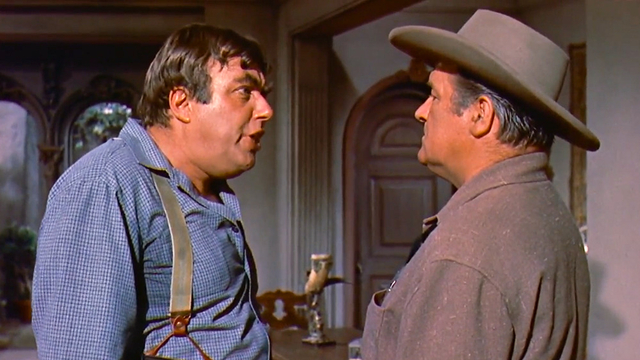
The only thing between Juan and the noose is Simon Agry learning that Juan's father is a wealthy rancher in Mexico who has sent Gomez (Joe De Santis), his ranch foreman, to negotiate with the judge for his son's release. Juan's father offers thirty purebred horses; Simon raises his price to $50,000 and gives Gomez forty-eight hours to come up with the cash, sending Carbo into town to curtly inform the sheriff that the hanging has been postponed.
The sheriff sends Buchanan on his way accompanied by two deputies tasked with killing the unlucky gunman somewhere out in the wilderness. Fortunately for Buchanan, he's made a fast friend in Pecos (western stalwart L.Q. Jones, soon to be a regular in Sam Peckinpah's films), another west Texan who kills his fellow deputy before he can gun down Buchanan from behind. Pecos says he knows a place where they can hide out and Buchanan offers him a share in his ranch out of gratitude.
Like Whitney's cowardly Amos Agry, who spends the film sweating profusely and clutching his heart as he runs back and forth between the town and his brother Simon's hacienda, Jones' Pecos carries his share of the burden of comic relief in Boetticher's picture. One darkly humorous moment occurs after Pecos ties the body of his dead colleague high up in a tree (to keep it away from scavenging animals) and feels obligated to pronounce a few frank but half-heartedly apologetic words in lieu of a burial service while Buchanan listens with a wry expression.
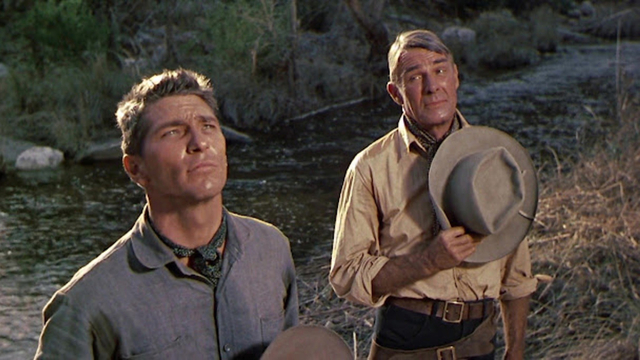
While Buchanan plans to return to Agry for his money, the sheriff is tipped off about the deal his brother the judge has made with Juan's father by their brother Amos, who hopes for a cut of the bribe if the sheriff can get Gomez to give him the cash. Buchanan and Pecos manage to rescue Juan when he's taken by the rest of the sheriff's deputies to the same hideout in the desert, but Pecos is killed and Juan re-captured when the henchmen cut themselves free.
There's a whole lot of very western movie business involving men riding back and forth under sunny skies darkened by Lucien Ballard's "day for night" cinematography. The rest of the film is concerned with the double-crosses Simon and Lew Agry pull on each other while Stevens' Carbo watches from the sidelines, wary of the damage the Agry's sibling rivalry is about to unleash.
Carbo, in his black clothes and hat, fits the iconography of the western movie bad man but since this is a Boetticher western he benefits from the director's fondness for exploring the moral complexity he creates behind the standard "black hat" villain. As with Scott and Richard Boone's outlaw in The Tall T, or Scott and Pernell Roberts' henchman in Ride Lonesome, a mutual respect grows between the hero and the villain.
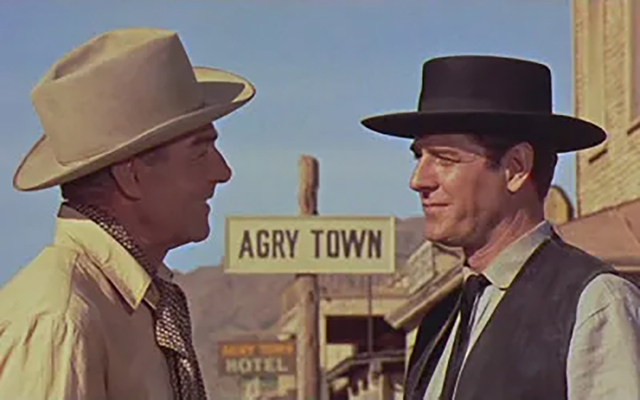
In films like The Tall T it's the recognition that they wouldn't have been enemies if they hadn't made certain choices earlier in their lives. In Buchanan Rides Alone it's a realization that they're the smartest men in a dismal situation. At the end of the film, when the street is littered with bodies (there are a lot of killings for what's at least peripherally a comedy), Buchanan is apparently the only man with the authority to tell Carbo that Agry is his town now and having recovered his blood money he's happy to leave him to it.
The film would be the last western Boetticher made for Harry Cohn at Columbia; after filming ended in early 1958 Cohn died in March. You have to imagine that the famously tight Cohn would have at least been pleased that the director wrapped shooting on the film in less than two weeks. Buchanan Rides Alone is as concise and briskly paced as the rest of his Ranown films, just 73 minutes long, perfect for the bottom half of a double bill.
Like most of Boetticher's films, it made more money in Europe than America, and as Nott says in The Films of Randolph Scott, that was noticed by the men who took over Columbia from Cohn. It certainly didn't rescue Boetticher from languishing as a b-movie director, and L.Q. Jones reflected later that while the director never rose to the ranks of a Raoul Walsh, Don Siegel, Edward Dmytryk or Peckinpah, he never had a shot at the same budgets or opportunities.
"It's hard to rate Budd," Jones said. "You can see the stuff that John Ford did, you can see the stuff that (William) Wellman did. They got shots at really big pictures. Budd, on the other hand, never really got a shot at a big picture. Look at the stuff he did with Randy (Scott) and (producer) Harry Joe Brown. They were making them for spit. I think our budget on Buchanan was somewhere between 300,000 and 350,000. When you have that sort of budget and limitation, can you be a John Ford?"
Club members can let Rick know what they think by logging in and sharing in the comments below, as access to the comments section is one of many benefits that comes along with membership in the Mark Steyn Club.