
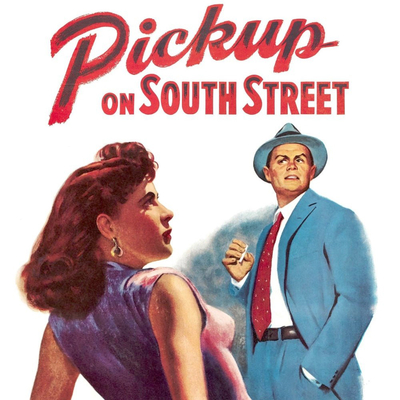
There's a clip on YouTube of director Samuel Fuller in the early '80s talking about the opening scene of his classic 1953 film noir Pickup on South Street. He would be about seventy years old at the time but he's full of energy and enthusiasm, as you would be if you were Samuel Fuller being interviewed for what I presume is French television. Fuller was and had been for decades something like a deity for French cineastes (the director had moved to France around this time) and he would never have an audience this avid anywhere else in the world.
Fuller is, as we used to say, a real character from charactersville, explaining how and why he made the picture in the kind of broad, Northeast American accent that has very nearly disappeared, even from the New York City where Fuller spent his teens working in newspapers and supporting his widowed mother.
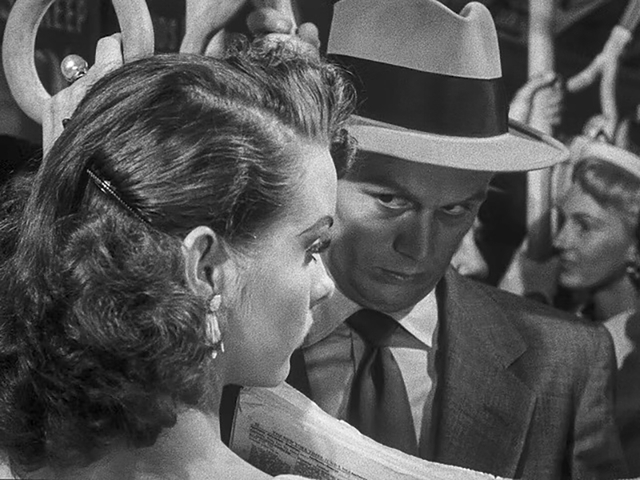
He talks about how studio workmen were moving the subway car set with wooden levers to mimic a moving train in the studio at Fox and how cramming his actors together so tightly was the purest of realism. "People are a million miles away when they're standing in the subway," he says. "They can be looking at a sign, they can be reading a paper. But if I'm in a subway and a man or a woman is facing me and we're that close – THAT CLOSE! I've been in a subway where the noses touch. The noses. So that's important story construction wise, to see the pickpocket at work..."
While Fuller might have tried to describe the packed subway car in his film as realistic, the scene is heightened and hyperreal, like the best kind of moviemaking. The sound design plays the biggest part – the train moving through the tunnels of Manhattan rumbles and roars at deafening volume, a primal, threatening sound that puts the audience on edge even before we witness the establishing action of the scene.
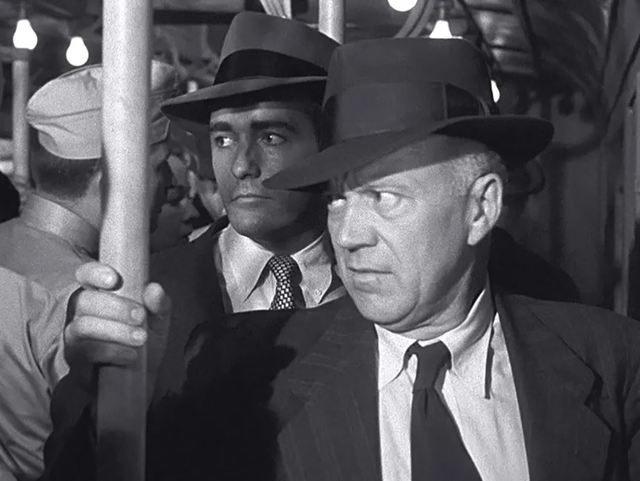
The scene is wordless. First we notice Candy (Jean Peters), a young woman in a white dress, and the two men who are watching her in the crowd. Then the pickpocket Skip (Richard Widmark) eases his way through the crowd and plants himself right next to her. As Fuller describes it they're so close their noses almost touch. The camera cuts back and forth to their faces; we have no way of knowing whether they're "a million miles away" as Fuller said or staring each other right in the eyes.
We do know that Skip's hand is busy opening her purse and rifling through it until he extracts her wallet. This is noticed by the older of the two men who tries to rush on to the subway platform to follow Skip but gets stopped by the closing doors. We hear the first dialogue of the picture, from the youngest man: "What happened?"
"I'm not sure yet," the older man responds.
Fuller made Pickup on South Street as part of his seven picture deal with Daryl F. Zanuck at Fox, who signed him after the success of The Steel Helmet, a Korean War picture that was really about Fuller's service in North Africa and Europe during World War Two in the 1st Infantry Division. Fox was a great place to be in the early '50s if you wanted to make noir – besides Pickup on South Street, Fuller made House of Bamboo for Zanuck, joining a roster of directors that included Elia Kazan (Panic in the Streets), Henry Hathaway (Call Northside 777), Robert Wise (Telegraph Hill), Otto Preminger (Fallen Angel) and Joseph L. Mankiewicz (No Way Out).
The film began as a courtroom drama written by Dwight Taylor called Blaze of Glory but as Fuller was at pains to tell the French television crew he substantially re-wrote it to focus on the pickpocket, inventing the character of Candy and drawing on his own experiences as a crime reporter in New York City. He worked with Dan Campion, an NYPD detective, while researching the film and based the character of hard-nosed Det. Dan "Tiger" (Murvyn Vye) on Campion.
When Zara (Willis Bouchey), the older of the two men tailing Candy, loses Skip in the crowd he goes to Tiger for help finding a pickpocket he can only identify by his face. In the meantime when Candy discovers her wallet missing she goes back to her ex-boyfriend Joey (Richard Kiley), who had sent her on the mission to deliver whatever was in the wallet to some unnamed recipient.
Joey describes the whole business as corporate espionage, with patent information on microfilm as the hot goods he was trying to sell. We know from talk between Zara and Tiger that it's about military secrets and communists; Zara and his partner are Feds but thanks to a dispute between Fuller, Zanuck and J. Edgar Hoover any mention of the FBI was cut from the finished film as well as early publicity material.
Joey is desperate that the microfilm is retrieved and delivered to his "clients" and pressures Candy to look for the pickpocket. "You've knocked around a lot," he tells her. "You know people who know people."
"You gonna throw that in my face again?" she replies, hurt and anger barely disguised in her voice.
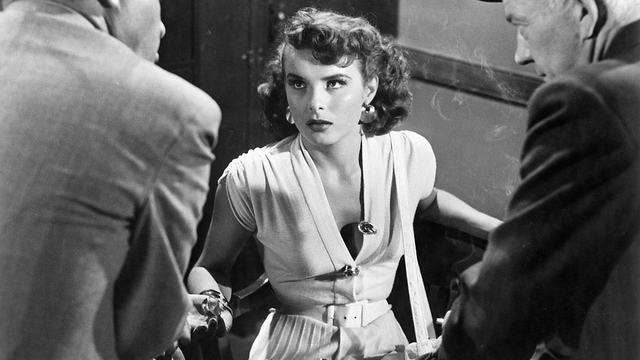
Without using any euphemisms or leading hints the audience knows early and clearly just what business Candy is – or was, if only just recently – occupied with. In Somewhere in the Night: Film Noir and the American City, Nicholas Christopher lays it out: "In Pickup on South Street, Candy (she has no last name) is an outright streetwalker, garishly dressed, poorly spoken, vulgar at every turn, who turns out to be the most moral character in the film (as well as the most patriotic!) long before the hero, a shameless and self-centred pickpocket, ever takes a single action beneficial to someone else."
Fuller had a hard time casting Candy; at one point Betty Grable was in contention but depending on what you read, turned down the part either because she didn't want to play a prostitute or because Fuller wouldn't write a musical number into the film for her. Zanuck wanted him to cast Marilyn Monroe, at this point still a mere starlet with a Fox contract (this was around her making Don't Bother to Knock and Monkey Business, and just before Niagara) but Fuller said no.
Shelley Winters and Ava Gardner (too glamorous, according to Fuller) were also considered and Fuller had already turned down Jean Peters when he saw her walk into the Fox commissary. He wasn't impressed with her in Captain from Castile but noticed her walk – a bow-legged stroll that Fuller associated with hookers. Peters isn't an actress we talk about much these days except as one of the women who got involved with Howard Hughes; Peters had the distinction of actually marrying him. She's great here as Candy and gamely absorbs a lot of punishment before the credits roll.
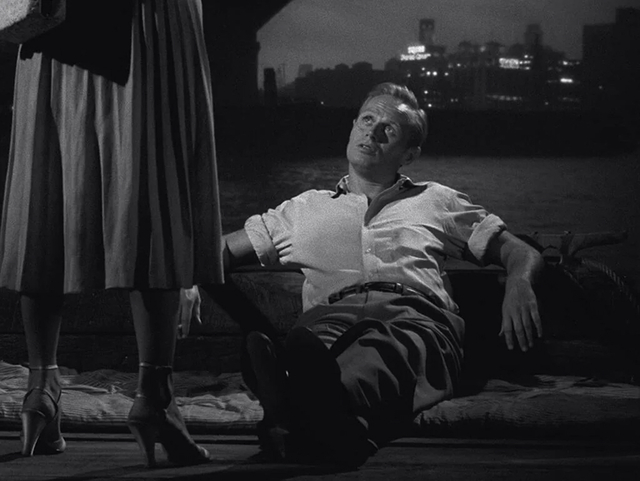
Widmark was, of course, one of the quintessential actors of film noir, alongside Sterling Hayden and Robert Mitchum. He would have earned that distinction just by playing Tommy the psychopath in his feature debut, Kiss of Death (1947) but after The Street with No Name, Road House, Night and the City, Panic in the Streets and No Way Out, Widmark was worried about being typecast. He changed his mind when he read Fuller's script, however, and added yet another great character to his roster of noir heroes, anti-heroes, scapegoats and villains.
Widmark's Skip is a cocky small-time hood who looks like he was headed nowhere even before he got mixed up with state secrets and commies. He lies as easily as he picks pockets and has no time for pleas from Tiger and Zara to help them out for the sake of his country. "Are you wavin' a flag at me?" he replies with a sneer.
"Do you know what treason means?" he's asked.
"Who cares?"
He's already been sent down three times by Tiger and if he's convicted once more he's facing life in prison. So he has every reason to distrust any guarantees he gets from the law, and his real superpower is being so small time that Candy and Zara have no way of picking him out in a city full of petty grifters.
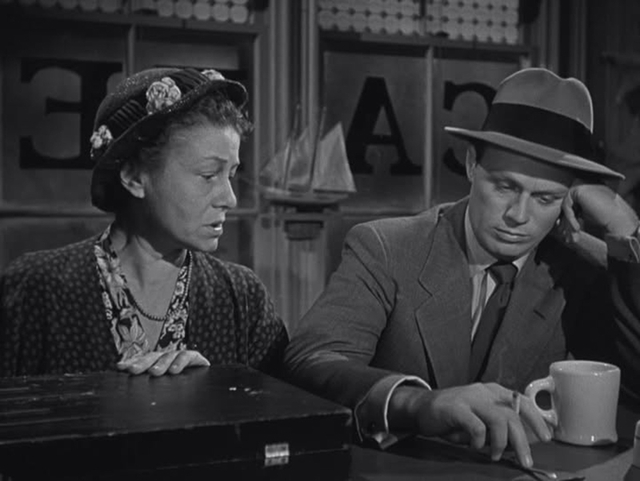
The one person who can put the finger on Skip is Moe (Thelma Ritter) a stool pigeon who grasses criminals out to Tiger for a fee calculated to the current cost of living. Candy is sent to her by Lightning Louie (Vic Perry), a grotesque mid-level kingpin she has somehow come to know in the course of plying her profession.
Ritter's Moe is both colourful and pitiful – a lifelong bottom feeder in the city's underworld whose snitching is earning her a nest egg for a burial plot and headstone in a reputable cemetery instead of her inevitable spot in the Potter's Field out on Hart Island, at the tip of Long Island Sound.
Or as she puts it: "I gotta go on makin' a livin' so I can die."
Both Tiger and Candy meet Moe's price and even buy one of the cheap ties she sells from the suitcase that provides cover for her real business. She has an encyclopedic knowledge of the tics and modus operandi of the city's pickpockets and can even provide an address for the fresh-out-of-prison Skip – a bait shop cabin out on piers over the water between the Manhattan and Brooklyn bridges.
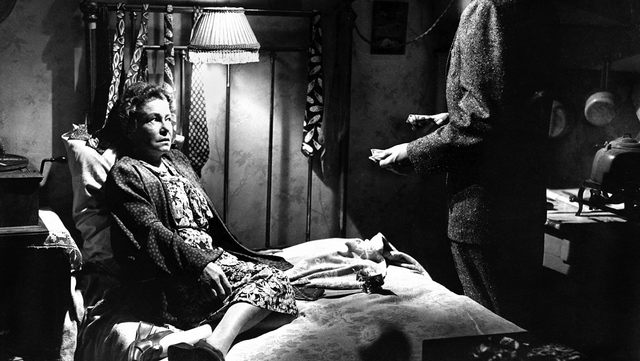
Ritter was a reliable scene-stealer in pictures like All About Eve, Rear Window and Pillow Talk, and her performance in Fuller's film earned her fourth out of six Oscar nominations (the only one the film received). What probably cinched it for her was the scene where she's found by Joey, who has taken the hunt for Skip into his own hands and armed with a pistol by his commie overlords.
Moe has tried to warn Candy and Skip about the danger they're in and get the message to Skip that Candy loves him in spite of himself. She's also let the cops and the Feds know how she feels about Reds, which is why it's chilling when she arrives home late at night, wearily sets about getting into bed and only notices Joey sitting in the shadows, his shoes on the mattress, when it's too late to run or scream.
She has a monologue/dialogue with her killer, justifying her actions in the context of a life without many options, reiterating her dislike of commie traitors and letting him know that she's tired and ready for the end – "an old clock running down." She regrets that she's headed for Potter's Field after all but offers just enough defiance to goad Joey into making sure his shot counts before the camera discreetly looks away.
(As an aside, I've always considered the casting of Richard Kiley as Joey even more effective given his resemblance to Gore Vidal.)
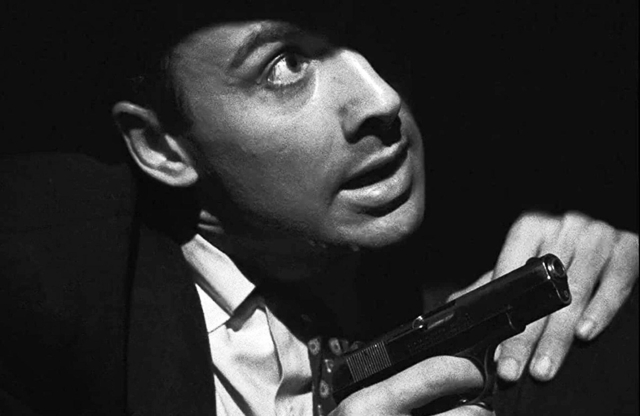
Like any good noir, the film carries around the promise of violence and delivers with two notably brutal scenes before the end. The first involves Candy, who has laid out Skip with a beer bottle and stolen the microfilm back from him, not for profit but to spare him the wrath of Joey and the commies. The only problem is that he kept back a single, crucial frame and when Joey notices he explodes in a frightened rage.
Peters is wearing a nightgown during this scene but in Fuller's original script she falls out of it during Joey's attack on her. "As we advised you before, this brutal beating of a half naked woman is entirely unacceptable and could not be approved in the final picture," wrote the Production Code administrators to Zanuck and Fuller, but it's easy to imagine that this provocation was meant to catch the attention of the Code and get sacrificed to maintain the brutality of the scene.
In If You Die, I'll Kill You: The Films of Samuel Fuller, Lisa Dombrowski devotes many long, detailed paragraphs to the director's choice of camera angles and cuts, almost amplifying the scene's violence with her analysis: "Every slap or shake is but the first of a series of blows, followed by a collapse into a wall or table or lamp or sometimes all three...The camera movement in the long take further heightens the chaotic energy of the fight, often paralleling or opposing the trajectory of characters in motion...Finally, the duration of the long take itself grounds the assault in real time and extends the seemingly never-ending attack."
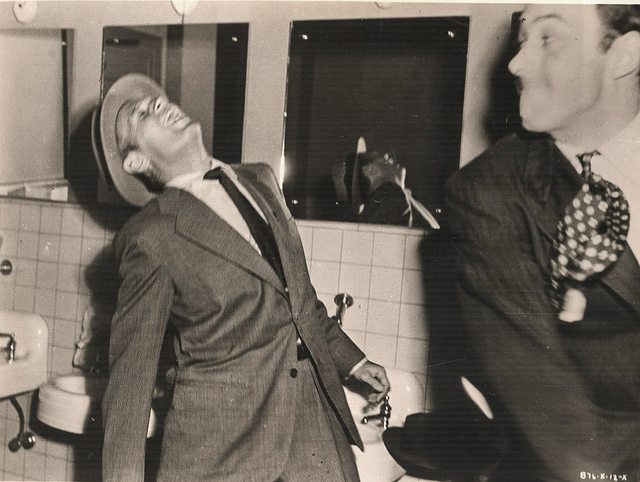
The scene sets up – demands, even – some sort of response in catharsis and sets Skip in pursuit of Joey, who he finally corners in a subway station, bringing the film's action full circle. Dombroski describes it as "a kinetic explosion that releases Skip's pent-up rage. Although the scene lacks the kneeing and kicking that (Code enforcer Joseph) Breen initially objected to in the script, Joey's collisions with various object, including Skip's fists, create yet another unrelentingly brutal sequence."
If you have any familiarity with the rules and goals of the Production Code it's shocking to see how easily Zanuck and Fuller brushed them aside with the finished version of Pickup on South Street, but it helps to know how little anyone at the studios respected the Code, and how indifferently the Code's champions defended it, especially in the last decade or two of its existence. Dobrowski reminds us that it was "Zanuck and Fuller's shared intention to produce a crime picture differentiated by its grit and visceral impact..."
They ended up "producing a prime example of how working within a major studio did not necessarily neuter the artistic impulses of a filmmaker. Today, many critics describe Pickup on South Street as a quintessential Samuel Fuller picture, yet it is also very much a product of the Hollywood studio system."
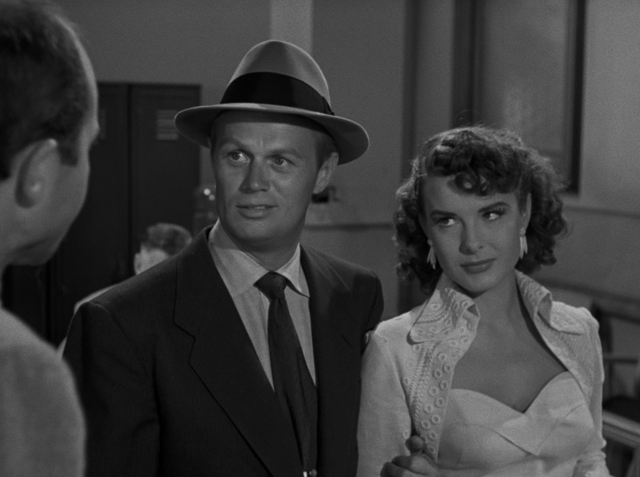
The film was a major success for Fuller and Fox, ending in the top half of the studio's releases that year, and it helped buff up the director's growing reputation in Europe, winning him a Bronze Lion at the Venice Film Festival in 1954. But it didn't stop the mercurial Zanuck from rejecting the next two films, both westerns (Run of the Arrow and Woman with a Whip – later made as Forty Guns with Barbara Stanwyck), that Fuller wrote.
The picture ends on an upbeat note with the commies beaten as soundly as Joey himself; Skip even manages to intercept the boat carrying Moe's body up the East River on its way to Potter's Field for what we assume will be a more dignified burial. Tiger is even cheated of delivering the fourth and final conviction that would send him away forever and he returns, smirk intact, from the cells to the downtown precinct to reunite with Candy, marvellously recovered from Joey's beating and near-fatal shooting.
The cop is sure that the grifter will be back to picking pockets and on his way back to Rikers soon enough, and while Candy defiantly tells Tiger that he's wrong, it's hard to imagine that a low-level crook teamed up with a former hooker are headed to suburban rectitude in Levittown. It just isn't that kind of picture.
Club members can let Rick know what they think by logging in and sharing in the comments below, as access to the comments section is one of many benefits that comes along with membership in the Mark Steyn Club.