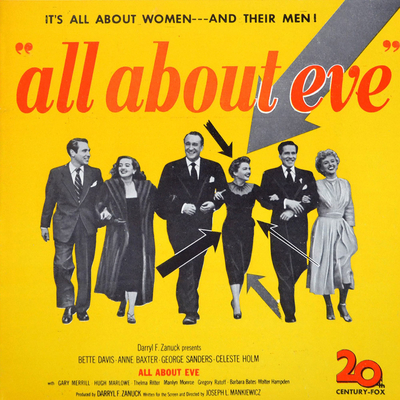
In her autobiography A Lonely Life, Bette Davis remembers making All About Eve with none of the rancour or drama that should provide all the dirt an essayist would look for when writing about the film. Her part was supposed to go to someone else, but when Claudette Colbert injured her back while filming Three Came Home, director Joseph L. Mankiewicz had producer Darryl F. Zanuck call Davis. "I can think of no project that from the outset was as rewarding from the first day to the last," she writes.
"It is easy to understand why. It was a great script, had a great director, and was a cast of professionals all with parts they liked. It was a charmed production from the word go. After the picture was released I told Joe 'he had resurrected me from the dead.' He had in more ways than one. He handed me the beginning of a new life professionally and personally. I also say a thank-you to Claudette Colbert for hurting her back. Claudette's loss was my gain. On what strange circumstances are whole lives changed."
But when my dear friend, the late Kathy Shaidle, wrote about the film on this site – one of her all-time favourites – she managed to discover something that would have drawn a black cloud over Davis' own memory of All About Eve, if she were still alive. Having upgraded her DVD reissue of the film with the then-new Criterion double disc Blu-ray (which Kathy left to me after her too-early death, five years ago this week), she noticed the 4K digital transfer "has mostly unveiled something Mankiewicz and company were likely trying to camouflage – namely, Bette Davis' appearance."
"It's now all too clear to a veteran viewer like me," Kathy wrote, "that her relatively smooth, taut face in original, older prints of this film was the result of painstaking lighting and other assists. This high-def Criterion edition not only exposes Davis' creeping jowls, forehead wrinkles and 'marionette lines,' it casts into high relief Davis' stubborn habit of overdrawing her upper lip and filling in her cupid's bow with lipstick. This shiny demarcation line can't be unseen."
I promised myself after Kathy nominated me to take over this column that I would do my best to avoid stepping on her toes and stay away from films she wrote about. What, I wondered, could I add to Kathy's critiques? I vowed to stay away from Davis in particular, one of her favourites (with one exception) but the anniversary of her death has made me miss my friend more than usually, and revisiting All About Eve with Kathy as my guide would at least provide the illusion, for a few moments, that she was still here.
Sidney Ladensohn Stern writes in his biography of the director and his brother Herman, The Brothers Mankiewicz: Hope, Heartbreak and Hollywood Classics, that when news broke that Davis had been cast "a number of directors called Joe to warn him how difficult she would be; one said she would show up with a yellow legal pad and a script marked with changes in every line. Davis's reputation for being difficult actually came from years of fighting to get the roles she deserved, but Joe was so apprehensive that when they met for dinner at Davis's request, he asked her agent, Lew Wasserman, to come as well, 'in case (Joe wrote Zanuck) she gives any indications of an intention to be either the writer or the director of the picture.'"
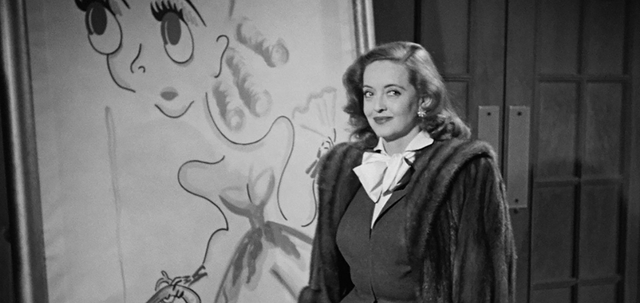
Davis' reputation as a "bitch" – shorthand for difficult female – was something Kathy discussed in a column where she compared the actress to her grandmother, who was "not a pleasant woman. Cold, vain, cheap, fussy and tactless, far fonder of her friends – of which she had, to me, a shockingly high number; my mother regularly mused about selling tickets to her funeral – than her own family."
"That Davis was a bitch in real life seems beyond dispute," Kathy wrote, "and even excusable, at least professionally: Her perfectionism and Yankee work ethic, combined with her peerless talent, single-handedly (and thanklessly) rescued at least one movie studio from bankruptcy."
"However, it is her screen persona that I'm addressing now, and here the 'bitch' aspect is lazily overstated."
Davis' bitchiness was the most obvious layer of a complicated persona that Kathy compared to no less than St. Teresa of Avila and Therese of Lisieux, trapped behind Davis' memorable "harridan" characters in films like The Letter, In This Our Life, The Little Foxes, Whatever Happened to Baby Jane? and Of Human Bondage. It's the Davis of Dark Victory, Now Voyager, The Old Maid, Winter Meeting and "the last acts of Dangerous and Jezebel."
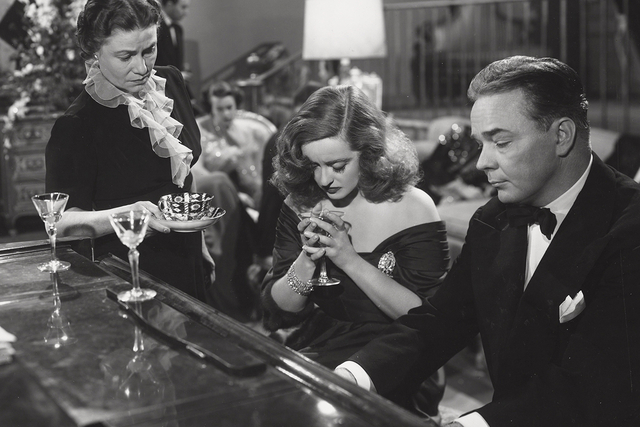
"A Sin (hers or somebody else's) compels her to keep a Secret," Kathy wrote, "and make terrible, noble Sacrifices, all the while Suffering Silently, both physically and emotionally, as said Sacrifices go unacknowledged and misunderstood by those around her."
"Thankless duty is the fuel of melodrama, and that body of work is a veritable ANWR of the thing. Despite that, the selfish, scheming Davis 'bitch' is the one we remember – shooting her lovers until the gun clicks empty, or 'best' of all, watching them die of protracted heart attacks as they beg her for the medication within her reach, but not theirs."
"Even when she isn't really a bitch at all – surely Margo Channing of All About Eve is simply a diva (and, it turns out, justifiably paranoid) which is assuredly not the same thing. (Although a lesser actress could have easily mouthed Mankowitz's dialogue to evoke the former.)"
It's easy to see how Kathy responded to Saint Bette, hiding behind the fierceness and "Yankee work ethic" of the Davis persona that was more broadly famous. She enjoyed her own reputation for brutal candour and outspoken opinion in the face of conventional wisdom and wrote frequently of her own "resting bitch face" – the mask she was resigned to present the world. At the same time, everyone close to Kathy could testify to her generosity, gracious manners and even warmth in the face of trying situations and tiring company. She truly understood the character(s) Bette Davis presented, and most particularly how they were misunderstood.
The origin of All About Eve has emerged piecemeal over the years and was finally laid out in Sam Staggs' All About All About Eve, his book-length essay on the film first published in 2000. It was generally known that it began as a short story, "The Wisdom of Eve", published in Cosmopolitan magazine in 1946 and written by Mary Orr – though the film's credits omit Orr and her story.
Kathy called the Orr story "undistinguished" and agreed that Mankiewicz did all the work that made us remember it today: "comparing the two is like placing 'Turkish Wizard of Oz' alongside the real thing."
What Stagg described was an encounter between Orr, an actress and writer married to a playwright and director named Reginald Denham, and an Austrian actress named Elisabeth Bergner, who joined the wave of refugees escaping Nazifying Europe and ended up working in London, New York and Hollywood, where she was nominated for a best supporting actress Oscar in 1935 for Escape Me Never.
Orr and her husband had been invited to a dinner party in Vermont where Bergner told Orr about a "terrible girl" who had wormed her way into Bergner's confidence after hanging around the stage door every night when Bergner was playing in The Two Mrs. Carrolls on Broadway. She had lied about her origins and made a play for Bergner's husband and Staggs' research gave her a name – Martina Lawrence – and even an interview for his book; a meeting that does little to clarify the inspiration for Eve Harrington or Lawrence's decades-long attempt to reclaim her place in Orr's story.
"Regarding the Martina Lawrence hieroglyphs," Staggs writes, "and attempting to translate them, I write in vanishing ink. Before I reach the predicate, the subject has dissolved. It cannot be real, the conclusion I have reached: that Martina, using her brief appearance in Mary Orr's story, inflated it to match the Mankiewicz script. In the depths of her mind she took up where the film faded out. And so it appears that Martina didn't have her identity stolen. Instead, she abducted Eve Harrington and has held her captive these many, many years – in the dimension of Time."
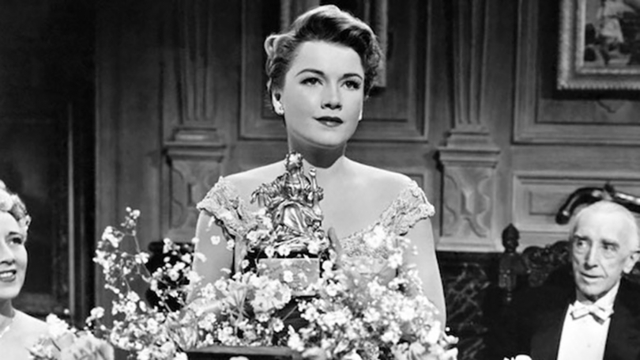
It's a fascinating footnote, but it adds little to Mankiewicz' story, which begins with Eve (Anne Baxter) at the pinnacle of her career, accepting an award from the Sarah Siddons Society for her vertiginous ascent to Broadway stardom. It's June and Eve is about to leave for Hollywood and her movie debut; her rise began the previous October, and will be described in voiceover by a critic, Addison DeWitt (George Sanders), Karen Richards (Celeste Holm), wife of a successful playwright, Lloyd Richards (Hugh Marlowe), and Margo Channing (Davis), an acclaimed star of the stage, just on the far side of forty and feeling the pull of gravity, both on her body and career.
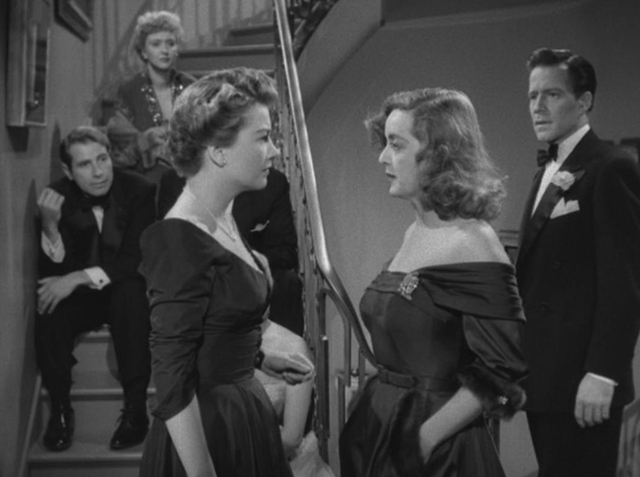
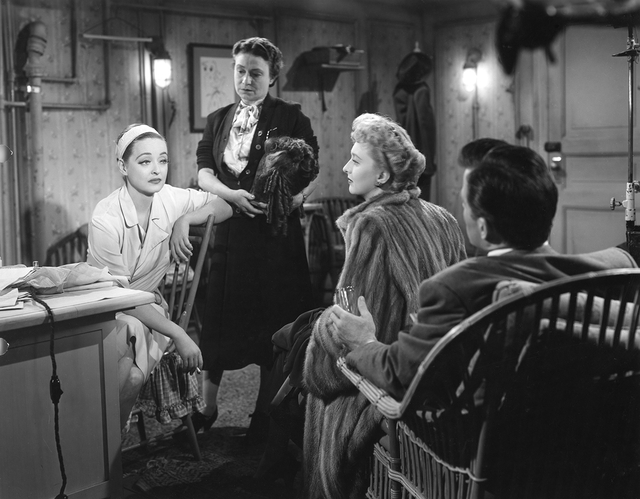
Eve is a fan with a sad story – a poor childhood on a farm, a dead flyboy husband – and an obsession with the theatre in general and Margo in particular. She quickly makes herself indispensable to Margo, to the chagrin of Birdie (Thelma Ritter), the actress' dresser and maid of all work. Despite materially improving Margo's day-to-day life – which includes her relationship with Bill Simpson (Gary Merrill), a director nearly ten years Margo's junior – Birdie and Margo begin to resent the young woman and try to fob her off on the producer of Margo and Lloyd's plays, Max Fabian (Gregory Ratoff).
The best thing about Mankiewicz' script is how gradually Eve's character reveals itself to Margo and her friends. Birdie's suspicion looks like simple fear of being replaced, while Margo's change of heart comes down to jealousy of a younger woman and the diva's infamously belligerent moods. DeWitt never seems to have been fooled, but his snakelike demeanor is primed to recognize fellow schemers.
Bill is too lost in the considerable business of his career and keeping Margo happy to take much notice of Eve, while it takes Karen a while to stop regarding Eve charitably as her "discovery"; when the young woman's treachery fully and finally reveals itself to her it's a shock. Only Lloyd remains blind to Eve's self-serving agenda when it's become plain to everyone else. He's described as a great talent as a writer but he comes across as a dolt. (His play, an antebellum drama titled Aged in Wood – what little we see of it – looks awful.) Considering Mankiewicz' reputation for incisive character studies, you can't help but wonder if this is a sly comment on the average intelligence of the popular playwright at midcentury.
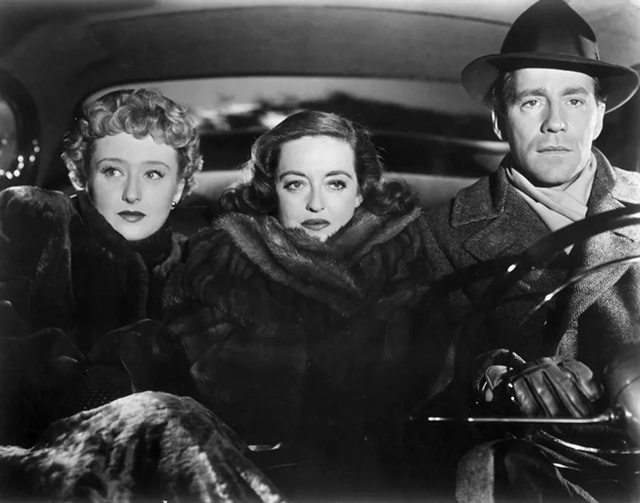
Davis, near the end of her third marriage, to artist William Grant Sherry, fell madly in love with Merrill as soon as rehearsals began. The feeling was mutual, though Merrill had to extricate himself from his own marriage. So the chemistry onscreen was real enough, as Davis was quick to admit:
"Margo Channing was a woman I understood thoroughly," she writes in The Lonely Life. "Though we were totally unalike, there were also areas we shared. The scene in which – stuck in the car – Margo confesses to Celeste Holm that the whole business of fame and fortune isn't worth a thing without a man to come home to, was the story of my life. And here I was again – no man to go home to."
"The unholy mess of my own life – another divorce, my permanent need for love, my aloneness. Hunched down in the front of that car in that luxurious mink, I had hard work to remember I was playing a part. My parallel bankruptcy kept blocking me, and keeping the tears back was not an easy job."
"I sensed in Gary my last chance at love and marriage," she adds. "I wanted these as desperately as ever. I had been an actress first and a woman second."
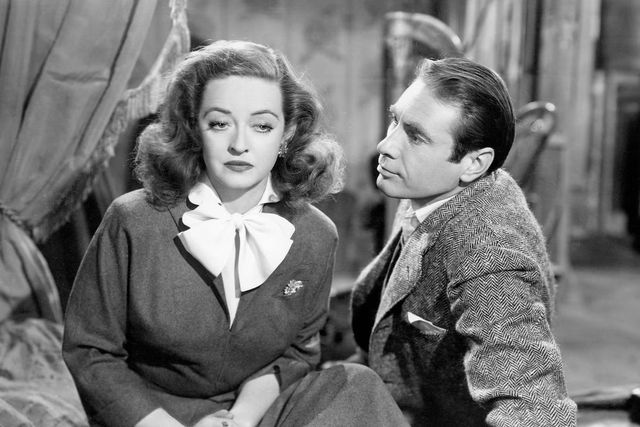
This probably accounts for how audiences – or at least this viewer – are willing to sit through Margo's bilious sarcasm and tantrums and loose cannon role in her friends' lives. Margo is really, truly a trial – a person to be endured more than enjoyed – but you can sense her insecurity boiling away, deep beneath the rages and casually hurtful remarks.
And Merrill really was her last chance – their marriage would barely make it to the end of the decade and he'd be her fourth and final husband. "By the time we played out our story and the actress had retired to be the little woman," Davis wrote, "I had fused the two men completely. Margo Channing and Bill Sampson were perfectly matched. They were the perfect couple."
"It was not a very pretty relationship;" Celeste Holm said later, "they laughed at other people. Bette and Gary formed a kind of cabal, like two kids who had learned to spell a dirty word."
But nobody was pretending that Margo was anyone's ideal (and by the end we realize that she certainly wasn't Eve's) and Davis isn't the sort of actress you watch for unalloyed heroism or edification. She suffers and, by the cinematic miracle of projection and identification, makes us aware of what makes us suffer.
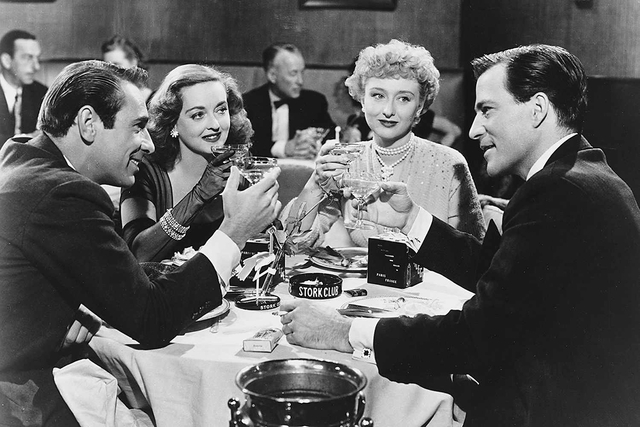
"I first watched All About Eve half a lifetime ago," Kathy wrote, "picking it up at a video rental joint in Toronto's Boystown, from its perch on a shelf labeled GLAMOROUS ALCOHOLICS. I harboured unattainable ambitions to the former state, but consoled myself that at least I'd achieved considerable success when it came to the latter."
"I bought my own VHS copy that week. On too many dark, lonely evenings (and the occasional sunny afternoon) I smoked and drank right along with stage star Margo Channing and her entourage..."
"This is not a family movie; it's strictly for grown-ups." Staggs writes in All About All About Eve. "Kids didn't go for it then and they still don't. It's not corny or titillating or obvious like so many movies of its time, nor does it contain moral uplift. It has a bit of cheap sentiment – 'You're an improbable person, Eve, and so am I...We deserve each other' – but not much."
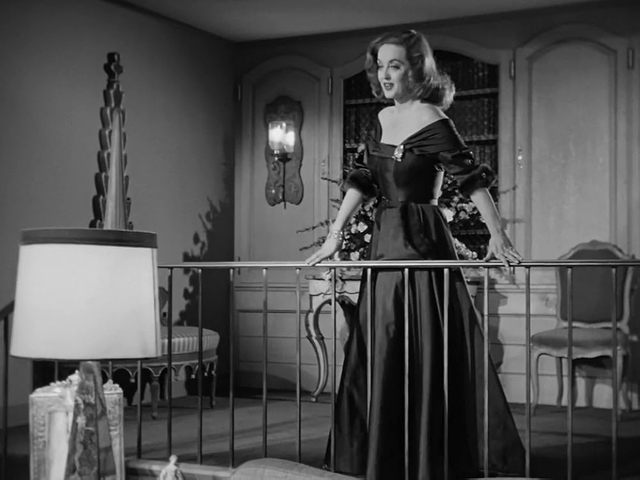
"Kathy did not lead a particularly 'full life,' her existence having been comprised mostly of a series of unpleasant surprises," my friend wrote in her own obituary. "Her favourite corporeal pleasure was saying, 'I told you so,' which she was able to utter with justification multiple times a day."
One of the unendurable aspects of the last five years has been the absence of that voice and her justified verdict on whatever news or trend was cresting. I have lost track of how many times I've been brought up short before completing the thought "I can't wait to hear what Kathy has to say about this."
But thanks to the cruelty of the universe we have been denied this, not to mention a few hundred movie columns. I don't think Kathy and I ever watched a movie together, though we did go see George Jones on one of his last tours. So in the end it's thanks to the gift of her column and her copy of All About Eve that I've been able to imagine watching one of her favorite films with my friend.
Club members can let Rick know what they think by logging in and sharing in the comments below, as access to the comments section is one of many benefits that comes along with membership in the Mark Steyn Club.