
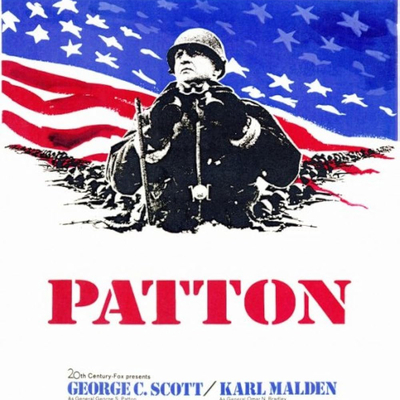
When Francis Ford Coppola was writing the first version of the script that would be released as Patton in 1970, he was so spoiled for anecdotes and incidents that he was able to ignore gems like one that occurred a few days after V-E Day, when General George S. Patton was in his headquarters in the Bavarian town of Bad Tölz. A Soviet general presented himself and demanded a meeting with Patton, who told his aides to "bring the bastard in."
Patton's Soviet counterpart demanded that a river boat used by German soldiers to cross the Danube and surrender to the U.S. Third Army be returned to him immediately. Patton responded by reaching into a drawer and slamming a pistol on his desk. He bellowed for his aides to "Get this son-of-a-bitch out of here. Who the hell let him in? Don't let any more Russian bastards into this headquarters. Harkins! Alert the 4th and 11th Armored and 65th Division for an attack to the east."
After hustling the Soviet general out and conveying their commander's orders, the aides returned to Patton to find him smiling and smoking a cigar. "How was that?" he asked, as the incident is recounted in A Genius for War, Carlo D'Este's exhaustive biography of the general. "Sometimes you have to put on an act, and I'm not going to let any Russian marshal, general or private, tell me what I have to do. Harkins, call off the alert of the divisions." This ended what was probably the first close call of the as-yet-unnamed Cold War.
This is my 250th column here and I thought I'd indulge the occasion by writing about one of my favorite films. I saw Patton for the first time not at one of the 70mm roadshow screenings when it was released or when it was aired on television by ABC as a special event two years later, but near the end of the '70s in the library of my Catholic boys' high school, on one of those "professional development days" when we only had to show up for the morning, leave our uniforms at home, and pick some sort of special activity as a treat. Watching a movie was definitely preferable to whatever was going on in the chapel or the gym.
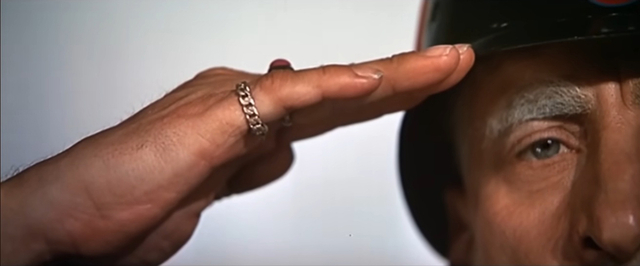
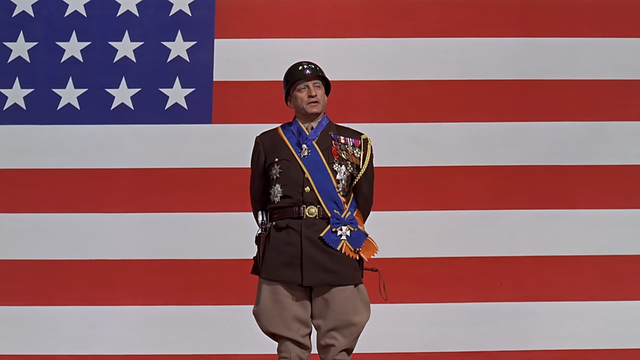
I was immediately captivated – as everyone usually is – by the famous opening scene, where George C. Scott's Patton climbs the stage in front of a massive American flag and stands at attention while a bugle call plays. The camera goes from a wide shot to a series of extreme closeups of Patton in his full-dress uniform, covered in medals and regalia (a uniform he apparently only wore once, in his backyard in Virginia, at the request of his wife for a photo the film's producers referenced for this scene).
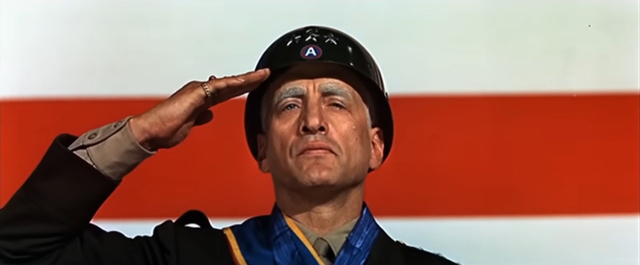
After the music ends, Scott launches into what is probably one of the greatest character introductions in movie history. Using bit and pieces cut together from the many speeches Patton actually delivered to troops under his command, it begins with the statement that "no bastard ever won a war by dying for his country. He won it by making the other poor, dumb bastard die for his country."
What follows is memorably bloodthirsty and utterly indelible, a cinematic moment endlessly copied and parodied, memorized and trotted out at the slightest provocation by fans of the film and Scott's colossal performance. "Americans traditionally love to fight," Scott as Patton tells the soldiers in front of him and us, the audience. "All real Americans love the sting of battle... Americans love a winner and will not tolerate a loser."
For Americans, the "very thought of losing a war is hateful." He celebrates the teamwork of an army and disparages writers at magazines like the Saturday Evening Post who celebrate individualism as, essentially, eunuchs. He says he pities the Germans they are about to engage in battle. "We're not going to just shoot the bastards, we're going to cut out their living guts and use them to grease the treads of our tanks."
Many years ago, when I occasionally wrote about movies among other things, I was asked what my favorite picture was by a colleague at a free weekly where I worked. She was a cineaste who taught film at the local art school and was a fan of all the usual very modern things. I told her that, based simply on the number of times I'd seen it, it would probably have to be Patton.
"Is that some kind of fucking joke?" she replied, her voice full of shock and disgust.
The scene Coppola wrote was originally supposed to appear halfway through the movie, just after the intermission that bisects the story, after Patton's first string of battlefield triumphs ends with scandal and disgrace. Coppola was long gone from the picture when director Franklin J. Schaffner (Planet of the Apers, Nicholas and Alexandra, Papillon) was in pre-production and Scott told him that there was no way he could film the rest of the movie if they shot that scene first.
It would push him to a place with the character that he would have a hard time climbing down from to explore any subtlety in the role. Schaffner decided to film the scene last but, along with producer Frank McCarthy, moved it right to the beginning of the picture, as a cold open before the credits roll.
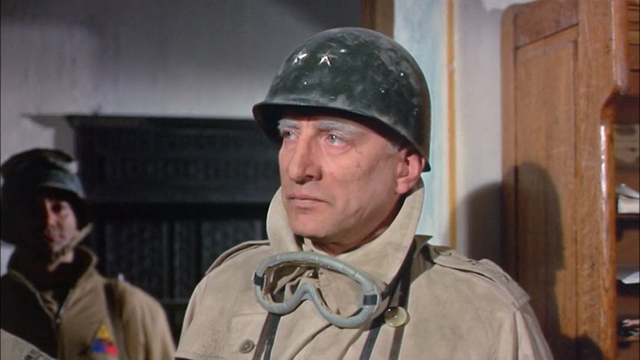
The film proper begins with the aftermath of Kasserine Pass, the first battle fought by American troops in World War Two and a notable defeat against Erwin Rommel's far more experienced Afrika Corps. General Omar Bradley (Karl Malden) and his staff drive through the aftermath of the battle, where Berber tribes are stripping the corpses and scavenging for valuables.
They visit the headquarters of the U.S. II Corps and observe a lack of discipline and the general attitude of a demoralized army. It's the sort of situation that requires a drastic solution and that solution arrives in the form of Patton, who is first glimpsed enjoying the march past of Moroccan troops in their ceremonial best after being decorated by the country's Sultan. He's asked what he thinks of Morocco and replies that he loves it: "It's a combination of the Bible and Hollywood."
We watch Patton descend on II Corps like an avenging angel, tearing through barracks and hospitals enforcing draconian new rules and giving out steep fines. He has a meeting to complain to Air Vice-Marshal Sir Arthur Coningham (John Barrie) about the lack of air cover he's getting from the RAF. It's interrupted by strafing German Heinkels and Patton leaps from his office window to stand in the middle of the road outside his headquarters firing at the bombers with his revolver.
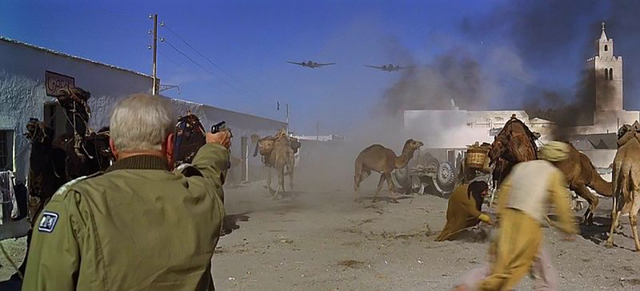
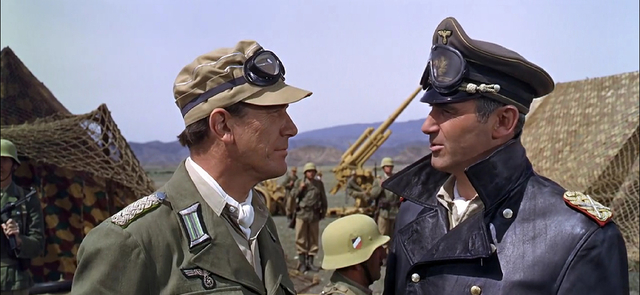
Nobody watching the film up to this point expecting anything less than a top-tier war film could be disappointed, and the picture moves on from this to the Battle of El Guettar, the first set piece combat scene in the picture and Patton's first victory against Rommel. This is where the first complaints will be heard – mostly from military history aficionados with a keen eye for everything from tank models and Spitfire variants to cap badges and tunic buttons.
Every time I watched Patton for many years I was dubious about the order of battle of the Afrika Corps – big square formations of men marching in the open around their tanks. It seemed an obvious way to march into an ambush and Schaffner had originally choreographed it with the tanks following the infantry but on the eve of filming one of his research consultants told him that official accounts had Rommel's men advance as combined armour and infantry, so he had to make a last-minute change.
But what bothers most war film fans is that every army in this World War Two picture is fighting with Cold War tanks – specifically the M41 Walker Bulldogs and M47 and M48 Pattons that had been sold to the Spanish army by the U.S.A., after they'd provided Franco's government with vast amounts of German and American surplus after the war in exchange for American air bases in the country.
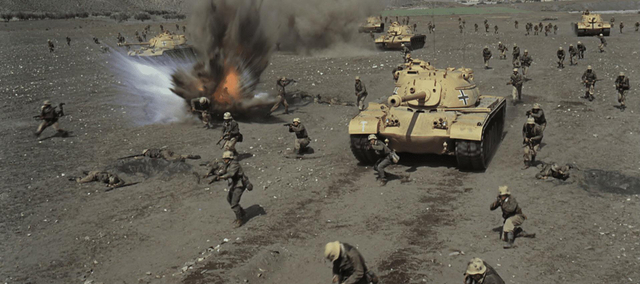
It wasn't just spaghetti westerns who made Spain their filming location; the Spanish government had a liaison office devoted to renting out its army for movie shoots, eager for the hard currency they brought into the country's struggling economy – Patton joined productions like Doctor Zhivago, Cromwell and El Cid in paying to use their conscripts as extras and labour, in addition to filming locations all over the Iberian peninsula that could provide everything from alpine meadows to deserts to snowy forests.
Twenty-five years after the end of World War Two there were precious few Tigers or Panzers in working condition, and even the abundant Sherman was rarely available in more than small batches. War movies from the '50s all the way to the '90s are full of these armored anachronisms, and the best you could hope for was a Russian T-34 mocked up as a Tiger in Kelly's Heroes and Saving Private Ryan.
What the Spanish air force did have was the Spanish-made CASA 2.111 – a licensed version of the He 111 with Rolls Royce engines, a pair that stood in for the whole Luftwaffe in Patton, far fewer than the nearly three dozen that the Spanish were able to provide for Battle of Britain a year earlier. It would be decades before digital effects could fill the skies and ground with period-correct planes and tanks, and even big budget Hollywood films didn't bother with mock-ups; we only seem to have made any real effort at historical accuracy in the last few years with films like Fury, and military museums like The Tank Museum at Bovington have created new revenue streams by renting out working "hero" vehicles for movies.
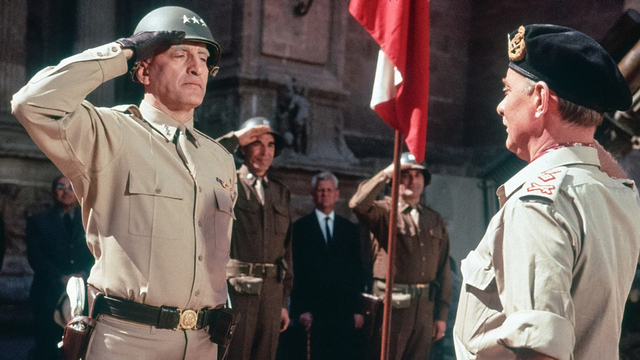
The armored anachronisms are wildly off-putting in a truly poor film like The Battle of the Bulge, when they accompanied sloppy attention to historical facts, but you can squint and ignore them in Patton because of the film's major special effect: George C. Scott's Patton. It's hard to believe he wasn't the first choice for the role, but Lee Marvin, Robert Mitchum, John Wayne and Rod Steiger were considered to play Patton before Scott was cast. (Of all of these alternatives, Steiger is the most plausible, and he apparently regretted turning it down later.)
In hindsight Scott's performance as General Buck Turgidson in Stanley Kubrick's Dr. Strangelove was his audition for the role of Patton – an outlandish caricature of Gen. Curtis LeMay, another polarizing military figure. Scott had hacked out the broadest strokes of the character in Strangelove and only needed to explore all the space he'd created for Patton, but this is only obvious to audiences today, and as Richard Zanuck of 20th Century Fox said years later in a making-of documentary, neither Scott nor Malden were considered big stars when the picture was made.
He's provided with ample material by Coppola's script (improved in structure and pacing by veteran screenwriter Edmund North), which is fascinated by Patton's larger than life personality and his lifelong belief in reincarnation. Specifically, Patton believed that our souls were coded with our role in society, and that he had lived through countless centuries as a warrior, fighting and dying over and over. He believed it without inspiration or affirmation; D'Este notes that, despite being widely read, he consulted no Buddhist or Hindu texts (outside of a cursory reading of the Bhagavad-Gita) to justify his conviction.
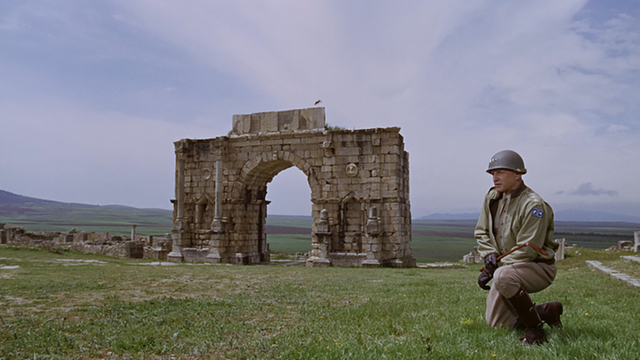
This is brought into relief in a scene, early in the picture, when Patton insists on a detour on the way to a battlefield with Bradley. He's driven to a ruin – the Roman city of Volubilis in Morocco, meant to be the ruins of Carthage – where he vividly describes the triumph of Rome over their Carthaginian enemies as if he were there to Malden's stone-faced but incredulous Bradley.
D'Este writes that even to old friends and colleagues like Eisenhower and Bradley, Patton was considered an enigma, and that there he could be two different men, one scholarly and well-spoken, with impeccable manners and a gift for diplomacy when required, and the foul-mouthed, belligerent, raging maniac barely contained by his "war face" – the two Pattons seen in succession in the anecdote in his headquarters at Bad Tölz. And that while one Patton often used the other to make an impression, sometimes the maniac appeared out of nowhere and could be his own worst enemy.
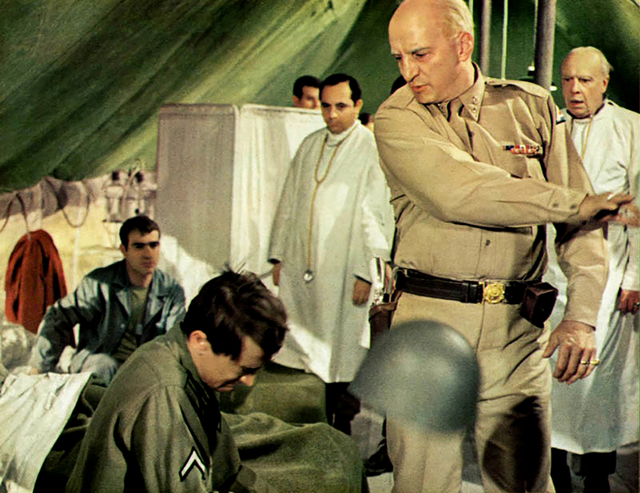
The maniac is the Patton who sabotages his triumphant, order-defying victories in the invasion of Sicily when he visits a field hospital and sees a soldier suffering from shell shock – an affliction D'Este is sure Patton suffered from while denying its existence entirely. He abuses the soldier verbally and physically, calling him a coward, slapping him repeatedly and finally pulling his pistol and threatening to execute him on the spot.
The incident – one of the defining ones in Patton's career, as much as any battlefield success – earns him a reprimand, an order to publicly apologize not just to the soldier (there were actually two such incidents in Sicily) but to the whole of his command in Seventh Army Group, before he's relieved of command and put on probation while Bradley is promoted above him to command American troops at Normandy.
Patton's disgrace is the climax of the first half of the picture, and while Coppola, North and Schaffner do their best to play it like a cliffhanger, in real life Patton's career was never going to end after his triumphal march into Messina, which did not happen as it does in the film, with British commander Bernard Montgomery (Michael Bates) strutting into the town to find Patton waiting, with troops and tanks drawn up in ranks to greet him with a smirk.
Patton never really lost the support of Eisenhower, head of the Allied coalition in Europe (and an offscreen presence in the film) or, just as importantly, General George C. Marshall, army chief of staff in Washington – both old colleagues of Patton, neither of whom had any intention of wasting his talents as a battlefield commander when the war moved to continental Europe.
In Patton the only characters who really get Patton are the Germans he's fighting – Rommel (Karl Michael Vogler) and Wehrmacht chief of staff Gen. Alfred Jodl (Richard Munch) and specifically military intelligence officer Capt. Oskar Stieger (Siegfried Rauch), an invented character and framing device made to comment on and explain Patton to his enemies – and to us.
Rommel is the opponent Patton longs to defeat most of all, and seems to respect more than any of his Allied colleagues, while Jodl – a bureaucratic officer living in thrall to the whims and illusions of his supreme commander, Hitler – allows himself to fall for the ruse created by Eisenhower, of a vast army led by Patton preparing to invade at Calais while the Germans are being diverted by the Normandy landings. He finds it utterly unbelievable that the Allies would punish a general like Patton for slapping an enlisted man.
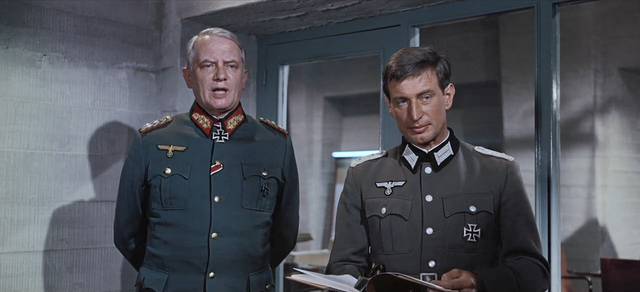
Rauch's Steiger sits in the Nazi command bunker tallying Patton's victories from Africa to Sicily to France and Belgium and presenting his research on Patton's character to a skeptical Jodl, who has no interest in Steiger's insights about the sentimental, poetry-writing, emotional, blaspheming, intensely religious man putting all his considerable energy into killing Germans with apparent indifference to the cost in his own men.
"The pure warrior," Steiger calls him as he's burning his files after Hitler's suicide and ahead of Germany's imminent defeat. "A magnificent anachronism."
The final act of the film – and of Patton's career as a fighting general – happens briskly, with Patton yanked from exile to lead Third Army under Bradley's command, forcing the break-out from Normandy, advancing with brutal speed across France until logistics stall him in sight of Germany, then turning his whole army on a pivot in two days to march north and break the siege of Bastogne at the Battle of the Bulge.
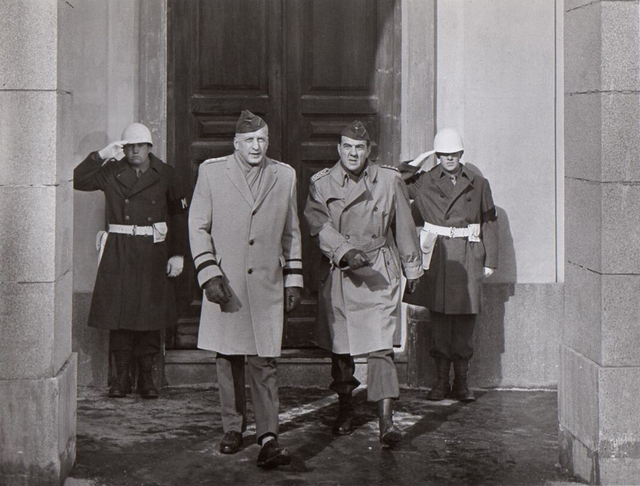
The film's elegiac finale plays like an epilogue: Patton creates more scandals when he refuses to fire Nazis from his administration while running the occupation of Bavaria and loudly opines that they should open a new front against the Soviets while they still have armies in Europe. He gets relieved of his command of Third Army and of any real responsibilities.
When we last see Patton he's being given a pep talk by Malden's Bradley, the old friend who has stuck by his side since the start of the picture, before wandering off with his dog into the mountains. Bradley, who is credited as a consultant on the picture and whose memoirs provided source material for Coppola's script, had actually come to dislike Patton long before the war ended, which has led to years of speculation about just how much the film's version of Patton owes to Bradley's opinions about the man.
Whatever Patton was trying to say about Patton appealed to audiences. The film was a huge hit, earning $61.7 million globally on a budget of $12.6 million and winning seven of its ten Oscar nominations, including best picture, director and screenplay. (Coppola credits his Oscar for Patton for stopping Paramount from firing him from The Godfather.) Scott beat Jack Nicholson in Five Easy Pieces and Ryan O'Neal in Love Story for best actor but turned down the award claiming his distaste for the Academy's voting process and competition between actors.
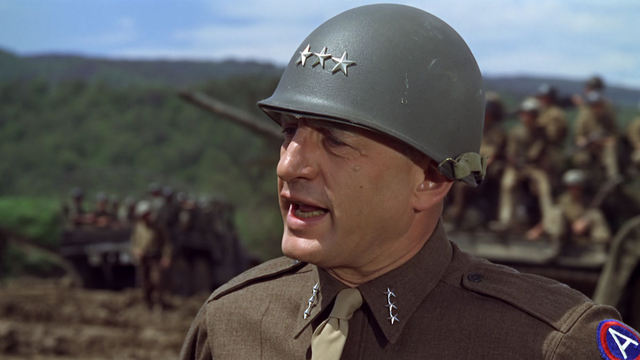
Richard Nixon was a big fan of the film and re-watched it endlessly in the White House screening room and on the presidential yacht. Director Oliver Stone is certain that Patton motivated Nixon to invade Cambodia and wrote a scene in his film Nixon where Tricia Nixon is goading her drunk father to green light the invasion during a screening. He had to get permission to include footage in his picture but while Fox agreed George C. Scott denied it without explanation. Stone had to cut the scene but he insists to this day that since Nixon's Cambodian invasion caused the Khmer Rouge takeover, Patton is one of the few films in history that "led directly to genocide".
Scott worried that taking on the role would end up overshadowing the rest of his career and he wasn't wrong. He had created some indelible performance before (The Hustler, Dr. Strangelove) and after Patton (The Hospital, The New Centurions, Hardcore). Even when he made a flop nobody doubted his talent, and he was finally tempted to return to the character of Patton sixteen years later with The Last Days of Patton, a TV movie.
If the final scenes of Patton weren't downbeat enough, the 1986 "sequel" (starring Eva Marie Saint as Patton's wife, Beatrice) follows what happened after he took his dog for a walk – his triumphant return to the US, failure as a military governor, and the car accident that paralyzed the general before killing him days before Christmas of 1945. It's full of flashbacks to his early life and career and utterly lacks the visual flair and emphatic storytelling that makes Patton so rewatchable.
It's not worth watching no matter how big a fan you are of Scott or Schaffner's original, but it reminds us of the salient fact about Patton: that the events in Patton cover barely two and a half years of his life, but they comprise the culmination of everything the man aspired, struggled and persevered to achieve – the focus of his purpose and role as he saw it, without which he would have considered his whole life (or this iteration of it in the cosmic wheel he imagined) wasted.
There are lives far more consequential in real terms than Patton's which will never see a biopic like Patton; George C. Marshall's for instance. But Patton tells a story that plays like a Greek tragedy fully invested with a spiritual dimension, of a man convinced of his fate, fighting to realize that destiny in the middle of a catastrophic historical moment, against an enemy imbued with rare evil even though his fiercest battle is with himself. And that's no kind of joke.
Club members can let Rick know what they think by logging in and sharing in the comments below, as access to the comments section is one of many benefits that comes along with membership in the Mark Steyn Club.