
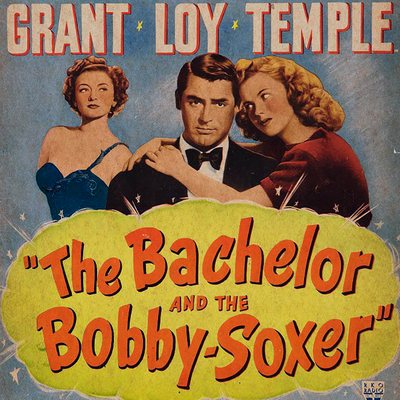
The Baby Boom were mostly still in their cradles or unborn when The Bachelor and the Bobby-Soxer came out in 1947, which makes the film a historical document – one of our first glimpses of a generation gap forming in postwar America. The whole idea of the teenager is really less than a century old, and by the late '40s it was edging out the "bobby-soxer" – a largely female phenomenon that was launched into public consciousness with the shrieking fans who descended on Frank Sinatra's performances at the Paramount Theater in New York during the war.
In his book Teenage: The Creation of Youth Culture, Jon Savage pins the emergence of the teenager in the public eye with the debut of Seventeen magazine in 1944 – the first magazine to cater to this demographic and specifically its female component, who Savage says "had always been in the forefront of the country's consumer culture."
He writes that "by the early 1940s, American adolescents had succeeded in creating a world quite distinct from both adults and children... Already defined as an ideal and a market, adolescents had begun to publicly assert their independence, a development that had caught government and industry by surprise. At the same time, their upbeat culture was beginning to spread through the youth of war-torn Britain and northern Europe."
The credits of The Bachelor and the Bobby-Soxer roll over a picture of a big suburban home behind a white picket fence; it's our signal that, while clearly a romantic comedy the film is also a domestic story, concerned with home, family and community. America was desperate to plunge into domesticity after a decade and a half of economic turmoil and war, and Hollywood was nearly delirious with the novelty, as this was the first time since the advent of sound that the studios could explore the subject with all their resources.
The camera enters the house and follows Bessie (Lillian Randolph), the inevitable black maid, as she goes about her morning routine – waking up the women who inhabit this generously-proportioned but cozy home, starting with the teenager of the house, buried beneath her covers underneath the standard issue Stanford pennant (the movie is set in that promised land, Southern California), begging for another five minutes of sleep.
Shirley Temple (nineteen when the picture was made) is the bobby-soxer of the title: Susan Turner is supposed to be seventeen, which means she spent her childhood during the depression and her adolescence during wartime, though being born into a family of lawyers and judges she was undeniably shielded from the majority of the worst effects of this dire era. Her parents are dead – or so we presume, though the film does nothing to explain their absence – and she is living in comfort in the split-level, neo-colonial home of her sister Margaret (Myrna Loy), a judge.
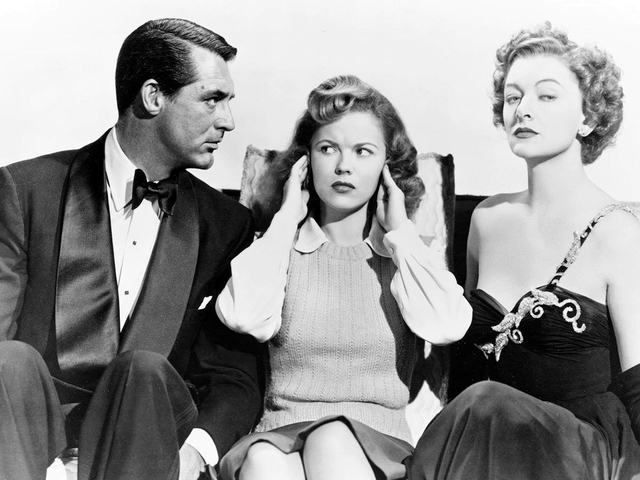
Loy's introduction is teased out as Bessie tells Susan that she's going to wake up "the judge", keeping the gender of the figure under the covers a mystery until Loy emerges from under the sheets looking far too glamorous. The notion of a female judge was obviously still a novelty in the late '40s: the first female probate judge in the U.S. was appointed in 1908, and the first female judge elected to state court was in 1920. Florence Allen was the first woman appointed to a state supreme court in 1922, as well as the first woman appointed to a circuit court in 1934.
Margaret Turner, the child of lawyers in a family of judges and lawyers, presides over a municipal courtroom, and the first case we see her try is a nightclub brawl, at the centre of which is Richard Nugent (Cary Grant), an artist so handsome that he's a frequent figure in the local courts as women (and their erstwhile beaus and suitors) set themselves at each other for his attention, drawing in the odd bouncer caught up in the fracas.
Nugent's frequent court appearances have captured the attention of two of the men in Margaret's life: her Uncle Matt (Ray Collins), the court psychiatrist, and Tommy Chamberlain (Rudy Vallee), an assistant district attorney and Margaret's frustrated suitor. Uncle Matt is interested in getting Margaret married (though not necessarily to Tommy) and is intrigued by Richard's propensity for attracting female chaos. Though unimpressed by Richard, Margaret nonetheless dismisses the charges against him, allowing the artist to move on to his next appointment.
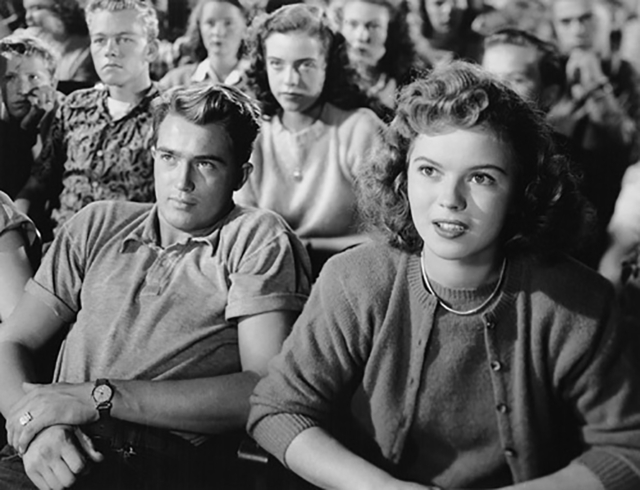
Richard has been booked to speak at Susan's high school – an assembly that Susan dreads until he takes the podium to a growing chorus of whistles and catcalls from the crowd and Susan's suddenly rapt attention. He is, as far as we can tell, a combination of Norman Rockwell and Thomas Hart Benton, successful both commercially and critically, and apparently quite reliant on the use of female models whose subsequent obsessions put him in front of judges like Margaret.
Richard is cornered by Susan after his speech and pressed to do an interview for the school newspaper; he delivers a melodramatically exaggerated account of an improbably hardscrabble upbringing and calls her "Miss Kilgallen" while trying to affect an escape. In his haste he gives her the impression that he wants her to model for him and Susan returns home, suddenly critical of the art hanging on the walls and unnerving her sister when she tells her who's caused this sudden turn to aestheticism.
Grant had come off a decent hit (Night and Day) and a major one (Notorious) when he signed on to make The Bachelor and the Bobby-Soxer for $50,000 plus what we'd call an executive producer's cut today of ten percent of the gross after $500,000 in earnings. It was not a happy shoot and Grant clashed with director Irving Reis, whose career had mostly been in b-pictures like the Falcon series of mysteries starring George Sanders.
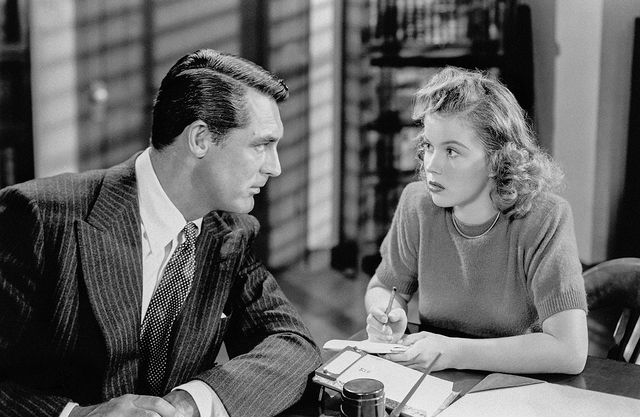
After complaining to producer Dore Schary about what he perceived as power plays by co-star Loy, there was a period when Reis directed Loy and Temple's scenes while Schary directed Grant's. In his biography of the actor, Cary Grant: A Brilliant Disguise, Scott Eyman tells a story of Grant arriving on set to find Temple doing an impression of him in front of the crew; he left and immediately complained to David Selznick, who had Temple under contract and on loan to RKO for the picture.
"Selznick read Temple the riot act for what he deemed unprofessional behaviour," Eyman wrote, "and she returned to the set to apologize. Grant accepted the apology, turned to walk away, then stopped. 'By the way,' he said, cocking his head in an exaggeration of Temple's imitation of him, 'it was a pretty good imitation.'"
Susan takes Richard's insincere invitation to model for him seriously and, while her sister is out with Tommy, dresses up in her best adult outfit for a visit to the artist's lavishly bohemian flat, letting the cocky 15-year-old bellboy working the security desk try to impress her by letting her in while Richard is out. (You can't help but wonder that audiences accepted without question that a boy would have this kind of job, and what happened between now and then that we can't imagine this happening today.)
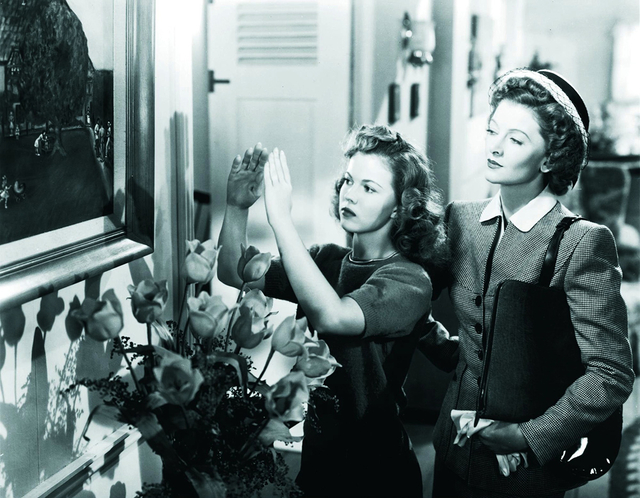
Richard comes home to find Susan curled up on his sofa, and before he can find a way to eject her politely Margaret and Tommy are banging on his door. Reis tactfully cuts to a police car, siren wailing, and Richard in jail consulting with his lawyer. In the meantime Uncle Matt persuades Margaret that sending Richard to jail will only make him a martyr to Susan and, citing the kind of pop Freudian psychology that was popular for much of the mid-century, comes up with an alternate plan.
In the chambers of another judge he presents a kind of plea deal: Tommy will refrain from charging Richard if he agrees to indulge Susan and squire her around as her boyfriend, with the presumption that she will be more likely to tire of him and her infatuation. When we first met Margaret she was wondering if sentencing an old man who ran away with a 16-year-old to three years in prison was harsh enough; a quarter of the way into the picture she's agreeing to let her teenage sister date a man eighteen years her senior – a man she regards as a disreputable libertine.
It's a premise that might have made its way into a film up till about fifteen or twenty years ago, when comedy was a fecund genre and the envelope for what was permissible had been pushed far out from shore by directors like Adam McKay, Judd Apatow and the Farrelly brothers. It might have even seemed tame then, but The Bachelor and the Bobby-Soxer was made when the Production Code was presumed to have been in full effect.
Either the Code was far more malleable than we think, and a studio could slip a dodgy scenario past the censors by promising that certain lines would never be crossed and nobody would get away with immoral acts when the credits rolled, or the Code was a paper tiger begging to be shredded piecemeal. After all Billy Wilder, who began every project wondering how he could punch new holes in the Code, had made The Major and the Minor five years earlier, a film based on an even more dubious premise (grown man falls for woman impersonating a 12-year-old) that launched Wilder's career as a director.
Or maybe it was simply the casting of Temple that imbued the film with a transgressive aura. Temple had been, until around 1940, the biggest child star in the world, but she had transitioned to more mature roles upon signing with Selznick and age-appropriate parts in films like Since You Went Away and I'll Be Seeing You. But the teenage Temple had to fend off advances from MGM producer Arthur Freed and Selznick all the while, and as the decade wore on she would make a slow slide out of films and into a career on television and, later, as a diplomat.
This perfervid fascination with the maturing Temple was resilient enough to reappear decades later in Marc Eliot's Cary Grant: A Biography, where the author talks about "the suddenly voluptuous Shirley Temple, who had set off a generation of middle-aged men into cold sweats while still a toddler and now came on like gangbusters, thrusting her ample bosom at Grant's bespectacled high school teacher every chance she got." (Putting aside the skeeviness of his assertion, Eliot's summary of Grant's character in the film makes you wonder what else he got wrong.)
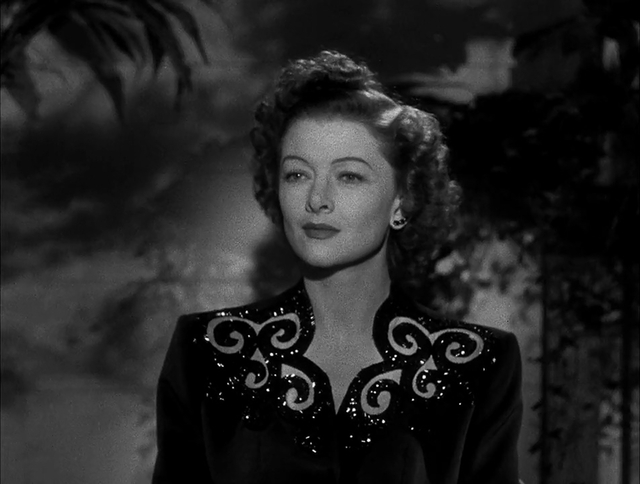
Eliot goes on to criticize Grant's chemistry with Loy, writing that even if "Grant was more than twice Temple's age, he looked better next to her than to Loy, who was only one year younger than Grant but looked to be at least five years his senior." It's an unfair shot even if he hadn't coloured it with his leering remarks about Temple; Loy had, to be sure, graduated long ago to a string of roles as Hollywood's ideal wife, beginning with Nora Charles in the Thin Man series and through films like Wife vs. Secretary, Test Pilot and The Best Years of Our Lives.
And there was no doubt that Grant usually looked better than any of his co-stars, but the chemistry between him and Loy was good enough to call for a reprise in Mr. Blandings Builds His Dream Home a year later. Eliot is more astute when he notes that the film "reflected Hollywood's recognition of the emerging teenage market that was changing the demographic makeup of the postwar moviegoing audience." He points out the arrival of "tender but twisted new faces" like Marlon Brando and Montgomery Clift, who Grant "couldn't quite understand... To him, the up-and-coming breed of movie stars seemed generally unkempt, indistinguishable from one another, and awfully hard to hear."
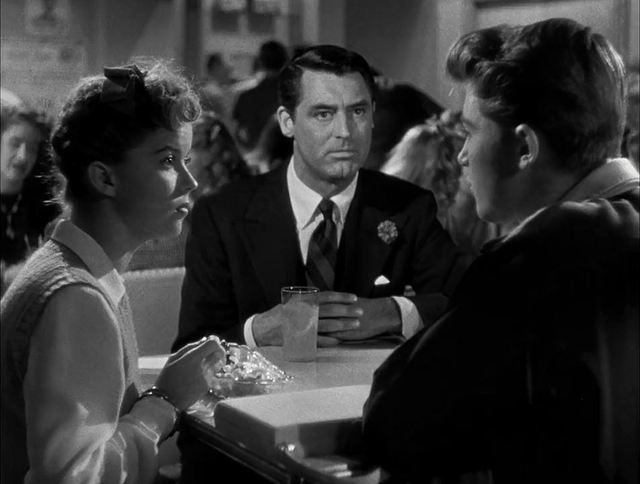
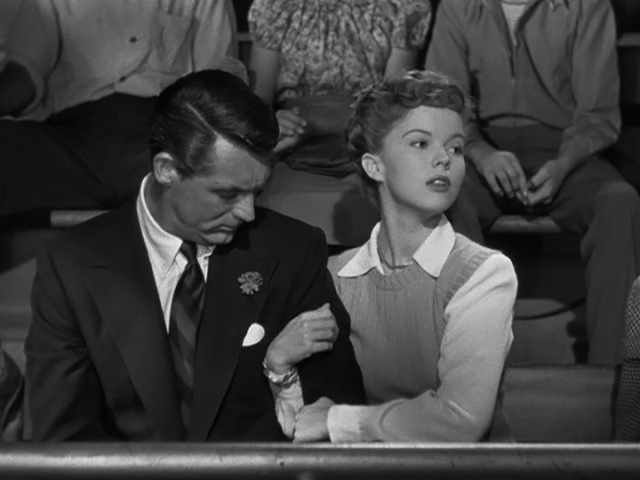
This incompatibility is the comic engine of the rest of the film, where Richard is forcibly immersed in this protean teenage culture while letting Susan think they're an item. He accompanies her to a high school basketball game where he meets Jerry (Johnny Sands), Susan's now-ex boyfriend, as he washes out on the court, distracted by Susan and her new beau.
Richard decides to build up the young man, hoping that Susan will see Jerry's virtues as she discovers his flaws. He starts parroting putative teen slang like "Mellow greetings, vookie dookie" while borrowing Jerry's jalopy and doing his best to mimic what he sees as the gormless and inapt manners of these suddenly visible teenagers. Since so much of Grant's persona is his comic discomfort at the world's attempts to chip at his dignity, the film becomes one more in a long list of pictures that the actor dominates effortlessly.
Teen style was still years from its rebellious phase, but there's an undeniable sense that something different is happening with this suddenly visible cohort of young people. In Teenage, Jon Savage reprints a list of "Teen Commandments" that were published in a 1945 issue of the New York Times Magazine, starting with "THE RIGHT TO LET CHILDHOOD BE FORGOTTEN" and "THE RIGHT TO A 'SAY' ABOUT HIS OWN LIFE" to "THE RIGHT TO QUESTION IDEAS" and "THE RIGHT TO STRUGGLE TOWARD HIS OWN PHILOSOPHY OF LIFE", and ending with "THE RIGHT TO PROFESSIONAL HELP WHEN NECESSARY".
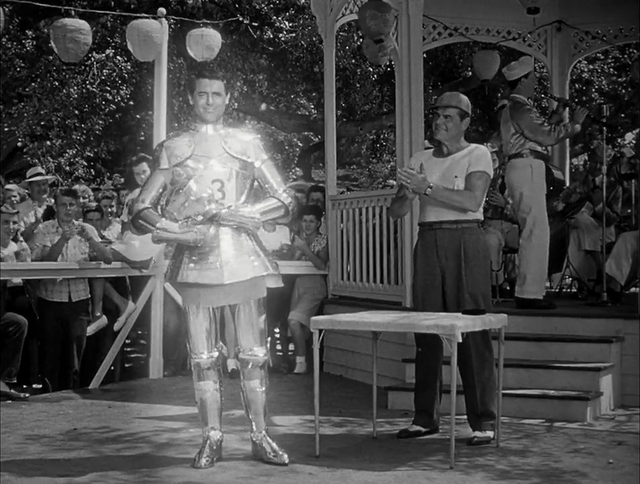
From the start Sidney Sheldon's script (yes, the author of potboilers like The Other Side of Midnight and creator of The Patty Duke Show, I Dream of Jeannie and Hart to Hart) makes it clear that Richard and Margaret will overcome their initial aversion on their way to falling in love. He hammers it home with a visual gag: while watching his lecture, Susan imagines a vision of Richard in shining armour; later in the film Margaret is overcome with the same vision.
They try to declare their feelings for each other over dinner in a nightclub but get interrupted by everyone from Richard's former models to Tommy, Susan and Jerry. This is followed by a bit of farce back home, where Margaret, Susan, Uncle Matt, Jerry and Great Uncle Thaddeus (Harry Davenport) slam a great many doors. Finally, Uncle Matt resumes control, talks Susan out of her infatuation and engineers a way to get Margaret on the same plane to Chicago as Richard while having the police haul away Tommy as a delusional kook who thinks he's a district attorney.
(Vallee, by the way, does a fine job with what's essentially a variation on the Ralph Bellamy role – the unworthy but not unlikeable suitor. Vallee's particular wrinkle on the part is a proud stuffiness without a hint of villainy. He had taken the gift Preston Sturges gave him by casting him in The Palm Beach Story and would play it out over the long third act of his career, in pictures from Unfaithfully Yours to How to Succeed in Business Without Really Trying.)

The Bachelor and the Bobby-Soxer was a hit and buoyed Grant through films like The Bishop's Wife, Mr. Blandings and I Was a Male War Bride before his career hit a slump in the early '50s that only recovered when he re-teamed with Alfred Hitchcock for To Catch a Thief. He was still one of Hollywood's great leading men but the roles that followed – in films like Houseboat, Operation Petticoat and Father Goose – became increasingly paternal, prompting him to retire from film in 1966, just as the counterculture was breaching Hollywood's gates.
Teenage culture, having got its nose into the tent, would grow in presence over the late '40s and '50s, alternating between confections like The Affairs of Dobie Gillis, Gidget and Tammy and the Bachelor and teensploitation like I Was a Teenage Werewolf and the Elvis pictures to statements such as Blackboard Jungle, A Summer Place and Rebel Without a Cause. But even those films barely hinted at what was to come in the following decade, and none of them would put "vookie dookie" in the teen lexicon.
Club members can let Rick know what they think by logging in and sharing in the comments below, as access to the comments section is one of many benefits that comes along with membership in the Mark Steyn Club.