

Dirty Harry was released near the end of 1971 and became an immediate hit, and just as immediately began a feud between its star, Clint Eastwood, and Pauline Kael, one of the most influential movie critics in America. In her review, published in the New Yorker on January 15, 1972, and titled "Dirty Harry: Saint Cop", Kael called the film "a kind of hardhat The Fountainhead" and "an almost perfect piece of propaganda for para-legal police power."
"When you're making a picture with Clint Eastwood, you naturally want things to be simple, and the basic contest between good and evil is as simple as you can get. It makes this genre piece more archetypal than most movies, more primitive and dreamlike; fascist medievalism has a fairy-tale appeal," Kael wrote, adding near the end of her review that "Dirty Harry is obviously just a genre movie, but this action genre has always had a fascist potential, and it has finally surfaced."
Invoking fascism not once but twice, Kael set the tone for the most vociferous criticism Eastwood would face for much of his career, and fired the first shots in a simmering vendetta between the actor and the writer that would inspire Eastwood to make a Kael-like critic the victim of the killer seventeen years later, in his final Dirty Harry sequel, The Dead Pool. "Please," San Francisco film critic Molly Fisher (played by Ronnie Claire Edwards) begs the killer, "I have a heart condition."
"A critic with a heart," he replies. "That's a laugh."
The film opens with what Kael called a "rather strange" choice – slow pans down the names of San Francisco Police Department officers killed in the line of duty on a memorial in the lobby of the city's Hall of Justice. And it is a rather strange choice as it puts the film that follows on a distinct political footing, and an assertion that the story we're about to see is a war story, and these names are the fallen, lost in defense of our peace and safety.
"Dirty Harry is not about the actual San Francisco police force," Kael writes, "it's about a right-wing fantasy of that police force as a group helplessly emasculated by unrealistic liberals. The conceit of this movie is that for one brief, glorious period the police have a realist in their midst – and drive him out."
The first scene shows us the worst version of the world we thought we were living in as the '70s dawned, with a young woman murdered by a sniper while swimming in a pool on top of a skyscraper. Dirty Harry wasn't alone in depicting this budding dystopia, nor was this a particularly right-wing fear; Alan Arkin's Little Murders, based on the play by Jules Feiffer and released the same year, was a black comedy told against the backdrop of a sniper (or snipers) randomly killing New Yorkers.
We're introduced to Clint Eastwood's Inspector Harry Callahan as he investigates the murder scene and guesses correctly that the killer was on the top of a neighbouring skyscraper. We watch him go about checking his hunch coolly while the credits roll and Lalo Schifrin's jazz-funk score plays, walking and climbing around the massive, strange machinery of the building's air conditioning units.
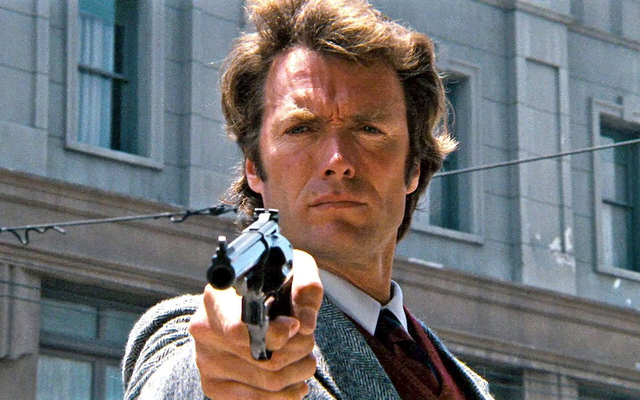
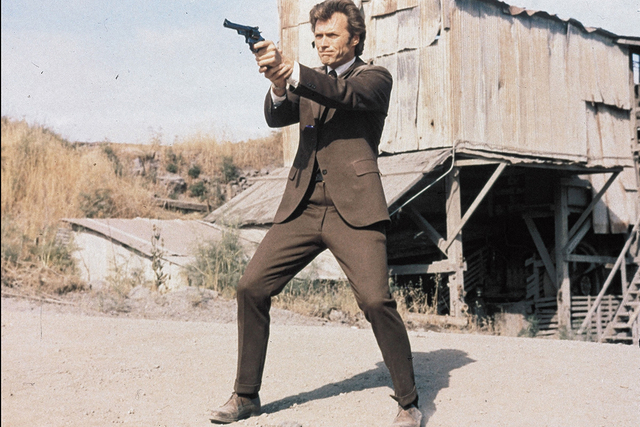
Ten minutes or so into the picture we get the scene that defines Callahan for what would turn out to be five films by the time Eastwood was done with the character. Trying to eat his hot dog at a lunch stand he's interrupted by a bank robbery he'd been anticipating since clocking the getaway car. He strides out into the street and casually pulls from its holster the weapon that he'd make his trademark: a Smith & Wesson Model 29, better known as the .44 Magnum – "the most powerful handgun in the world" as he describes it to the first bank robber he shoots with it (Albert Popwell) while the man lies wounded on the ground.
It's a big gun – a revolver built to kill big game, and the film made it a hot gun to shoot and collect for decades, based on what I've seen on firing ranges. I've never shot a .44 Magnum, but I did try out its older, smaller brother, the .357 Magnum, and I have to commend Eastwood for looking like Harry can handle the kick from the gun while firing with one hand. The huge blast from Harry's gun is a major part of the film's soundtrack; the only thing that I thought Bruce Surtees' camera didn't capture was the massive muzzle flash I remember from the .357, which had faces peering out from the stalls along the firing line at the Montreal range where I tried out the gun nearly forty years ago – a scene I remember much like a similar one in the first Robocop movie.
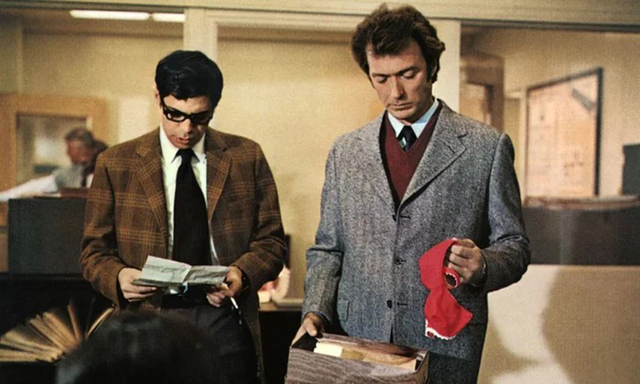
Director Don Siegel efficiently sets up the tropes that would populate the cop film and the action movie for decades afterward. Harry is a loner and a rogue, with very little patience for department politics or public relations niceties. He's hard on his partners so he prefers to work alone and resents Chico Gonzalez (Reni Santoni), the rookie detective that gets assigned to him; his last partner is in the hospital, the one before that is dead. He doesn't make friends easily and has no interest in making new ones.
His wife is gone – we don't learn why until late in the film – and he apparently has little to do except his job. On the surface he doesn't have much in common with the everyday citizens he serves and protects, though the film strives mightily to make comparisons between Harry and the killer with the sniper rifle that he'll pursue for the rest of the picture. "Dirty Harry and the homicidal maniac," read the tagline at the top of the poster that sold the film when it was released. "Harry's the one with the badge."
Dirty Harry began, much like Eastwood's career, with the days of the television western. Screenwriter Harry Julian Fink worked on shows like Tate and Have Gun – Will Travel and collaborated with his wife Rita (under the screen credit R.M. Fink) on a script titled Dead Right, set in Seattle and New York City in various drafts. It passed through various hands before being bought by Warner Bros., who imagined it as a vehicle for Frank Sinatra, with Sidney Pollack or Irvin Kershner directing.
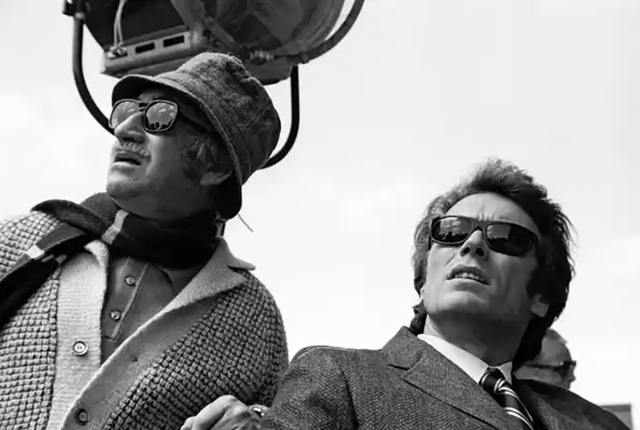
The role of Harry would be offered to a variety of actors, including John Wayne, Robert Mitchum, Burt Lancaster, Steve McQueen, Paul Newman and George C. Scott. John Milius rewrote the script when Sinatra and Kershner were set to make the film, and Terrence Malick – at that point only known for a short film, Lanton Mills, with Warren Oates and Harry Dean Stanton – wrote another draft in late 1970 where the villain was a vigilante killing wealthy criminals who escaped justice.
Paul Newman, who turned down the film because he thought Harry was too right-wing for him, recommended Eastwood. Siegel, who had started his career as a montage editor at Warners working on films like Casablanca, worked his way through westerns and noirs before making a mark with Invasion of the Body Snatchers in 1956. He'd directed Eastwood in Coogan's Bluff, Two Mules for Sister Sara and The Beguiled and established a good working relationship with the actor as his breakout roles in Sergio Leone's westerns made him a star.
Eastwood and Siegel insisted on returning to the Finks' earlier versions of the script, which focused the film back on to Harry and the killer, and Siegel made a film with remarkable efficiency and austerity. There's really nothing else on the screen except Eastwood, the killer, and the city of San Francisco in all its scenic, seedy glory.
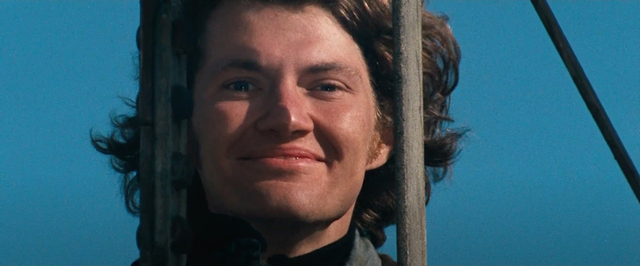
The sniper is a serial killer who calls himself Scorpio, clearly based on the Zodiac Killer who had recently terrorized the Bay Area and evaded the police. Audie Murphy was originally offered the part but died in a plane crash before he could accept the part, and James Caan was set to play the part when Sinatra and Kershner were attached. The role ultimately went to Andy Robinson, an unknown who Eastwood had seen in a play and had no film experience.
Siegel liked Robinson because he wanted the killer to have "a face like a choirboy" and the actor responded by creating an unsettling, detestable psychopath with a broad sado-masochistic streak who shrieks contemptibly when he's wounded. Kael described Robinson's Scorpio as a "hippie maniac" and most other reviewers followed suit, though I've never thought that was a particularly apt description.
It was probably the recent Manson Family killings and Robinson's long hair that made this an easy assumption. Scorpio is certainly no pacifist – he has easy access to a range of firearms including a silenced sniper rifle and a machine gun and knows how to use them – and he's quick to use racist epithets. He's more of a freak – a garden variety misfit and creep (much like Manson) grown dangerously out of control who has taken on vague hippy camouflage the way most men below a certain age (like Callahan himself) were wearing their hair longer in those days.
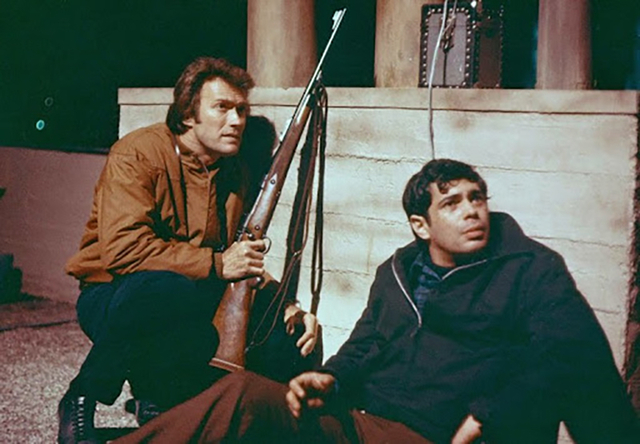
The first glimpse we get of San Francisco at street level is in the bank robbery scene, when Harry walks to lunch past an antique store and an adult bookshop. (A movie theatre around the corner on the Universal backlot set is playing Play Misty for Me, Eastwood's recent directorial debut.) We're taken inside and outside the garish Columbia Street strip bars in North Beach, and the city's reputation as a magnet for what were once called alternative lifestyles is showcased when both Scorpio and Harry spy on the citizenry with their sniper scope and binoculars and eavesdrop on two men flirting and what looks like the beginning of a hippie threesome.
Harry follows a suspect and ends up being beat up by a group of locals who accuse him of being a peeping Tom when he's caught looking through a window at "Hot Mary" – an apparently beloved neighbourhood nymphomaniac and/or prostitute. Harry and his partner get in a rooftop shootout with the killer, who ups the ante by kidnapping a 14-year-old girl and ransoming her with a time limit based on how much oxygen she has to breathe. Harry offers to be the bagman with the ransom, which only gets him beat up again while his partner is wounded trying to save him.
When the film was released, Harry was described as a descendant of the western gunman and hero as he evolved into an antihero. Kael was one of many critics who compared him to Gary Cooper in High Noon, a film she calls "phony in its own way". Cooper's marshal "threw his badge on the ground in contempt for the cowardice of the townspeople, who didn't live up to the principles of the law and wouldn't help him defend it" while Eastwood's Harry "says that the laws were written by dupes who protect criminal rats and let women and children be tortured."
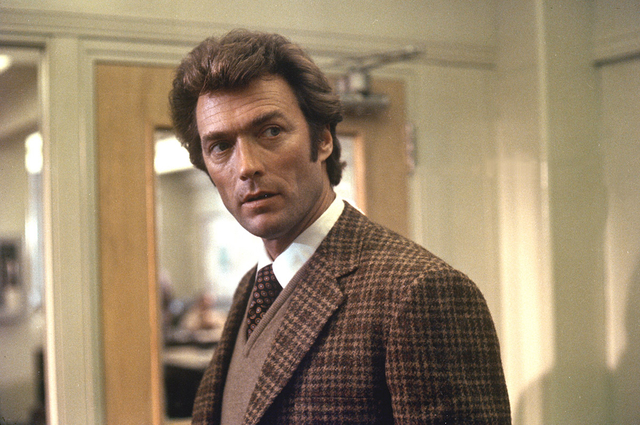
Harry Callahan really looks more like a film noir hero, and while the urban grit and sleaze and even the film's location – the hometown of Sam Spade, no less – should have been a tip-off, it wasn't a genre associated with the actor at the time. Siegel definitely had his noir bona fides in order, but Eastwood had embodied the western antihero in spaghetti westerns and would dominate the modern revisionist western from Joe Kidd and High Plains Drifter through The Outlaw Josey Wales and Pale Rider to his farewell to the genre in Unforgiven (and his slight return in Cry Macho).
When Harry visits Gonzalez in the hospital he learns that his partner isn't planning on returning to the force when he recovers. Talking to his wife, Harry is sympathetic – it's not an easy life, especially if you have a family. He tells her that his wife died when her car was hit by a drunk driver. She asks him why he does it and he tells her he doesn't know why, that sometimes there are no reasons for things – as neat a bit of noir hero existentialism as I can imagine.
Harry tracks Scorpio to Kezar Stadium, where he's living in the groundskeeper's quarters, and runs him to ground in the middle of the field, wounding him in the leg with a shot from his Magnum. He advances on the whining, pleading killer with vengeful fury and, when Scorpio starts crying about his right to a lawyer, begins stepping on his wounds as Surtees' camera flies up into the air into the sky above the fog-shrouded stadium.
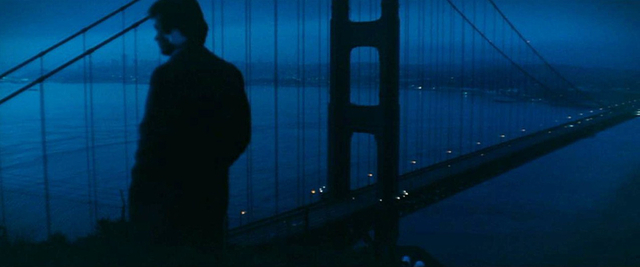
Awash in dim blue twilight, Harry watches while the naked body of the kidnapped girl is pulled from the hole where Scorpio left her. In the district attorney's office he's told that the evidence tying the killer to his murders is inadmissible because Harry had violated his rights while torturing him for information. The sneering D.A. (Josef Sommer) even consults the opinion of a professor from Berkeley, no less, to tell Harry why Scorpio will be released free of charges.
"Berkeley," Kael wrote, "has push-button appeal as the red center of bleeding-heart liberalism; it has replaced Harvard as the joke butt and unifying hatred of reactionaries." And besides, she explains, "anyone who knows San Francisco knows that in the highly unlikely circumstance that a law professor were to be consulted, he would be from the University of San Francisco, a Catholic institution closer in location and nearer in heart to the S. F. Police Department – or, if not from there, from Hastings College of the Law, a branch of the University of California that is situated in San Francisco."
In an essay on the Library of Congress website, screenwriter Matt Lohr notes how Dirty Harry took place in the legal landscape after the Escobedo and Miranda Supreme Court rulings that gave suspects "rights of the accused" that had been of little concern to law enforcement until then. "At every turn," Lohr writes, "(Harry's) drive for justice is met by superior officers all too willing to negotiate with Scorpio, and lawyers who seem more concerned with the killer's rights than those of his victims. They're forever warning Harry against acts of potential harassment, coercion, or excessive force."
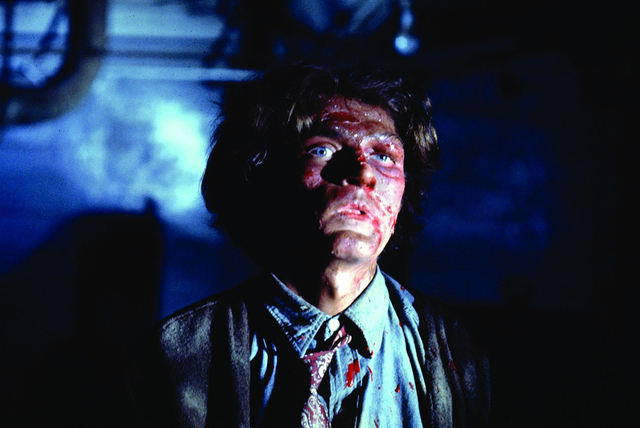
When Harry begins following Scorpio in his spare time, the killer hires a black man to beat him bloody so he can blame it on Callahan – a task that the man takes to with obvious pleasure, especially when the killer goads him with racist taunts. Sure that he's forced the cop to back off, Scorpio hijacks a school bus and holds the children inside for ransom, this time asking for more money and a getaway plane.
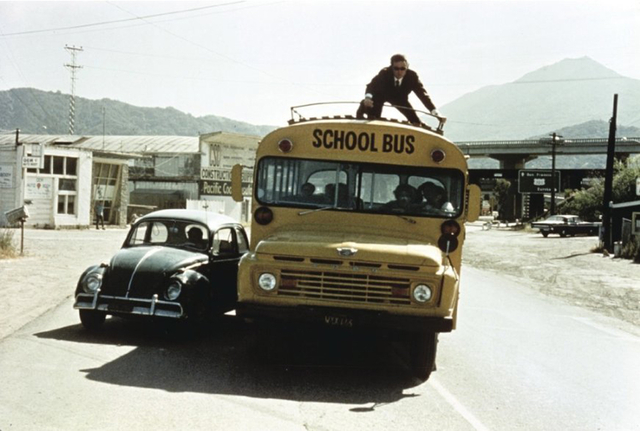
Refusing to be the bagman again, Harry strikes out on his own and goes full action hero, leaping on the roof of the bus while it's driving to the airport and forcing the killer to try to escape through a quarry. Scorpio cravenly takes another luckless child hostage, giggling while he threatens to kill him, but he's no match for Harry's rage and lightning draw. Wounded, he gives Harry another chance to deliver his "how many shots did I fire?" monologue, but takes his chance anyway and gets blown through the air and into a quarry pond, which is where Harry tosses his badge, disgusted with the system that's abandoned justice in favour of the law.
"Harry has dirtied himself for the last time;" Kael wrote, "there is no one now to save us from evil, because the liberals are running the city."
In Kael's review of Dirty Harry, it's not just her distaste for what she perceives as Eastwood and Siegel's political apostasy that sets her off, it's the enthusiastic reaction of the audience to the film. Like the Puerto Ricans who "jeered – as they were meant to – when the maniac whined and pleaded for his legal rights" or the "pink-cheeked little girl saying 'That was a good picture' to her father."
Kael, famously a defender of genre cinema, employs the term as an insult in her review, evincing notable contempt for Siegel as "an accomplished exciter"
"What produces a killer might be a subject for an artist," she writes, "but it's a nuisance to an exciter, who doesn't want to slow the action down."
In his essay on the feud between Kael and Eastwood, Keith Phipps notes that "Kael's Dirty Harry review can be read as an example of Kael's difficulty in engaging with certain types of movies and their stars – in spite of her habit championing disreputable art she uses 'genre' in the piece like it's a dirty word."
She compared the movie unfavorably with The French Connection, writing that it "lacks the zing and brute vitality" of William Friedkin's film, which came out the same year.
Kael is notorious in some circles for wondering aloud, after Nixon's 1972 landslide, that "I live in a rather special world. I only know one person who voted for Nixon. Where they are I don't know." Depending on what you read, this was either the epitome of liberal bubble-think or her own admission that she lived in one and that it coloured her views.
There was, no doubt, a widespread fear at the turn of the '70s that crime was rising and that criminals were suddenly emboldened by a new political and judiciary consensus that crime needed to be treated like a disease that had infected its perpetrators. That punishment and enforcing laws was being diminished in favour of a new obsession with treating "root causes". Kael summed this idea up in her review of Dirty Harry when she wrote that "since crime is caused by deprivation, misery, psychopathology, and social injustice, Dirty Harry is a deeply immoral movie."
Eastwood later claimed to his biographer Richard Schickel that Kael had phoned him and confessed that she never meant what she wrote and that she was "just a dumpy little movie critic, and I have to do that." But actress and onetime Eastwood muse Sondra Locke, who had personal reasons to doubt him, said that he made this up.
What's certain is that Clint Eastwood broadened his appeal as a star with Dirty Harry and made four more pictures (of wildly varying quality) playing the iconic role, and that Don Siegel wrote the blueprint for the decades of cop and action films that followed. What's also certain is that whatever influence Dirty Harry had on movies, we're back in a world where it's widely believed that the judiciary is indifferent to punishing crime, and that police are more concerned with policing speech and opinion than assault, theft, rape and murder. It remains to be seen whether Harry Callahan or Pauline Kael won their feud.
Club members can let Rick know what they think by logging in and sharing in the comments below, as access to the comments section is one of many benefits that comes along with membership in the Mark Steyn Club.