
"There is no other city one can know as completely from the movies and television as New York," wrote film location scout Nick Carr in 2015. "Even if you've never set foot in Manhattan, there's a good chance you can instantly picture a multitude of its neighbourhoods: Carrie Bradshaw's favourite cupcake spot (the Village); the Ghostbusters' firehouse (TriBeCa); the deli where Harry met Sally (Lower East Side)."
Or, if you're a movie fan with a particular taste in New York cinema, your mind's eye can easily recall the setting of the conclave of New York gangs in TheWarriors (Riverside Park in Manhattan standing in for Van Cortland Park in the Bronx), Needle Park (the block just south of Verdi Park on the Upper West Side) or the bloody climactic shootout in Taxi Driver (East 13th Street in the East Village). That New York is a permanent backlot in many peoples' imaginations, but it hasn't existed for decades.
"From the movies," Carr writes, "you'd think Manhattan to be riddled with dank, dangerous, trash-strewn back-alleys, complete with rusting fire escapes and crumbling, graffiti-covered brick walls. So it often comes as a total shock to most directors when we tell them that Manhattan actually has only three or four of these types of alleys (Cortlandt Alley, Great Jones Alley, Broadway Alley, Staple Street), and none are dangerous in the slightest."
When The Taking of Pelham One Two Three came out in the fall of 1974, New York City was building up to a fiscal crisis and a year away from president Gerald Ford's statement that he would refuse to give the city a bailout, which led to the famous New York Daily News headline "FORD TO CITY: DROP DEAD".
The exodus of jobs and residents that was underway by the late '60s shrank the city's tax base while a budget deficit that began with mayor Robert F. Wagner's administration in the early '60s was compounded by Wagner's successor, John Lindsay, borrowing heavily to improve city services. New York was funding free tuition at the City University of New York and keeping transit fares low while relying on federal aid to make it from year to year.
Meanwhile in the movie theatres the "New York as shithole" genre had come into focus with Midnight Cowboy in 1969, followed by Cotton Comes to Harlem (1970), Shaft, The French Connection and The Panic in Needle Park in 1971, Super Fly and Across 110th Street in 1972 and Badge 373, The Seven-Ups, Mean Streets, Black Caesar, Willie Dynamite, Gordon's War, Hell up in Harlem and Serpico in 1973.
The Taking of Pelham One Two Three shared screens in 1974 with Claudine, Three the Hard Way, Crazy Joe and Death Wish and, as the city's fiscal crisis became global headlines, was followed by Dog Day Afternoon and Report to the Commissioner in 1975 before the cinematic capstones to the subgenre: Taxi Driver (1976) and The Warriors (1979).
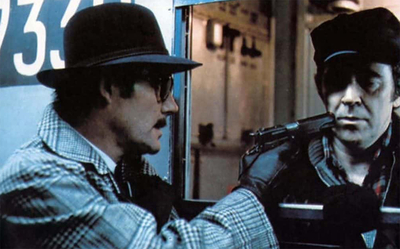
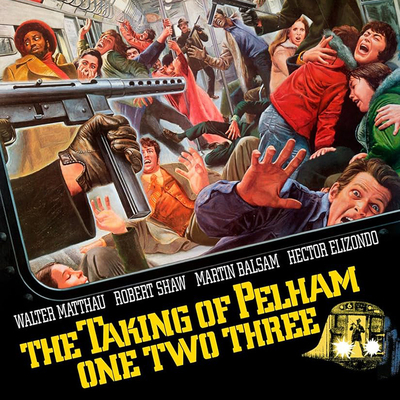
The film begins, after the credits roll over David Shire's punchy, brassy score, in the New York City subways, where a trainee conductor (Jerry Holland) is about to begin his first shift alone on the southbound Lexington Avenue 6 train at 59th Street station. Four pointedly inconspicuous men in hats, moustaches and raincoats carrying conspicuously large packages get on the subway, and before it can get to Grand Central-42nd Street one of them pulls a gun and tells the motorman (James Broderick, father of Matthew) that he's taking over the train.
All the while Lt. Garber (Walter Matthau) of the NY Transit Police is showing around a group of visiting managers from the Tokyo Subway around the subway command centre, wise-cracking and insulting them and everyone else while he introduces co-workers like his colleague Lt. Rico Patrone (Jerry Stiller) and Correll (Dick O'Neill), the belligerent, high-strung supervisor of the command centre.
When one of the 6 trains – named Pelham 123 for its starting location (Pelham Bay Park) and time of departure (1:23pm) – stops in the middle of the tunnel the staff at the Grand Central Tower alert Correll that something has gone wrong. Everyone is quick to blame the driver until the leader of the hijackers, Mr. Blue (Robert Shaw), informs them over their radio that he is in charge of the train and that they have one hour to give him and his associates a million dollars before he starts executing a hostage every minute.
(And if you're thinking that a million dollars doesn't sound like a lot of money, remember that at an inflation rate of 579.8% that adds up to $6,797,626.77 in today's money. Which still isn't a lot of money.)
The movie was based on a 1973 thriller by former movie publicist Morton Freedgood writing under his pen name John Godey. It was made for a relatively modest budget ($3.8 million) by Joseph Sargent, a director whose name won't ring many bells today.
Sargent began his career as an actor, with an uncredited role in From Here to Eternity, but quickly switched to directing, mostly on television and shows like Kojak, Lassie, The Man from U.N.C.L.E. and Star Trek ("The Corbomite Maneuver"). In 1970 he made the cult Cold War sci-fi thriller Colossus: The Forbin Project; in 1972 he directed The Man, starring James Earl Jones as a man who ascends to the US presidency thanks to succession protocol. He followed that up with White Lightning, the first in Burt Reynolds' Southern action-comedy pictures that would lead to Smokey and the Bandit.
Sargent is a classic journeyman – competent but not artistically ambitious, a successor to those studio system directors who made up to a half dozen films a year, on time and on budget, with barely a week vacation between pictures. He would make MacArthur, the biopic starring Gregory Peck, as well as Jaws: The Revenge and countless TV movies (The Night That Panicked America, The Karen Carpenter Story, Abraham – starring Richard Harris as the Old Testament patriarch – and Bojangles, with Gregory Hines as the once-famous dancer).
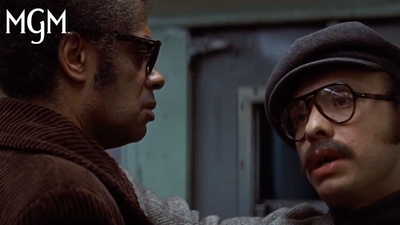
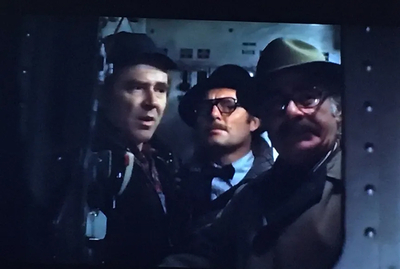
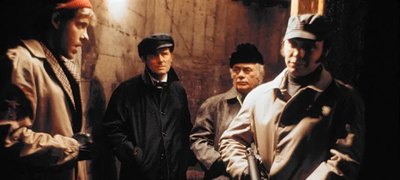
But Sargent was no talentless hack; his direction of Pelham One Two Three is lean and to the point, as showcased with his economical introduction of the four hijackers, who give themselves coloured pseudonyms. (Quentin Tarantino would, nobody will be shocked to learn, pay homage to this in Reservoir Dogs.)
Mr. Blue is an ex-British army officer-turned-mercenary, forced to find a new career when business in post-colonial Africa dried up. Mr. Green (Martin Balsam) is a former Transit Authority motorman bitter after being fired for helping run drugs through the subways. Mr. Brown (Earl Hindman) is the muscle, a bit of an oaf and a stutterer but loyal to Blue for unexplained reasons. Mr. Grey (Hector Elizondo) is a leering, trigger-happy thug who was apparently too nuts for the mafia.
A less confident director would have encouraged the actors to play their roles big, but Sargent lets the four men slowly reveal the characters and motivations of his villains, with the certainty that actors like Shaw and Balsam had the skill to find the key note – cold sociopathy in the former, guilt and weakness in the latter – that makes them compelling in constant close-up.
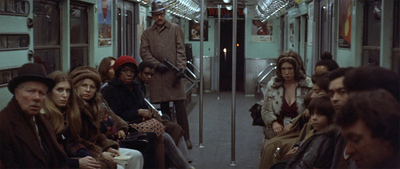
The eighteen hostages on the subway are a collection of both current and timeless New York "types" – a pimp and a hooker, a philosophical old Jewish man, a hippy, a new age flake, a praying Latina, a hysterical mom and her two unruly boys – but they're rarely cartoons, mostly because Sargent and his production team coat everything in a thick shell of period urban griminess; this is one of those films you can almost smell.
Hijacking – or skyjacking, as was the custom at the time – was going through a kind of golden age in the late '60s and early '70s, with an attempted hijacking reportedly every week for almost five years. The trend had begun in the late '50s with so many revolutionaries and counter-revolutionaries seizing planes and demanding they land in Havana that "Take this plane to Cuba!" became a comedy gag line, but by the late '60s middle eastern terrorists and Palestinians in particular had cornered the market, though outliers like D.B. Cooper found a way to grab headlines.
While negotiating with Mr. Blue and trying to get the ransom money to him, Garber wonders just how the hijackers are going to escape – a tunnel under midtown Manhattan is very different from a plane in the air, full of jet fuel. Stiller even gets to make a joke about taking the train to Cuba. Adding to the mystery is the knowledge that an undercover transit cop is among the hostages, though nobody knows who they might be, or even if it's a man or a woman.
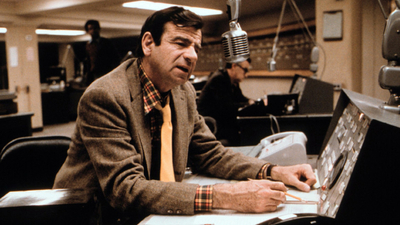
The choice of Matthau as the film's de facto protagonist – though the actor always insisted that he was never really the main character – says a lot about the curious tone of Peter Stone's script. Matthau's Garber is the ultimate New Yorker – expecting the worst and meeting it with a wall of sarcasm; his performance is one enormous eye roll, radiating contempt for everyone from the hijackers to his superiors and colleagues.
The contempt is well-deserved; when the crisis escalates to the mayor's office we meet the man in charge of the city (Lee Wallace), an Ed Koch lookalike suffering from the flu and begging anyone to take the responsibility away from him, starting with his cynical, hyper-efficient deputy major (Tony Roberts), who openly pours scorn on him, and his wife (Doris Roberts), the real power behind the throne. (Though Koch, of course, never had a wife.) The scenes at Gracie Mansion play like a sitcom – I imagine it airing as Hizzoner and running as a summer replacement series on ABC.
Most of the supporting cast surrounding the hijackers and their hostages are basically comic relief, and they get suitably great lines from Stone, like Correll, the irritable transit command supervisor who tells Garber to "Screw the passengers. What do they expect for a lousy thirty-five cents – to live forever?"
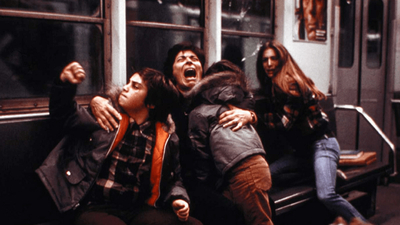
The film is at pains to show us the sorry state of the city's subway system and, by extension one of the world's greatest cities, at very near its breaking point. The New York City Transit Authority – now the MTA – let them film in Brooklyn's abandoned Court Street station (now the New York Transit Museum) but insisted that the cars and platforms were clean of the graffiti that was beginning to swallow up the system and the city.
"New Yorkers are going to hoot when they see our spotless subway cars," Sargent told the Los Angeles Times in an interview. "They (the TA) said to show graffiti would be to glorify it. We argued that it was artistically expressive. But we got nowhere. They said the graffiti fad would be dead by the time the movie got out. I really doubt that."
"There was a pervasive sense that the social order was breaking down," recalled the novelist Kevin Baker. "Most subway trains were filthy, covered in graffiti inside and out. Often only one – and sometimes no – carriage door would open when they pulled into a station, and in summer they were 'cooled' only by the methodical sweep of a begrimed metal fan that just pushed the sordid air about. The trains ran late, and were always crowded; their denizens included chain-snatchers, raggedy buskers and countless beggars, including at least two legless individuals, manoeuvring with remarkable agility between the cars on their wheeled boards."
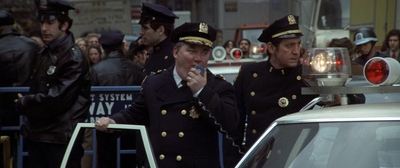
Sargent does a great job with the action set-pieces of his picture – the scene where the ransom money has to be counted and stacked at the Federal Reserve Bank downtown and rushed uptown to the hijackers, and the finale where the subway is sent careening at top speed through the tunnels after their escape.
The Taking of Pelham One Two Three didn't do well when it was released. Perhaps it was because it arrived during the peak of the "New York Goes to Hell" genre; perhaps it was because some critics, like Roger Ebert of the Chicago Sun-Times, grouped it in with the disaster movie films that were also contributing to the early '70s zeitgeist, like Airport, The Poseidon Adventure and The Towering Inferno. This might have been a fair call if the scenes of the subway barreling down the tracks had lasted more than ten minutes at the end of a story that's mostly about a stand-off.
Since then the picture has developed a cult following and taken its place among the best of the "New York Drops Dead" films made when the city was actually going down for the count. (It has been remade twice – once as a TV movie in 1998 and again as a big budget action film starring John Travolta and Denzel Washington in 2009.) They actually evoke a kind of nostalgia now, mostly for people who never had to live through the period, and when people who actually did and should know better reminisce about the semi-derelict downtown and cheap rents that hosted a renaissance in music and art.
When New York's Film Forum ran a retrospective of these films ten years ago, the New York Times published an opinion piece wondering if this nostalgia for an ailing city, collapsing under corruption and neglect, was really healthy, especially after the still-underfunded subway had just suffered a derailment that stranded passengers in a smoke-filled train.
"The agony of the subways," wrote Clyde Haberman, "also has more than a few New Yorkers worrying that they've begun an inexorable descent, maybe even back to the 1970s, when the city endured what could reasonably be described as a near-death experience. It might be useful, then, for everyone to take a deep breath and think about how far New York has come from those bad old days."
He added that when Hollywood had recently made A Most Violent Year, set in the New York of 1981, they had a hard time finding locations: "To capture a stricken landscape, the filmmakers could not find all that they wanted in the city. They went instead to Detroit."
Club members can let Rick know what they think by logging in and sharing in the comments below, as access to the comments section is one of many benefits that comes along with membership in the Mark Steyn Club.