
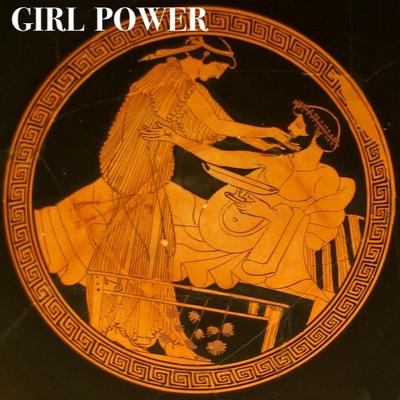

As the #MeToo year of 2017 rolled toward winter, women across the land continued to rage. Like numberless rivulets flowing in from mountain, hill, and plain, the accusations of abuse - wholly true, partly-true, and wholly fabricated - all eventually combined into one great flood, saturating everything. That meant social media posts, water cooler conversation, magazine articles, TV interviews, human resource policies, proposed legislation and beyond.
Along with the rage came female exultation at the power to destroy a man's career, marriage, life, with just an accusation. But in those charged days and weeks, a different kind of exultation was occurring inside a tall grey skyscraper smack dab in the middle of Manhattan.
The address was 500 Fifth Avenue: the headquarters of book publishers W. W. Norton & Company. Only a few months earlier, commercial prospects for Norton's forthcoming translation of The Odyssey looked on par with other such releases: respectable, but not exactly blockbuster. But now, everything had changed. Life, fate, the universe, destiny, the stars - whatever it was - had so arranged the world the past few months, that this new translation could turn into something bigger than anyone at Norton had dared dream of.
You see, this new, about-to-be-released translation of The Odyssey wasn't like the others. Oh no. In perfect alignment with the zeitgeist, this was a translation produced by a 100% true-blue genuine authentic female human being: a woman! And even better: not only was the translator a woman, she was a self-proclaimed feminist woman, and an Ivy League professor feminist woman to boot. But best of all: she was the first woman to ever translate The Odyssey into English!
Could this get any better for the Norton publicity department? Actually, yes: in addition to all the other great news, the new translator sported arm-tattoos every bit as crudely-wrought as anything you'd see on a Riker's Island gang member: a big rose; an amateurish caricature of an octopus; two badly-drawn horses; a fox face; a dolphin; various indiscernible doodles, and more. This, plus a couple of other features, combined to produce the dirty, roadworn aura of someone who'd popped more than one Ecstasy tablet, and God knows what else, during 90s raves in Britain, where she grew up. Adding to the overall picture was her outspoken pride in her own vegetarianism. Yet another cherry on the marketing cake was that in conversation, she incessantly repeated run-of-the-mill leftist cliches as though they were established facts no remotely rational person could doubt. And - joy of joys! - she had even claimed - and would continue to claim - that previous (male) translators had mistranslated The Odyssey in service to their own unconscious hatred of women. As she would later put it:
"The vast majority of translations that readers read in English for classics are by men. This is an issue, and we should talk about it... It's very visible to me how misogynistic some of these translations are, and not because they were consciously imposing misogyny, but they had some unconsidered biases. Men are never asked about their gender, and this omission is seriously distorting. It's very clear gender has an impact on men's work."
As if all this wasn't grand enough for Norton & Company, she was even willing to perform live promotional readings of her translation somewhat in the dramatic style of a slam poet, during which she would add in her own Muppet-style voice characterizations for the different characters.
In short, Emily Wilson, the University of Pennsylvania classics professor and author of the new translation, was a modern book publisher's dream. She ticked every appearance box, every opinion box, every ivory tower "girlpower!" box, every idiosyncrasy box, every anger box, every unrestrained accusation box, and of course, she ticked the big cultural moment box. True, she did fall a bit short of the demographic ideal - she was a heterosexual caucasian - but then, how many black lesbians were out there reading, let alone translating, Homeric Greek? None. So Emily Wilson was as good as it got, and W. W. Norton & Company had gotten her.
Whereas only months earlier book sales looked like a challenge, now the PR media pitch for the new translation wrote itself:
In every sphere of life, from the beginning of time, men have dominated and controlled everything. Treated as second-class citizens (and usually worse), women around the world are finally rising up. As the world celebrates this MeToo moment and rejects a phallocentric past, Norton is pleased to announce the release of the first-ever English translation of The Odyssey by a woman. What this means is, Emily Wilson's new translation is much more than a translation. It is a world-changing historical event, not least because all previous translations were marred by the male chauvinism of their translators - a grotesque injustice this version corrects. Now you can be part of this righteous, progressive, feelgood story by purchasing and praising Emily Wilson's translation today (and if you dare imply other translations are more faithful to the original text, it means you're like Harvey Weinstein).
Okay - that's not what the Norton publicity team actually said. But it's kind of what they said. And you can tell because almost every review used that same framing. In fact, Wilson's translation - released November 2017 - garnered reviews so adulatory, it almost seemed like the reviewers were competing over who could use the most superlatives in a single article. This was even true when (perhaps for the sake of their own scholarly reputations) the reviewers felt forced to allude, however gently, to a few of Wilson's unusual translation choices (and by "unusual", I mean "incorrect", about which more later).
Lest anyone think I'm exaggerating about the adulation and the feminist framing, here are a few review excerpts:
Charlotte Higgins, The Guardian: "Emily Wilson's crisp and musical version is a cultural landmark... Armed with a sharp, scholarly rigour, she has produced a translation that exposes centuries of masculinist readings of the poem... This translation will change the way the poem is read in English. When Keats first looked into Chapman's Homer, he felt like 'some watcher of the skies / When a new planet swims into his ken'. So it is with Wilson's Odyssey... A woman's voice: how beautiful to hear it."
Corinne Pache, Bryn Mawr Classical Review: "Emily Wilson's Odyssey is a delight to read... (it) is the first English translation of the poem by a woman... Compared with her predecessors', Wilson's Odyssey feels more readable, more alive... Wilson has put gender at the center of her interpretation of the poem, arguing that she avoids falling into the misogynistic traps that ensnared earlier male translators, who were unwilling or unable to showcase Odysseus' ambiguous traits or to check their own disdain of female characters... an amazing achievement, a thrill to read, and the best English translation. Hers is the Odyssey my students will read from now on. It is a brisk, lively, often magical, version of the ancient epic that captures its enduring appeal and urgency."
Josephine Balmer, The New Statesman: "Not only is this the first English verse translation of the poem by a woman, it is a fluid and immensely readable versification... English translations of the epic have remained firmly male... But late last year, Emily Wilson's new translation appeared, like one of Zeus's thunderclaps, to part the clouds. In practice, Wilson's quiet ambition provides an immediacy and clarity, blowing away the cobwebs of pseudo-archaisms or epic pomposity, the brilliant clear sky after one of the many storms Odysseus endures... It is immensely satisfying to see The Odyssey in the hands of such a careful and creative scholar who can pore over the semantic nuances of Homer's Greek as well as those of her own English."
Wyatt Mason, The New York Times Magazine (review featuring the sledgehammer-to-the-face-title, "The First Woman to Translate the 'Odyssey' into English", just in case you were too stupid to get the point): "Throughout her translation of The Odyssey, Wilson has made small but, it turns out, radical changes to the way many key scenes of the epic are presented - 'radical' in that, in 400 years of versions of the poem, no translator has made the kinds of alterations Wilson has, changes that go to truing a text that, as she says, has through translation accumulated distortions that affect the way even scholars who read Greek discuss the original....When I first read (Wilson's) lines early this summer, I was floored... it had such directness... (Wilson finds) equivalents in English that allow the terms she is choosing to do the same work as the original words, even if the English words are not, according to a Greek lexicon, 'correct'."
Well, yes. That last sentence admits to something mostly glossed over amidst all the adoring genuflection: important incongruities, shall we say, between Homer's original Greek text, and Wilson's rendition of it. No one at Norton seemed to mind, or even notice, the paradox: whereas their prize translator came out of the box claiming her translation corrected centuries of misogyny-inspired errors, her translation itself inflicted enormous damage on a few key concepts and passages in The Odyssey. I'd like to dive into that next time, not least because, as you've probably guessed, it was this very translation which Christopher Nolan used most in creating his forthcoming movie.
If you missed Tal's Odyssey Parts I-IV, you can read them here, here, here and here.