
The collaboration between director Michael Powell and writer/producer Emeric Pressburger began on the eve of World War Two and built up a considerable head of steam making films for and about that war. Some were obvious propaganda (Contraband, 49th Parallel, One of Our Aircraft is Missing) while a couple were far too idiosyncratic to match any workable definition of propaganda (The Life and Death of Colonel Blimp, A Canterbury Tale). Blimp was so at odds with the British government's idea of what aided the war effort that Churchill himself ordered the military not to assist the filmmakers during its production.
The pair continued to make films about the war when it was over, starting with A Matter of Life and Death (1946), which marked the beginning of their visually lush, highly stylized creative peak that continued with Black Narcissus (1947) and The Red Shoes (1948). Their last film together (before a rather disappointing late reunion for They're a Weird Mob and The Boy Who Turned Yellow) was another war picture about British special agents and resistance fighters during the German invasion of Crete, Ill Met By Moonlight (1947), which marked the end of Powell and Pressburger's production company, The Archers.
But the oddest film in The Archers' catalogue of war pictures has to be their most conventional entry in the genre, a relatively accurate, visually straightforward picture that seems at great pains not to distinguish itself from other postwar British war films – like The Cruel Sea, The Dam Busters, Dunkirk, Reach for the Sky, Above Us the Waves, Raiders in the Sky, The Colditz Story or Sink the Bismarck!. If all you knew about Powell and Pressburger was Black Narcissus and The Red Shoes (never mind The Elusive Pimpernel or Tales of Hoffman) you'd never guess it was part of their filmography.
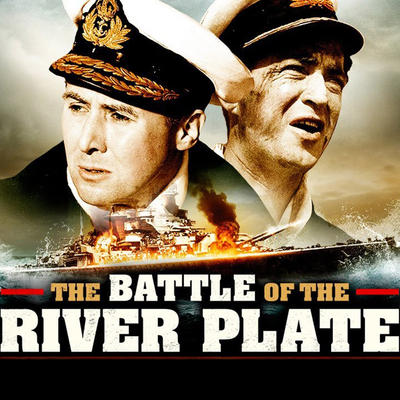
The Battle of the River Plate, released in 1956, is set during the opening months of World War 2 when, after invading Poland and quickly carving up the country with an unlikely ally, the Soviet Union, Germany sat behind its borders and uneasily surveyed its next enemies – Britain and France. The film is based on the true story of one of the rare military flashpoints of that period, when Germany kicked off its attempt to starve Britain of essential overseas trade by attacking merchant shipping headed for the island.
The Admiral Graf Spee, named after a naval hero of the First World War, was a so-called "pocket battleship" laid down in 1932 and launched after Hitler took power. Even before the Nazis were in charge Germany was intent on defying the limitations imposed on it by the Treaty of Versailles and the Washington Naval Treaty and the Graf Spee, while technically complying with the limit of 10,000 tons of displacement, actually blew past that by nearly another 5,000 tons.
Armed with six 11-inch big guns, the Graf Spee was really a very fast heavy cruiser, designed as a "surface raider" and, alongside its sister ships, the Deutschland (later renamed the Lützow) and the Admiral Scheer, was built to wreak havoc on the shipping lanes crucial to Britain's survival. The Graf Spee slipped out of harbour before the invasion of Poland and disappeared into the North Atlantic for three weeks before receiving the order to start attacking shipping all the way from the coast of South America to the Indian Ocean.
"This is a story of sea power," the narrator tells us over a surging wake from a fast-moving ship after the credits have rolled. Powell's film begins over halfway into the Graf Spee's brief wartime career, with its sinking of the oil tanker MV Africa Shell off Mozambique. Captain Dove (Bernard Lee), the tanker's captain, is taken prisoner on the German ship while his crew is allowed to row back to shore, protesting the whole time that he was safely within Portuguese waters when they were attacked.
He's treated with chivalrous courtesy by the captain of the Graf Spee, Langsdorff (Peter Finch), who disagrees with Dove's assessment but lets him make a formal complaint before showing him to his quarters, where he'll soon be joined by the officers of the other ships that the German ship sinks over thousands of miles of ocean. He even has the ship's tailor make him a new uniform for the colder seas they traverse on their hunt and affably explains how the ruses they use to deceive their quarry and confuse their enemies as they go – like changing the ship's name plates or building fake funnels and gun turrets to alter its silhouette.
Like similar characters in Colonel Blimp and 49th Parallel, Langsdorff is a "Good German" – a dedicated soldier but not a Nazi ideologue, and he conducts his piracy on the high seas with what passes for a code of honour in the war's early months. Ships are warned before the Graf Spee fires its guns, their crews treated with courtesy once interned on the raider or on its supply ship, the Altmark. It's a far cry from the sneak attacks and "sink upon sighting" of the U-boat wolf packs that will soon represent the German navy on the high seas.
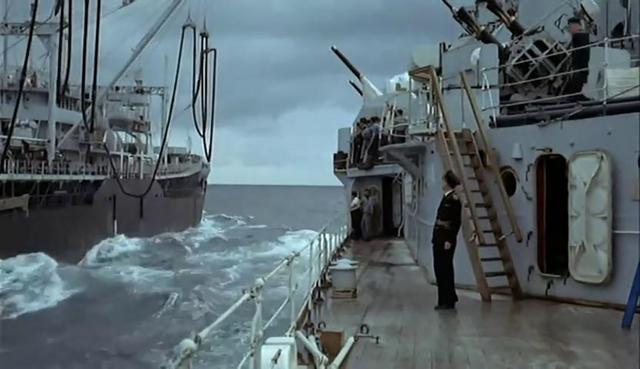
Dove is even allowed to wander the ship and watch the refuelling and provisioning with the Altmark by his gracious host. The real Langsdorff was noted for avoiding the stiff-armed Nazi salute, favouring the old one of the Imperial Navy where he began his career, and Finch observes this detail consistently.
This isn't to say Langsdorff was an enemy of the regime, though he was apparently dismayed at the Nazi-Soviet Pact and the truce it made with Bolsheviks. Some like to speculate that, like Rommel – another "Good German" who gave heroic service to the regime – his discontent might have turned into dissent and conspiracy later in the war, if he'd survived to see it, though there's no way we'll ever know, and this might simply be part of the myth that's grown up around the man.
There were a few of these "Good Germans" showing up in war films by the '50s. It's tempting to speculate that, while Powell and Pressburger might have been motivated by their own conceptions of men and morality outside propaganda, the decade since the war ended had seen West Germany join in the postwar economic miracle and become a valued member not just of Europe but of the international community in the world after Bretton Woods and the Marshall Plan. (West Germany had joined NATO the year before the film came out.) The existence of "Good Germans" was crucial to the idea that Nazis were an exception and not the rule of German national character, and that whatever mistakes they might have made, you couldn't deny that Germans on the whole were very good at their jobs.
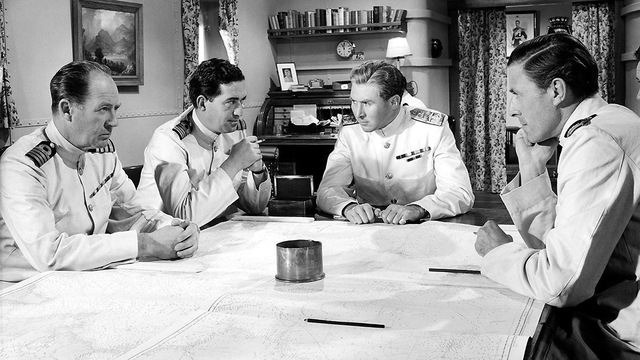
But while Langsdorff and the Graf Spee are hunters, they're also being hunted. As soon as they knew there was a surface raider on the loose, the Admiralty put together several hunting groups to patrol the trade routes – a collection of battleships, aircraft carriers, destroyers and cruisers, some of them French ships, since it wouldn't be until the following year that Britain's only real European ally was knocked out of the war.
For the purpose of our story it's only three ships: the HMS Exeter, a heavy cruiser, and two light cruisers – the HMS Ajax and the HMNZS Achilles, its sister ship, transferred to New Zealand's navy. They're all under the command of Commodore Henry Harwood (Anthony Quayle) on his flagship, the Ajax, and he lays out his plan of attack for all the ship's captains as soon as we meet him.
With reports of Langsdorff's rampage trickling in piecemeal, and the identity of his ship a mystery thanks to his camouflage tactics, Harwood has to play a hunch, and while the Graf Spee seems to be everywhere all at once, he bets that the busy shipping routes along the coasts of Argentina, Uruguay and Brazil will be too tempting, so he plans on setting his trap there.
In 1944, when Powell and Pressburger made The Volunteer, a short recruiting film for the Fleet Air Arm starring Ralph Richardson, the Archers initiated a relationship with the Admiralty that the director described as useful years later, while making The Battle of the River Plate, when he summed it up in his memoir A Life in Movies:
"Dear Powell and Pressburger, if you ask for what you want when you want it, you can't have it. Or if you could have it, it would cost you an astronomical fee. Do as we say, tell us exactly what you want, and when it is possible to give it to you, we'll tell you to come and get it, and it won't cost you or the taxpayer a penny."
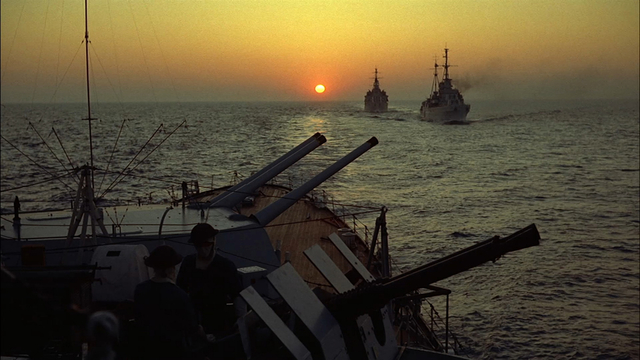
For The Battle of the River Plate, the Archers wanted to avoid too much use of miniatures so they arranged with the Admiralty for the use of as many real ships as they could. The Achilles had survived the war and was now the Indian navy's INS Delhi, but the Ajax had been scrapped in 1949 and was played onscreen by the HMS Sheffield.
The Exeter was sunk in 1942, during the Second Battle of the Java Sea, and was played by the HMS Jamaica. An American heavy cruiser, the USS Salem, stood in for the Graf Spee, although there was little resemblance between the two ships. The Salem had nine guns to the Graf Spee's six, for instance, and appears onscreen with its bow number, 139, prominently displayed, which meant Finch's Langsdorff had to explain to Dove that this was another clever disguise. Two destroyers, the HMS Battleaxe and the USS William R. Rush were used as camera ships, and the light cruiser HMS Birmingham's guns were filmed firing during battle scenes, while the ship stood in for the Graf Spee and the Exeter in other scenes.
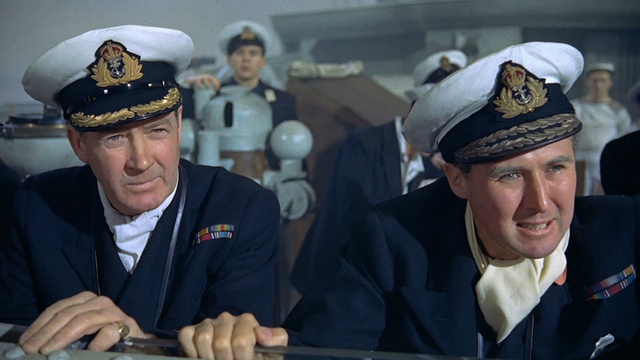
The only scene in the picture that has that camp, stylized Powell and Pressburger touch is when the British prisoners on the Graf Spee are serenaded with "Stille Nacht" by the German crew and presented with leftover Christmas decorations to brighten up their quarters, to celebrate St. Nicholas Day, and just as the battle between Harwood's ships and their German quarry suddenly begins. It must have been something that Powell needed to insert into the film, because while St. Nicholas Day falls on December 6th, the Battle of the River Plate commenced on December 13th.
Onscreen the battle lasts for around twenty minutes while in real life it was just over an hour, and it's unlikely anyone on the four ships, all of them at action stations, was caught unawares. Langsdorff, who had orders to avoid confrontations with enemy ships, assumed that the three cruisers were screening a convoy and gambled that he could fight his way through them to get to his real quarry. The British cruisers and the German pocket battleship held each other tensely in their sights before the first shots were fired.
By all the rules of naval warfare at the time it was an uneven fight; the British ships might have been faster but the Graf Spee's guns were heavier and had longer range and its armour was thicker. As expected the Graf Spee fired first, and Harwood's plan was to come at the German ship from different directions and divide its fire. As Harwood surely knew, it was their only chance at winning, and a slim one at that.
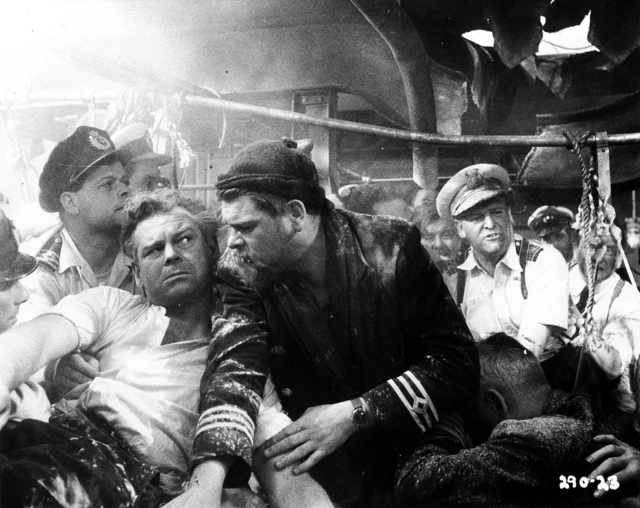
When the battle begins Powell restricts the action to its British (and New Zealand) participants, with barely a look in at Langsdorff and his crew. Our only view of the action on the Graf Spee is from the room where the captured officers hide on the floor while shells and shrapnel tear through the walls. The film was shot on The Archers' beloved Technicolor film stock, but run through new VistaVision cameras, which meant lots of wide shots of naval action but no real close-ups.
Dudley Pope's The Battle of the River Plate, published the same year that the film came out, remains the most authoritative record of the career of the Graf Spee. His description of the battle is savage, with hundreds of shells fired by both sides; Harwood's ships, with their smaller calibre main guns (the Ajax and Achilles had eight six-inch guns apiece while the Exeter had six eight-inch guns), could only chew up the Graf Spee piecemeal, while the Graf Spee's bigger guns, controlled by the latest targeting technology in the German navy's arsenal, was guaranteed to inflict heavier damage whether they landed direct hits or close impacts.
Even when the pocket battleships shells closely straddled their targets, the shrapnel bursts were lethal; crew exposed on the decks were killed outright while shrapnel tore through the cruisers' light armour with almost the same deadly effect. Pope's description of the carnage is relentless, particularly on the Exeter which, being the more heavily armed ship, bore the brunt of the Graf Spee's fire.
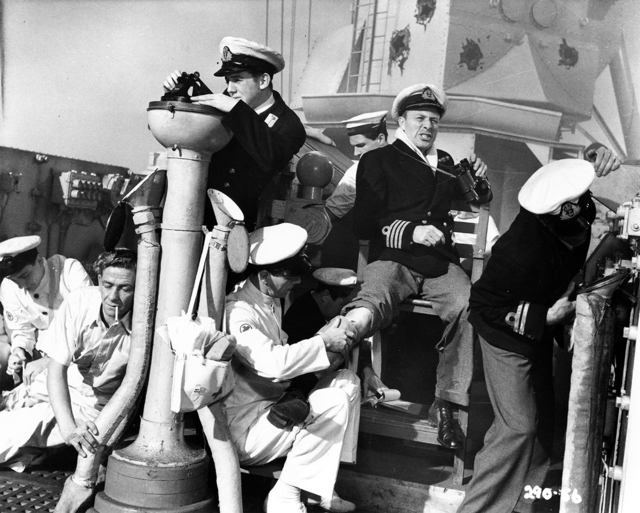
Struggling to keep its guns firing while attempting damage control all over the ship, Pope describes the effect of just one shell impact on the Exeter:
"The explosion was felt all through the ship, as though she had been punched in her solar plexus. Blast and fumes thrust back along the starboard passage; one bulkhead door was blocked with debris and bodies, and another with the wreckage of the kit lockers; the Chief Petty Officers' flat was in darkness and filled with dense fumes and steam escaping from a punctured heating pipe."
With only one eight-inch turret able to fire and just a single four-inch gun operating, the Exeter was forced to withdraw first, while the Graf Spee continued to menace her as if contemplating an easy kill. Harwood ordered his two light cruisers to charge the German ship to draw its fire and let the severely wounded Exeter sail out of the big guns' range.
Harwood had no idea how badly the Graf Spee was damaged but it quickly became clear that his quarry was sailing for the mouth of the River Plate and the ports at either Montevideo or Buenos Aires. In Powell's film the prisoners held in the German ship have no idea what's happened after the guns stop firing until they're informed that they have dropped anchor in Montevideo and that they're going to be freed.
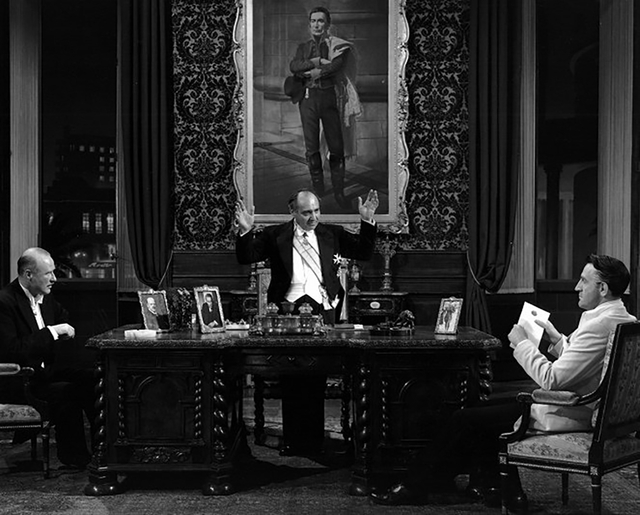
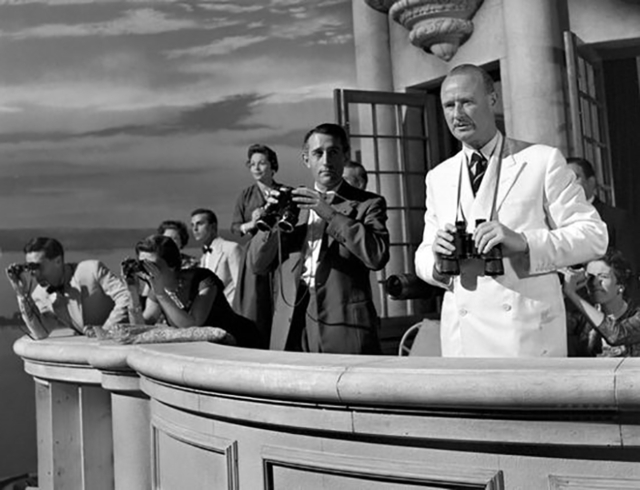
At this point the film shifts tone so thoroughly that it's almost like another movie. It's no longer a story about sailors and sea battles as much as one about diplomats, journalists and the psychology of crowds. While Harwood and his captains sit and wait in international waters along the 125-mile wide mouth of the River Plate, Langsdorff is on shore with Dr. Langmann (John Chandos), the German minister, pleading with Guani, the Uruguayan foreign minister (Peter Illing), for time to repair his ship while the British minister, Eugen Millington-Drake (Anthony Bushell) conspires with his French counterpart (Douglas Wilmer) to keep the pressure on the Germans and buy time until reinforcements arrive to bolster Harwood's battered battle group.
You can tell that Powell is having fun painting a gaudy portrait of Montevideo, cluttered with Latin-American stereotypes like Manolo, the owner of the harbourside bar where Fowler (Lionel Murton), a rakish American reporter, sets up his command post with a clear view of the Graf Spee at anchor, broadcasting live to all the American radio networks as the story becomes an international sensation.
The Archers combed London's theatres and agencies for actors with a Latin-American look to play all the characters filling the crowded scenes in Montevideo, and for Manolo they cast a young actor who spoke several languages including Spanish, who'd been stuck in small parts for several years, the most notable of which was in John Huston's Moulin Rouge, and who'd had a fairly colourful career in the RAF during the war working in special forces and intelligence: Christopher Lee.
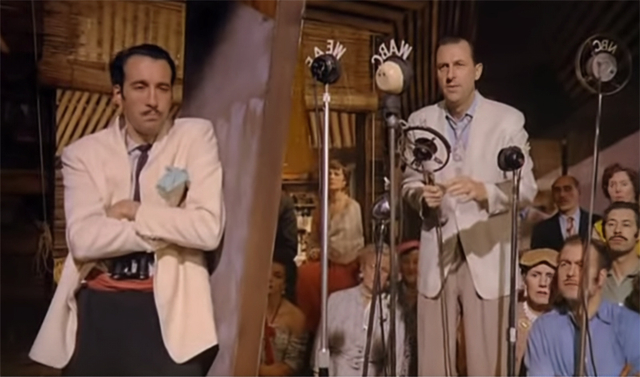
Lee's Manolo doesn't speak a word of English as much as he gestures vehemently and argues constantly with Dolores (April Olrich), the singer in his bar's house band. While the diplomats, naval attaches and MI6 spooks start spinning disinformation all around Langsdorff and the Graf Spee, Fowler obligingly repeats stories that the Ajax and Achilles, since reinforced by the heavy cruiser HMS Cumberland (playing herself), have been joined by the heavy cruiser Renown and the aircraft carrier Ark Royal (both actually hundreds if not thousands of miles away).
One of the most remarkable stories in Pope's book is how wild the speculation was about the force waiting for the Graf Spee even when they were only separated by a few miles. Langsdorff was never certain what he might expect to meet if he tried to make a break for the open ocean from the Plate; chartered planes flying over the estuary reported four British cruisers waiting for him, and "one of the Graf Spee's gunnery officers personally reported sighting from the Director Control Tower a large warship which he considered to be the Renown; and on the horizon he saw what seemed to be the Ark Royal and two or three destroyers."
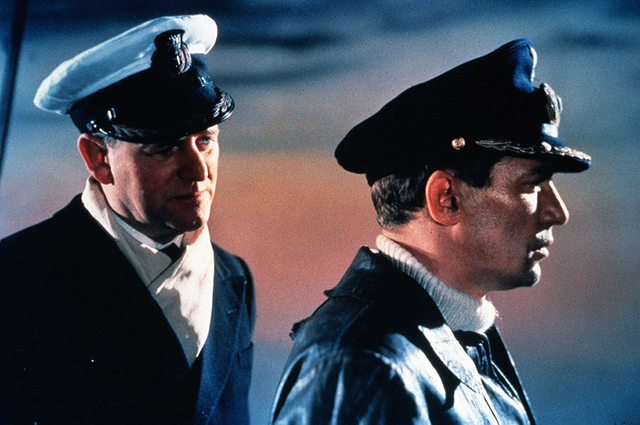
All he did know was that in Berlin, neither his commanding officer, Admiral Raeder, nor Hitler himself wanted the Graf Spee and its crew to be interned in either Montevideo or Buenos Aires. Better to fight his way out and perhaps inflict serious blows on the British ships waiting for him; in any case Guani and the Uruguayan government – under no small pressure from the British and French ministers – give him just 72 hours to fix his ship and weigh anchor.
The tragedy of the film, revealed in its last act, is how Langsdorff – a noble man of action, admired by other noble men of action like Dove – is trapped in a web spun by less noble men; men of words and subterfuge and lies who really run the world. He buries his men, bargains in good faith and never knows the full extent to which he has been deceived. On the sea he can control his destiny and even deal honestly with enemies; on land he's out of his depth, surrounded by enemies for whom honesty is weakness.
The story of the Battle of the River Plate had been told once before on film – in 1940, not long after the battle, by director Maurice Elvey (House of Blackmail, The Wandering Jew) in For Freedom, a picture about a newsreel company owner whose son, frustrated by his father's decisions, quits and ends up in South America just in time to cover the Graf Spee. It featured the real Capt. Dove as himself and included the story of the Altmark, which tried to escape back to Germany but was run aground by British planes and ships in Norway.
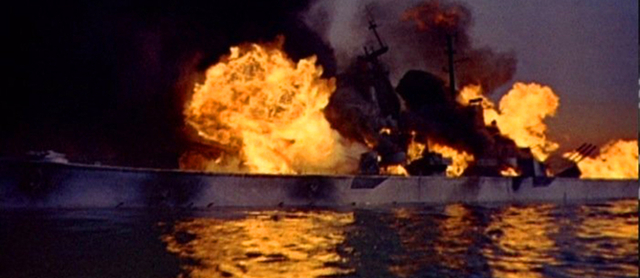
At the end of his film Powell makes a curious decision centred on an omission. Langsdorff, with Fowler narrating and the whole of Montevideo watching, sails his ship with a skeleton crew out into the Plate estuary and, just as the sun sets, scuttles the Graf Spee with a series of explosive charges. He had informed both the German and Uruguayan governments of his plan but left everyone else – the British, the crowds, the media – to guess what he would do next. Perhaps it was his way of maintaining some control over his destiny at the end.
The film ends with Dove telling the numb, depressed Langsdorff how much he and the British officers who sailed with him involuntarily during the Battle of the River Plate admire and respect him, followed by Harwood and his ships sailing back out to sea to continue fighting the war. What Powell pointedly avoids telling us is that after sailing with the rest of his men to Buenos Aires and ensuring that they wouldn't be interned, Langsdorff shot himself on the Imperial German Navy ensign.
While The Battle of the River Plate was finished in 1955, Rank executives decided to hold it for a year so it could be chosen as the next year's Royal Command film performance. It was a hit in Britain at number four in 1957's box office after High Society, Doctor at Large and Kenneth More in The Admirable Crichton.
It was released in the U.S. as Pursuit of the Graf Spee where Stanley Kauffmann called it "almost unrelievedly dreadful" in The New Republic. It did a lot to deplete the momentum holding The Archers together and, after the relative success of Ill Met by Moonlight, they called it quits, leaving Powell to commit what would be regarded as career suicide with Peeping Tom.
Club members can let Rick know what they think by logging in and sharing in the comments below, as access to the comments section is one of many benefits that comes along with membership in the Mark Steyn Club.