
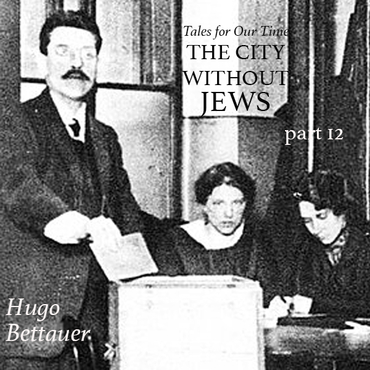
Tales for Our Time is a unique feature of The Mark Steyn Club - and, we're pleased to say, one of our most popular: our nightly audio serialisations of classic literature from Orwell's Nineteen Eighty-Four to Jane Austen's Northanger Abbey, via some neglected but highly pertinent gems such as Conan Doyle's tale of proto-jihadists preying on foolish westerners, The Tragedy of the Korosko.
Our current caper is The City without Jews, Hugo Bettauer's satire of 1922. In tonight's penultimate episode there is a faintly Epsteinian flourish:
In the course of time Leo had opportunity to learn that Herr Krötzl was not only a rabid anti-Semite but also a notorious drunkard, who usually had a drop too much even at breakfast at the Parliament buffet. However, he had considerable gifts of persuasion, and was quite popular among his constituents for his homely way of putting things. He was a widower, and from time to time harbored in his home a presumable housekeeper—occasionally one that had barely passed the legal limit of fourteen years.
Members of The Mark Steyn Club can hear me read Part Twelve of our tale simply by clicking here and logging-in. Earlier episodes can be found here.
Thank you for all your perceptive comments about this caper. Rachel, a New York Steyn Clubber, writes:
Dear Mark,
Although I am very much enjoying listening to your reading of this juicy novel, I must admit it is quite "cringy." I am a proud and feisty (not voluptuous) Jewess but this novel kind of scares me. When you are reading I want to shush you. This blatant admiration for the Jews is not meant to be spoken about in public. It's dangerous. What is to be gained from it? I am so curious to hear how this novel ends. I'm guessing it is a tragedy.
Well, we'll find out tomorrow night, Rachel. I don't know about "blatant admiration for the Jews", but I like the author because of his portrait of a society that he did not know was about to exit the stage of history. Habsburg Vienna was one of the world's great cities. It has not been so for a long time, even before its recent Islamisation. Between the Holocaust and the foundation of Israel, the Habsburgian Jewish life - whether of the imperial capital or the Bukovina - has entirely vanished and can never return. I find that interesting and poignant: it reminds me of conversations with my late colleague, George Jonas, who, speaking of 'tween-wars Hungarian cultural life, used to say things like "My father knew the names of librettists" - a fabulous sentence. A lot of those librettists were Jewish.
I'll be right back here tomorrow with the conclusion of The City without Jews. If you're minded to join us in The Mark Steyn Club in this our ninth season, you're more than welcome. You can find more information here. And, if you have a chum you think might enjoy Tales for Our Time (so far, we've covered H G Wells, Jane Austen, Dickens, Wodehouse, Kipling, Kafka, Gogol, Baroness Orczy, Victor Hugo, Louisa May Alcott, O Henry, John Buchan, Scott Fitzgerald and more), we have a special Gift Membership that makes a perfect birthday present.