Lee Marvin had a reputation for being a great interview, obliging the press who expected the ultimate movie tough guy with more than they expected. His agent, Meyer Mishkin, said that Marvin gave his best performances for the press, going so far as to play with a knife during interviews.
"Most people only wise up when they are down on the floor with the blood everywhere," was one such gem. In another he said that despite their brutality, he didn't think his films had a bad influence on the audience. "The Shirley Temple movies are more likely to do that; after listening to 'The Good Ship Lollipop' you just gotta go out and beat up somebody. Stands to reason."
He spoke like one of his profession's foremost authorities on violence: "When I do a scene I make it as rough as I can. Knock a man down with one round, then walk up on him and put three or four more in his face. Roll him over and put one in his back. Make it ugly... I say make it so brutal that a man thinks twice before he does something like that."
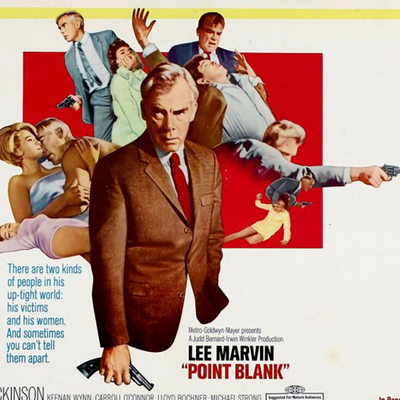
But as Dwayne Epstein recounts in Lee Marvin: Point Blank, his biography of the actor, Marvin was taken aback when he rewatched the film that gave his bio its title – probably his greatest role – near the end of his life.
"I saw Point Blank at a film festival a year or so ago and I was absolutely shocked," Marvin recalled. "I'd forgotten. It was a rough film. The prototype. You've seen it a thousand times since in other forms. That was a troubled time for me, too, in my own personal relationship, so I used an awful lot of that while making the picture, even the suicide of my wife."
You could argue that Marvin's Walker in Point Blank is less a man than an idea made flesh – a force incarnate, his purpose boiled down to a single motivation. You could even go so far as to argue that he doesn't exist at all, and that everything we see from the moment the picture goes from past to present is either a dream or a reckoning. It's that kind of picture.
MGM sold Point Blank as a heist picture in their early promotional campaign, and we get a heist for the first five or so minutes of the picture. Walker is persuaded to help hijack a mob cash drop at the recently abandoned Alcatraz prison by Reese (John Vernon), an old friend and (it's implied) army buddy. Walker's wife Lynne (Sharon Acker) is drawn into the plot and becomes an accomplice when Reese double-crosses his friend, shoots him in one of the prison cells and leaves him for dead.
Somehow and improbably, Walker survives and in a single cut we meet him again, sharply dressed, his hair grayer, on the sightseeing ferry circling Alcatraz, chatting with Yost (Keenan Wynn). Walker wants to find Reese and recover his money – the $93,000 that was his cut of the heist. Yost tells him that he's in Los Angeles with his wife and sets the relentless mechanism of the film in motion.
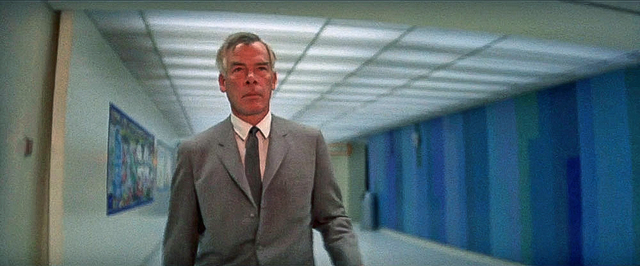
We see Walker next walking toward the camera down one of the underground tunnels at LAX, his heels clicking metronomically, the sound echoing off the multi-coloured tile walls. He's a missile making his way toward Lynne, who we see going about her day unaware what's heading her way. It's one of the film's signature scenes and a hallmark of what many critics have described as modernist fantasy.
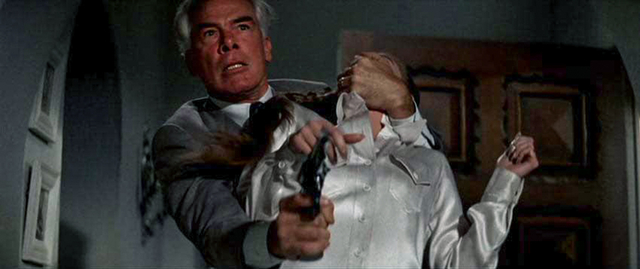
When Walker finally tracks down his wife he explodes into her apartment and empties his revolver into her bed before realizing Reese isn't there. Spent, he sits down and ejects the brass from his gun. His wife sits down next to him and, while Marvin stares catatonically into space, explains what happened with her and Reese and how she let herself get swept up in the betrayal in a monotone that got Acker the worst notices in reviews of the picture.
Reese is apparently gone; he had no intention of sharing the heist money with Walker as he needed all if it to pay off a debt to "the Organization" and buy his way back into their good graces. He's done with Lynne, though she gets an envelope of cash from him on the first of every month and while Walker settles in to wait for the courier she kills herself with an overdose of sleeping pills. (Director John Boorman wrote in his autobiography how he watched Marvin barely react to a suicide attempt by Michelle Triola, his common-law – not legal – wife, and how it was reenacted in the film.)
The whole sequence is deliberately dreamlike; when Lynne reminisces about when they met there's a flashback to the two of them on a pier, Walker dressed like a stevedore while a small gang of roughnecks linger ominously around the couple. After Lynne dies Walker wanders from room to room; her body vanishes from the bedroom then the furniture completely disappears, only to reappear again when the courier finally arrives and, under duress, points Walker in the direction of "Big John" Stegman (Michael Strong), an associate in the Organization hiding behind the front of a used car dealer.
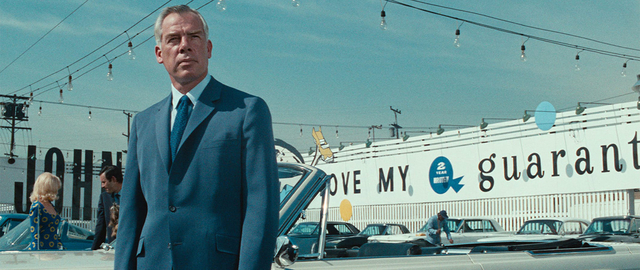
Lee Marvin was at the height of his career when he made Point Blank; he'd worked his way through the first decade of his movie career playing memorable heavies in films like The Big Heat, The Wild One, Bad Day at Black Rock, Seven Men from Now and The Man Who Shot Liberty Valance. Winning an Oscar for best actor in Cat Ballou (a smash hit that nobody talks about any more – for good reasons) made him a major star though, and he followed it up with Stanley Kramer's didactic but prestigious Ship of Fools and The Professionals, a hit action epic.
He had met Boorman while shooting The Dirty Dozen in the UK and they discussed a script that had been brought to him – an adaptation of Donald Westlakes 1963 thriller The Hunter (published under his pen name, Richard Stark). Boorman had made his reputation directing documentaries for the BBC and had made his feature debut with Catch Me If You Can, a more than competent rip-off of Richard Lester's Beatles pic A Hard Day's Night featuring their Merseybeat rivals, the Dave Clark Five.
They agreed that it was a great story but a terrible script. Since Marvin had complete control over his next project he called a meeting with Mishkin and several MGM producers, and Boorman remembered (as recounted in Epstein's book) that "Marvin asked: 'I have script approval?' They agreed. 'I have cast approval?' 'Yes.' 'Approval of technicians?' 'Yes.' For the first time in his career, he had assumed the heady powers of superstar. Rising to leave, he lobbed the grenade in their midst. 'I defer all these approvals to John.'"
And so thanks to Marvin, John Boorman had complete creative control over his sophomore film. "Making my first picture in Hollywood," Boorman said, "I was fortunate enough to have the gift of freedom. And he backed me all the way with a belief and loyalty that was inspiring."
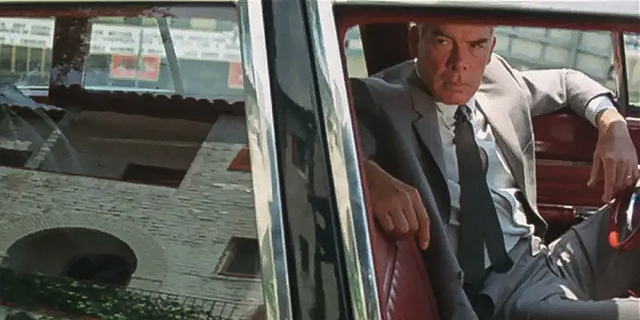
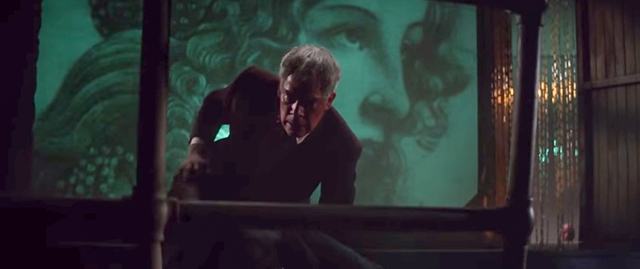
Walker aims himself at Stegman; he uses the pillars under a freeway and one of his own cars to scare him into saying where he can find Reese. He looks up Lynne's sister Chris (Angie Dickinson), who was also involved with Reese. She's running a nightclub that the mob took over, the kind of place that looks like a middle-aged person's idea of what the Whisky a Go Go or Fillmore West was like.
There are go go girls and a liquid light show and a house band playing what sounds like an amphetamine-stoked version of "Tighten Up" while the lead singer does his best James Brown/Wilson Pickett impression, screaming into the faces of the patrons – mostly squares in suits slumming – to get them to scream back. (The band is actually Stu Gardner and his trio; he'd go on to be Bill Cosby's musical director and write the theme for The Cosby Show.)
Stegman's thugs try to corner Walker backstage at the club but he's ready for them, hitting back with a fury that doesn't look fake. Marvin had been a Marine, fighting at Kwajalein and Eniwetok before being wounded by a Japanese machine gun at Saipan, winning a Purple Heart and earning a medical discharge. None of the violence in Point Blank is undersold and every punch and kick looks like it hurt.
This was a time when words like "alienating" and "assaultive" were being thrown around approvingly in the best film circles. The French new wave had changed the rules of filmmaking – or so it was said – and directors like Boorman (and Arthur Penn and George Lucas and John Cassavetes) had been inspired by films by Jean-Luc Godard and Alain Resnais. While it was released just as the New Hollywood was starting to storm the cinemas, Point Blank is rarely mentioned alongside Bonnie and Clyde, The Graduate, Easy Rider and Medium Cool.
You could call the film transitional – Last Year at Marienbad crossed with noir like House of Strangers or Kansas City Confidential – or, if you were feeling uncharitable, lump it in with Hollywood pictures straining for relevance in the face of a youthquake; films like Candy, Skidoo or Bedazzled. After all, Irwin Winkler and Robert Chartoff, two of Point Blank's producers, had just made an Elvis film, Double Trouble.
Or it could be that Boorman, still early in his career, would be more easily lumped in with English eccentrics like Ken Russell and Lindsay Anderson, thanks to later pictures like Leo the Last, Zardoz and Excalibur. In any case Point Blank tends to be regarded as an outlier – a product of the zeitgeist; inspired by but set apart from the canon.
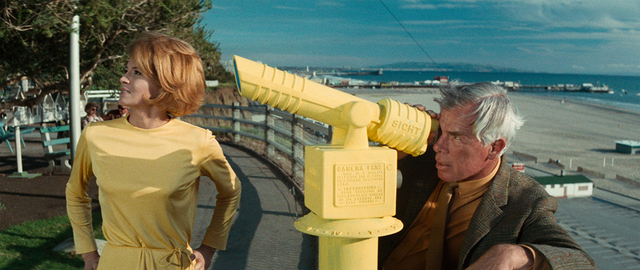
Walker needs Chris to act as bait so he can get past the wall of security the Organization has placed around Reese's penthouse apartment. He manages it with surprising ease and surprises Reese mid-coitus with Chris. At gunpoint, his old friend names his superiors in the Organization – in ascending order Carter, Brewster and Fairfax – but when they struggle at the edge of the roof they're startled by a bodyguard in another room and Reese slips out of the bedsheet he was wrapped in and falls to his death.
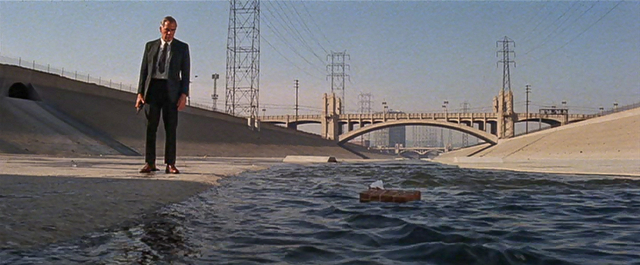
Like a guided missile Walker threads his way through the layers of security around Carter (Lloyd Bochner) and forces him to arrange for payment, with Stegman handing over the cash in the middle of the concrete bed of the Los Angeles River. Expecting another double cross, Walker forces Carter to come with him and sends him into the crosshairs of the sniper (James Sikking) Carter hired to kill Walker and Stegman.
Yost steps in out of nowhere again and tells Walker that Brewster will be in town for a meeting at the lavish safe house the Organization keeps in Beverly Hills. (The same house the Beatles had stayed in when they played Shea Stadium in 1966.) He only needs to sit tight and wait for him to show up; Walker convinces Chris to wait with him after Carter's henchmen have ransacked her home.
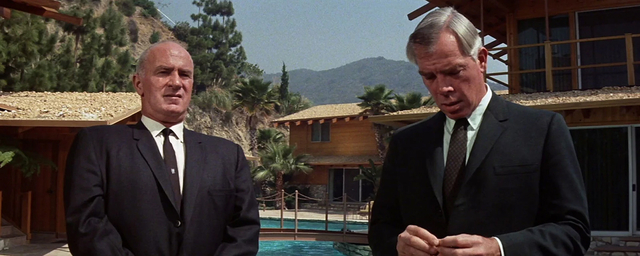
In his biography of Marvin, Dwayne Epstein testifies to an attraction on-set between Dickinson and Marvin, who had previously worked together on The Killers, Don Siegel's 1964 remake of the 1946 noir starring Burt Lancaster and Ava Gardner. He was tipped off by the bartender at The Raft, one of Marvin's favorite watering holes, though Dickinson said that while she had no inkling of Marvin's deeper feelings for her at the time, his generally taciturn demeanor might have made it easy to miss.
"My guess would be that from him," she said, "a look would be comparable to a pass from somebody else. Again, so hard to read Lee."
Enraged more than baffled by Walker's stoicism, Chris tries to get a response from him with her fists, slapping and punching Walker in a rage until she collapses on the floor, her anger and energy blunted against his indifference. She tries to taunt him by turning on every appliance in the house, belittling him over the intercom and finally smacking him on the side of the head with a pool cue. They end up in a clinch on the floor and move to the bedroom for some particularly bad movie sex – a real accomplishment in an era full of bad movie sex.
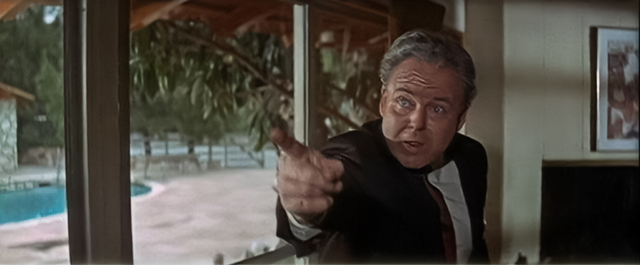
Brewster (Carroll O'Connor) finally arrives by private plane at Santa Monica airport where he's met by Sikking's sniper, who wants to be paid before he'll do another job for the Organization, a matter complicated greatly by killing Carter, the man who hired him. Brewster arrives to find Walker waiting to sap his bodyguard to the ground; O'Connor wheels around to deliver one of my favorite lines in the picture:
"You're a very bad man, Walker, a very destructive man! Why do you run around doing things like this?"
Brewster wants to know what Walker wants; he can't believe he's just after $93,000 but Walker repeats what he's been saying since the start of the picture: "I really just want my money." (Walker's single-minded pursuit of what he's owed is the most sympathetic thing about the character for me; as a freelancer for most of my adult life I feel like I'm perpetually waiting for payment from immovable clients committed to outlasting my patience, perhaps even outliving me. Every freelancer shares this, and we've all found ourselves repeating Walker's mantra.)
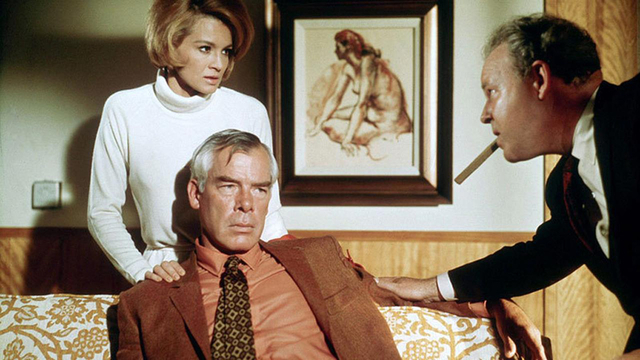
Brewster tells Walker that the Organization is a big business with carefully maintained balances on its books and no room to dispense random payments to someone like Walker. The debt he claims he's owed was incurred outside its operations, and since Fairfax is just a functionary who signs cheques the buck stops with him and he has no authority to pay for goods or services that haven't been delivered.
Boorman said that he was at pains that the Organization not resemble the mafia or any other ethnic organized crime, so he insisted that blue-eyed WASPs be cast as its representatives, the sort of men you'd find sitting on any corporate board at the time. (It was only discovered later that Lloyd Bochner, a Canadian, was also Jewish.)
Writing about the film recently, critic Christopher Rhoten compares Walker with Americans waking up to the spread of the corporation in their country post-war, where "the structure he has believed in – marriage, brotherhood, loyalty – is now gone, and the enemy is a never-ending ladder of indistinguishable corporate stooges who keep telling Walker that no one is really in control, so no one can really give him anything."
"Not only is there no one willing to pay him, but no one even has the physical cash. Walker's struggles are not met so much with blunt resistance as with modernist obfuscation and artifice."
Walker the irresistible force tests the immovability of the Organization just enough to arrange payment – back in San Francisco, where the cash drop he and Reeves robbed has moved across San Francisco Bay to Fort Point, in the shadow of the Golden Gate Bridge. There's a twist at the end, but I think most viewers will have anticipated it, and it really won't come as a shock.
What remains unsettled is just who Walker is, and what exactly we've been watching for the last ninety minutes. Was he killed at Alcatraz, and has this just been the dream of a dying man? Or is Walker revenge incarnate, a ghost on a mission who leaves behind a trail of bodies though, notably, he doesn't actually kill anyone as much as direct them to the place where they die. All we know is that Boorman's camera pans out of the shadows where Walker disappears, then across the Bay as the sun rises to rest on a final shot of Alcatraz.
But just as I think Dekker was a replicant, the Thing is alive at the end of The Thing and that Tony Soprano dies when the screen goes black, I think Walker was killed in the first scene.
Point Blank did well in the theatres, making $9 million dollars on a $2.5 million budget, getting noticed just enough to help build its cult status. It would get a shout out in the punning title of the 1997 action-comedy Grosse Pointe Blank and get re-made as Payback in 1999, with Mel Gibson taking Marvin's place to no great effect. Marvin enjoyed working with Boorman enough to make another movie with him a year later – Hell in the Pacific, with Toshiro Mifune. More about that another time.
Club members can let Rick know what they think by logging in and sharing in the comments below, as access to the comments section is one of many benefits that comes along with membership in the Mark Steyn Club.