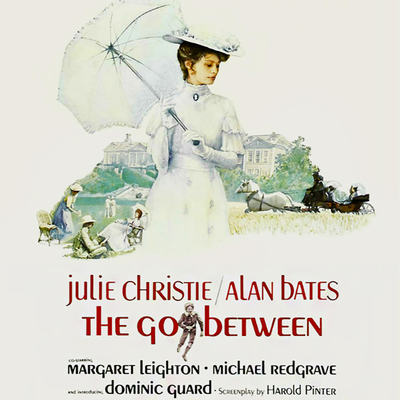
L.P. Hartley's novel The Go-Between begins with one of the most famous first lines in modern literature: "The past is a foreign country: they do things differently there." The quote has certainly outlived Hartley; it's invoked constantly by anyone trying to make a point about "presentism" and the tendency to judge historical motivations and events by current standards or morality. It even got referenced (and subverted) in Douglas Adams' The Hitchhiker's Guide to the Galaxy.
The quote paraphrased some lines delivered by Hartley's old school friend Lord David Cecil in a lecture he delivered at Oxford in 1949. It was crucial enough to his story that they're the first words spoken in Joseph Losey's 1971 movie adaptation of Hartley's book, delivered by Michael Redgrave in voiceover as the adult version of the boy at the centre of Hartley's story about class, sex and innocence lost, set in the twilight of Queen Victoria's reign.
It's implied that modern viewers might find the story they're about to watch strange, inasmuch as the world the characters inhabit and the decisions they make would be incomprehensible today. Things have changed essentially – for the better, many of us would state confidently. But as with any sentiment expressed so often that it's become conventional wisdom, is it actually true?
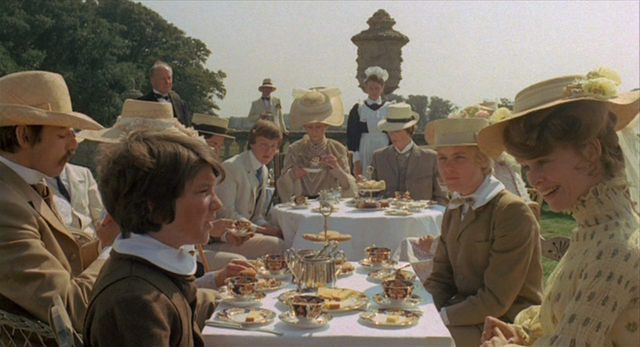
After the credits roll over Michel Legrand's ominous piano figures on the soundtrack and Redgrave delivers the iconic quote, the film begins with two schoolboys being driven in a horse and carriage down a wooded driveway. Evoking similar scenes in Jane Austen and Evelyn Waugh's Brideshead Revisited, we glimpse a huge country house between the trees and our journey into the land of landed gentry and the aristocracy has begun.
Leo (Dominic Guard) is the guest of his schoolfriend Marcus Maudsley (Richard Gibson) for summer vacation. Leo is from the aspirant middle class; in an overheard conversation we hear Marcus' mother note that he "lives in a very small home with his mother." He's a charity case like Charles Ryder in Brideshead, but unlike Ryder he has to endure his friend calling him a "slug" along with sundry other verbal and physical bullying. Among the first lessons he learns is not to neatly fold his clothes but to drop them on the floor when he's finished with them.
"The servants will pick them up," Marcus explains. "That's what they're for."
We meet Marcus' very patrician father (Michael Gough), formidable mother (Margaret Leighton) and insufferable older brother Denys (Simon Hume-Kendall). But most notable of all is his older sister Marian (Julie Christie), with whom Leo is immediately smitten when he glimpses her lounging in a hammock in the sun. "My sister is very beautiful," Marcus says, a statement that's partially a question begging Leo's agreement, which he eagerly gives.
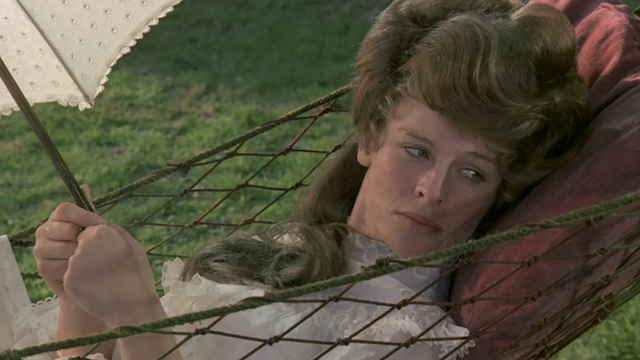
Marian immediately takes to Leo – the only person in the family who doesn't treat him with condescension or impeccable correctness, both of which only underline his status as interloper. The summer is the hottest anyone can remember and Leo only has a woolen Norfolk jacket to wear (he makes an excuse that his mother forgot to pack his summer suit and everyone politely pretends to believe him). Marian immediately offers to take him into Norwich to buy new summer clothes.
She tells him to amuse himself in the cathedral for an hour while she runs an errand; he sees her at a livestock auction in the cathedral square talking to a man. Leo sees the man again when he heads out with the Maudsleys for a swim; Denys takes great exception to a trespasser using their stretch of water but walks back his ire when he recognizes him as Ted Burgess (Alan Bates), the tenant farmer who works their land.
In an earlier era, he might have been scolded for his presumption but Denys knows that Ted is crucial to their income so he makes a great show of graciousness (eager to know afterward if he demonstrated the appropriate noblesse oblige. Denys is clearly aware of his future responsibilities as oldest son.)
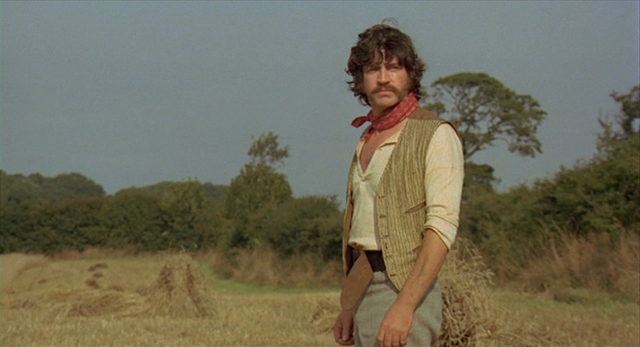
At breakfast one Sunday morning there's someone new at the table. Hugh (Edward Fox) has a vicious scar across his cheek; Denys says he was "gored by the Boers". He introduces himself to Leo after mass – a conversation and a negotiation where they playfully but purposefully figure out how to address each other, a matter complicated by the fact that Hugh is Viscount Trimingham.
When Marcus is quarantined for measles, Leo is left to his own devices and wanders the estate all the way to Ted's farmstead, where he injures himself sliding down a haystack. Angry at first, Ted becomes interested when the boy reveals that he spends time alone with Marian and enlists Leo to courier messages discretely between them. As the boy's already been pressed into service to deliver a message between Hugh and Marian – for which he earns the nickname "Mercury" – he agrees, and positions himself in the midst of the romantic triangle at the heart of the story.
In Hartley's book the older Leo is explicit about his confusion about what was expected of him during summer vacation at Brandham Hall with the Maudsleys: "I did not understand the world of Brandham Hall; the people there were much larger than life... They were, I fact, the substance of my dreams, the realization of my hopes; they were the incarnated glory of the twentieth century; I could no more have been indifferent to them than after fifty years the steel could be indifferent to the magnets in my collar-box."
L.P. Hartley was born in 1895, the son of a solicitor who went to Harrow and Oxford before joining the army in 1917, though thanks to a weak heart he never saw combat. He was social enough as a young man to find his place in a literary milieu with names like David Cecil and Aldous Huxley. Besides The Go-Between his greatest success was his Eustace and Hilda trilogy of novels (The Shrimp and the Anemone, The Sixth Heaven and Eustace and Hilda), though he did indulge in that most English of literary pastimes and wrote a series of well-regarded ghost stories.
The Go-Between, book and film, is often described as a story about the crushing inequities of the British class system, which would have either amused or outraged Hartley – a man greatly attuned to the hierarchies of class who wrote about them with keen appreciation. He was also not a man who would have been politically sympathetic to Joseph Losey – an American and one of the most famous victims of the blacklist – or his screenwriter, Harold Pinter.
In a review of a biography of Hartley, the author is described as having become more reactionary as he aged: "He regarded his country as having been corrupted by too much compassion. He used his literary gifts to articulate the most terrible ideas. The English working class he called the WC, changing this, in case his point had been missed, to 'the toilet'. He wanted wrongdoers 'literally branded, with F for forger, V for violent criminal etc.' and many people hanged. Humans weren't the only object of his hatred either. Disturbed by swans while boating on the River Avon, Hartley killed two with barbiturates wrapped in bread pellets."
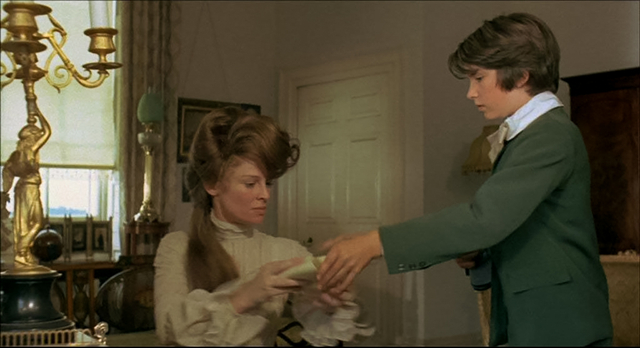
Pinter's script and Losey's direction are austere by inclination, so quite a bit of the detail in Hartley's novel is discarded in transition from the page. One detail is that Brandham Hall is the seat of Trimingham's family and that the Maudsleys are renting it from him; Hugh is, like so many aristocrats at the time, in dire financial straits, and the most suitable arrangement that can be made is that he and Marian get married, entitling her to his title and him not just to her money but to live in his family home again.
A more conventional story would have made Trimingham, with his disfiguring scar and title, the villain of the piece, but as Fox plays him he's the most genuinely kind adult Leo encounters in the story. Perhaps its because he's been humbled by his circumstances, but along with Burgess he becomes one of the two father figures the boy is drawn to during his summer in the country.
Alan Bates' Burgess is presented as the epitome of rough masculinity – strong, a good shot and the star batsman during the cricket match between the gentry and the locals that marks the peak of Leo's summer. Hugh, on the other had, embodies the more socially ratified manly virtues that Leo aspires to for himself one day.
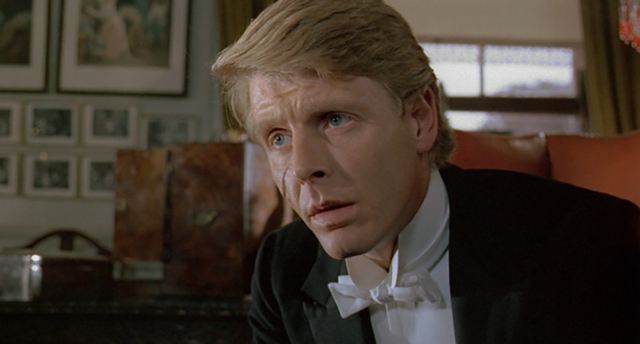
At one point Leo enters the study, Brandham's inner sanctum of masculinity, to ask Hugh a question about a book he's been reading, where two men fight a duel over one man's wife. Trimingham is welcoming and, only just hiding his bemusement, even offers the boy a cigar. Leo's troubled by the message about honour in the book and wonders if the wife shouldn't bear some responsibility for putting the men in such a situation.
Hugh tells him firmly: "Nothing is ever a lady's fault."
Mr. Maudsley enters and asks Trimingham: "Have you been telling him some smoking-room stories or showing him some pictures?" He indicates the pictures – a wall of racy Georgian engravings – and Leo visibly blanches when he examines them closely.
"He doesn't like them," Mr. Maudsley drily notes.
In Hartley's book Leo is allowed to explain his reaction, that "they made me feel uncomfortable... pictures, I thought, should be of something pretty, should record a moment chosen for its beauty. These people hadn't even troubled to look their best; they were ugly and quite content to be so. They got something out of being their naked selves, their faces told me that; but this self-glory, depending on nobody's approval but their own, struck me as rather shocking – more shocking than their occupations, unseemly as those were. They had forgotten themselves, that was it; and you should never forget yourself."
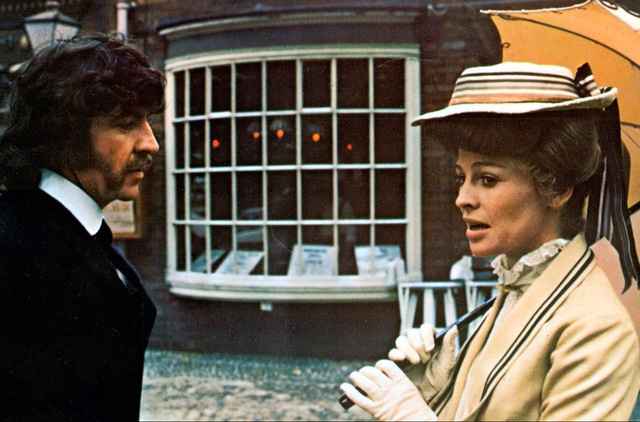
As the summer wears on, Leo become more uncomfortable acting as postman between Marian and Ted, especially when he figures out the true nature of their relationship. The imminent announcement of her engagement to Hugh should end the correspondence but they continue asking him to carry their letters. Marian becomes angry when he tries to refuse, going so far as to remind him of his station and her family's generosity. She calls him "a poor nothing out of nowhere."
Her mother is clearly aware of the situation and confronts Leo about his role. When the summer heat finally breaks with a thunderstorm on the boy's birthday she forces him to take her to where Ted and Marion are likely to be and the lovers are discovered having sex in the barn. In a pair of shots designed to echo each other, Mrs. Maudsley covers Leo's eyes while Marian buries Ted's face in her shoulder. Within a few brisk edits we learn that Ted, shamed and disgraced, has shot himself at his kitchen table.
The tragic end of their affair is the emphatic punctuation to a line in a letter Leo receives from his mother, after he asks if he might come home early, and she insists that it would be rude to leave so close to the end of the summer: "We can't expect to be happy all the time, can we?"
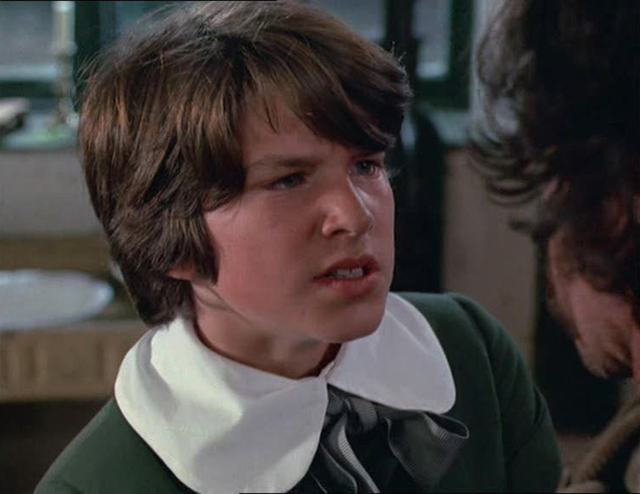
Hartley was always disappointed that readers misread his story and made heroes out of the obvious villains. While it's certain Losey and Pinter didn't share Hartley's politics or worldview, it's still possible to watch The Go-Between and reach the same conclusion the author intended – that Marian is the villain of the piece.
Losey frames his story with flashes forward to fifty years after Leo's experience at Brandham, to Redgrave as a reserved older man who never got over his part in the events of that summer. He visits Marian – now the dowager Lady Trimingham, who has survived Hugh and the son she had after her affair with Ted, legitimized by Hugh as his heir. (As he said, a lady can do nothing wrong.) Her son died during the last war, while in Hartley's book we learn that Marcus and Denys both died in the First World War.
She has a grandson, the current Viscount Trimingham, whose resemblance to Ted is the first thing that strikes Leo. He's estranged from his grandmother and ashamed of his illegitimate origins – still an open secret – and Marian sends Leo out on one last errand to tell him the truth of their story and convince him not to be ashamed. "Our love was a beautiful thing, wasn't it?" she insists.
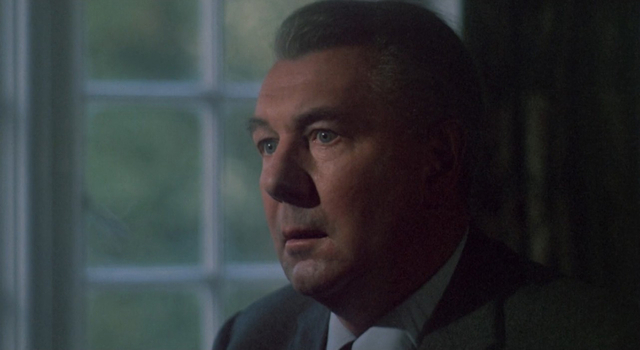
In Hartley's book Marian looks back on the tragedies that have left her alive while taking her family when she's reunited with Leo after fifty years: "But they weren't our fault – they were the fault of this hideous century we live in, which has denatured humanity and planted death and hate where love and living were."
She pleads with Leo to talk to her grandson: "Tell him he must get rid of these silly scruples... Poor Ted, if he'd had more brains he wouldn't have blown them out. You owe it to us, Leo, you owe it to us, and it'll be good for you, too. Tell him there's no spell or curse except an unloving heart."
"With every step I marvelled more at the extent of Marian's self-deception," Leo thinks to himself as he leaves her. "Why then was I moved by what she had said? Why did I half wish that I could see it all as she did? And why should I go on this preposterous errand?"
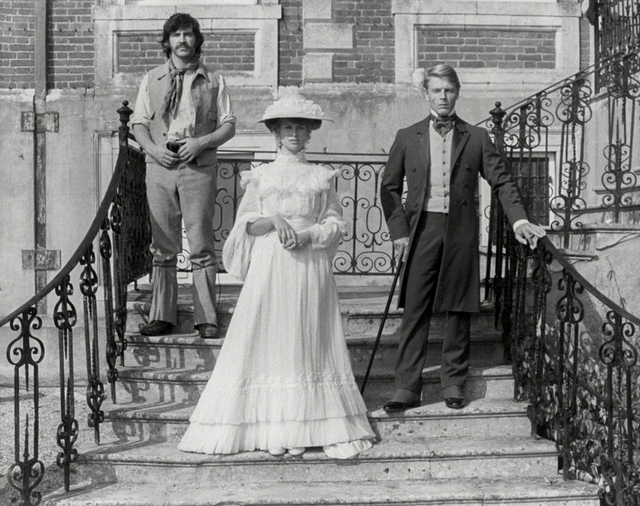
The conventional response to The Go-Between is that cruel social norms and the iron bars of the British class system were what kept Ted and Marian apart, that hypocrisy killed Ted, and that Marian is truly on the side of love at the end. And while I'm sure Losey and Pinter, both men of the left, believed it, Hartley's version of Marian as a charming sociopath who sewed chaos in her life still abides in their screen adaptation of his story.
I'm speaking as someone who hasn't been able to watch an episode of Downton Abbey all the way through without being distracted with rage at the whole system that keeps "above stairs" and "below stairs" an organizing principle of a whole society. And still I can't see what appeal Marian had for Ted except her beauty, and the challenge of flaunting social custom.
Desire and pride are poor motivations for anything; it's hard to see how Hugh wasn't always going to be a more suitable husband for Marian, or what she might have brought into Ted's life that he needed (besides money, provided she wasn't disinherited). There is, after all, a difference between knowing your place and knowing when there's no place for you. Putting aside tumbrels and gallows, the only sane way to react against oppressive class hierarchies is to reject and ignore the absurd rituals that define and ultimately diminish the class at the top.
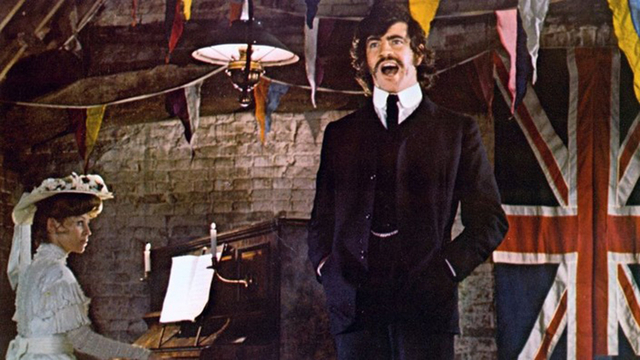
While it's true that the sexual landscape of The Go-Between looks like another country today, it's hard to believe that society in general and Britain in particular is closer to the ideal of a "classless society". Fifteen years ago Andrew Neil hosted a documentary for the BBC called Posh and Posher: Why Public School Boys Run Britain where he pointed out how a certain class – and a narrow slice of it at that – are back to holding the reins of power in the UK after a brief window (roughly from the '60s to the '90s) when there seemed to be real social mobility in politics. Recently everyone from the Times to the Guardian have made the same observation about the arts.
In his book Class in Britain, David Cannadine writes that "by comparison with England, Americans are not interested in the language of class, or in the models of society which in Britain that language describes. The result, as Lord Beaverbrook once remarked, is that in the new world, unlike the old, the only difference between the rich and the poor is that the rich have more money." This doesn't mean that class doesn't exist in the United States, but that nobody there has the language to talk about it, or enough interest to try.
A really insightful YouTube video titled "Why the British class system refuses to die" explains how class in Britain evolves constantly while producing roughly the same rigidly stratified social conditions. Even unprecedented levels of mass migration into the country haven't resulted in a liberal vision of a more meritocratic society, and that in "working class communities already under pressure, immigration just intensifies competition for housing, jobs and public services, but more than that it destabilizes the few sources of where identity comes from."
For the upper classes who "live in neighbourhoods that aren't really affected by immigration, their children attend schools that are buffered from this disruption, and their social capital allows them to bypass any friction points so they don't really understand what all the fuss is about."
"Immigration does not flatten the hierarchy. It just redistributes the friction."
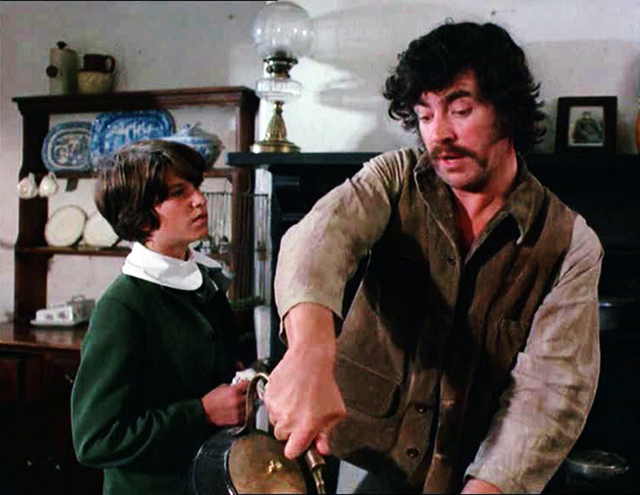
Many people tried to make a film out of The Go-Between, starting with Anthony Asquith and then Alexander Korda, who wanted to cast Margaret Leighton as Marian and hired no less than Nancy Mitford to write a script. Losey tried making a film version as early as 1963 and had an unfinished script by Pinter for most of the decade. He was finally able to get funding from MGM and EMI as part of a brief partnership that also produced Get Carter, and even then Losey's budget was cut in half before filming started.
The head of MGM hated it and was sure he had a flop, but it won the top prize and Cannes, got eleven BAFTA nominations (winning for Fox, Leighton, Pinter and Dominic Guard) and saw an Oscar nomination for Leighton. It took a while but the picture more than made up its budget and Losey, who gave up his fee in favour of a percentage of the profits, ended up with nearly £40,000. It was, however, the last film he made with Pinter after a career peak with pictures like The Servant (1963) and Accident (1967).
Despite being one of the blacklist's most notable victims – Martin Scorsese played a thinly disguised version of Losey in Irwin Winkler's Guilty by Suspicion (1991) – I think Losey's career in Europe far exceeded what he would have done in Hollywood. There would have been a couple of decent but minor film noirs, a "message picture" indistinguishable from a Stanley Kramer film, and a lucrative but overlooked decade or two in television. Without the blacklist, as he was quoted saying in his New York Times obit, "I would have three Cadillacs, two swimming pools and millions of dollars, and I'd be dead."
Club members can let Rick know what they think by logging in and sharing in the comments below, as access to the comments section is one of many benefits that comes along with membership in the Mark Steyn Club.